
Summary: New laboratory-grown retinal organoids recreate key features of human retinal development and reveal factors that promote axon growth from retinal ganglion cells, a step toward restoring connections between the eye and brain.
Source: IUPUI
IUPUI researchers are growing three-dimensional “mini retinas” from human pluripotent stem cells to model how the human retina develops and to explore ways to restore vision when connections between the eye and the brain are damaged. These retinal organoids reproduce many structural and developmental features of the retina, enabling scientists to study retinal ganglion cells (RGCs) and identify molecular signals that encourage the long axons these cells need to transmit visual information. The findings appear in the journal Scientific Reports.
Retinal organoids are self-organizing clusters of cells derived from human pluripotent stem cells (hPSCs), which can be reprogrammed from adult tissues such as skin. In the IUPUI laboratory, these organoids form layered structures that follow the spatial and temporal sequence of normal retinal development, offering a powerful in vitro system to investigate cell differentiation, organization, and wiring.
Jason S. Meyer, an associate professor of biology in the School of Science at IUPUI, and his colleagues used these organoids to study retinal ganglion cells. RGCs form the essential link between the eye and the brain by extending long axons that bundle into the optic nerve and carry visual signals to central targets. When RGCs or their axons are damaged—most commonly in glaucoma—sight is lost because the connection to the brain is interrupted.
“Retinal organoids have become an important focus in vision research over the past few years,” Meyer said. “Until now, most work emphasized photoreceptors and other retinal neurons, but the ganglion cells themselves and their long axons have not been studied in depth within organoid models. Our study explores not only how organoids generate an RGC layer but also what promotes the extensive axon growth those cells require to reestablish connections.”
Retinal ganglion cells are the primary cells damaged in glaucoma, a condition that affects an estimated 70 million people worldwide and is a leading cause of irreversible blindness. Replacing lost RGCs or promoting regeneration of their axons has proven difficult because mature retinal tissue rarely provides the signals that guide long-distance axon growth.
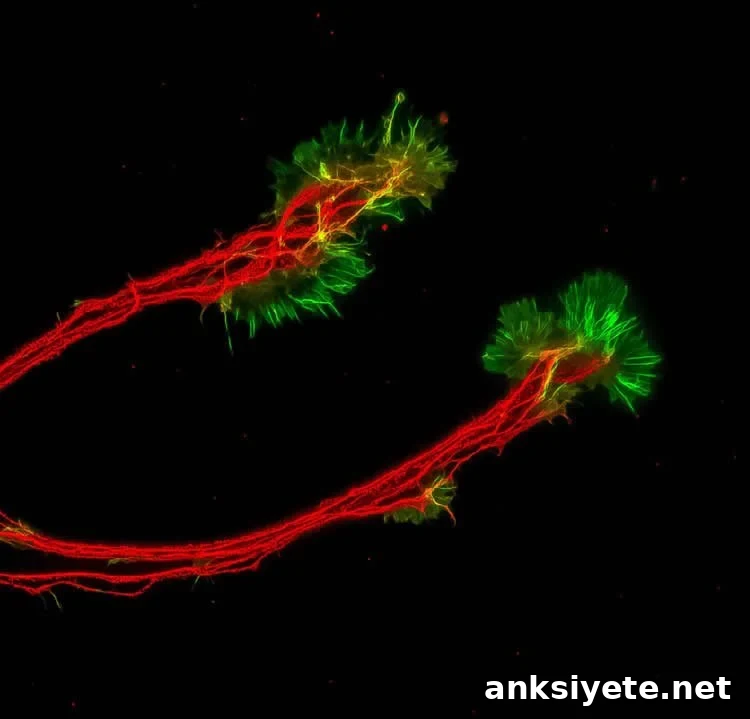
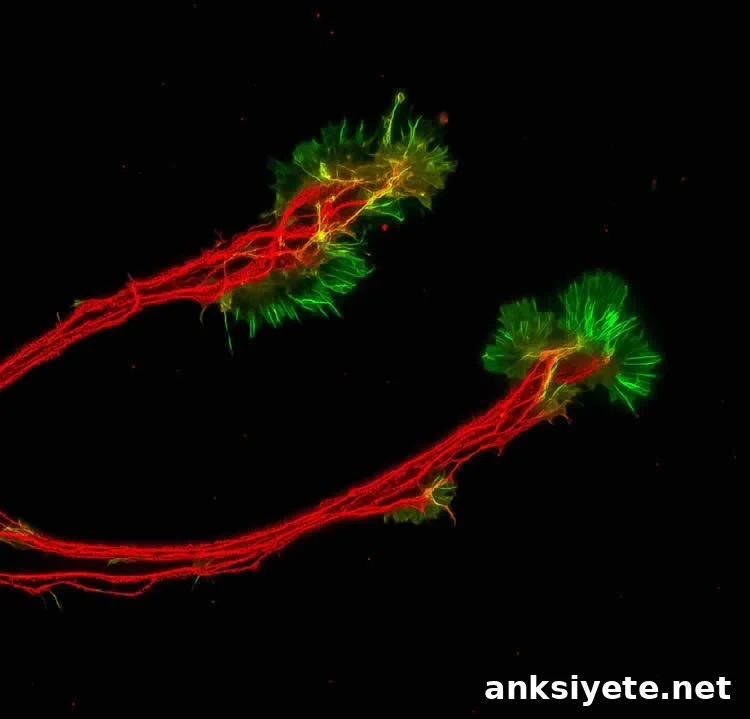
Clarisse M. Fligor, the paper’s first author and a graduate researcher in biology at IUPUI, screened several growth factors known to influence RGC development and found that the protein Netrin-1 markedly enhances axon outgrowth from organoid-derived RGCs. Netrin-1 is abundant during early human development but becomes scarce once the retina matures—an observation that helps explain why mature RGCs have limited regenerative capacity.
“The adult retina doesn’t usually produce the developmental cues that encourage RGC axons to grow long distances,” Fligor explained. “Our results suggest that recreating some of those early developmental signals, such as transient exposure to proteins like Netrin-1, could be necessary for guiding transplanted or newly generated RGCs to make the correct connections.”
The study also examined how substrate composition and additional growth-factor signaling influence neurite extension. Organoid-derived RGCs displayed diverse morphologies, elaborate growth cones, and expression of multiple guidance receptors—properties consistent with neurons capable of directed axon navigation. Modifying the extracellular environment and growth conditions significantly improved neurite extension in experimental assays.
Authors on the study include Clarisse M. Fligor and Jason S. Meyer (IUPUI) alongside Kirstin B. Langer, Akshayalakshmi Sridhar, Priya K. Shields, Michael C. Edler, Sarah K. Ohlemacher and Chi Zhang. Collaborating authors include Daniel M. Suter and Yuan Ren from Purdue University, and Valentin M. Sluch and Donald J. Zack from Johns Hopkins University.
Funding: This research was supported in part by the National Eye Institute, the National Science Foundation, and the Indiana Department of Health Spinal Cord and Brain Injury Research Fund.
Publication: The findings were published in Scientific Reports.
Abstract (revised)
Three-dimensional retinal organoids derived from human pluripotent stem cells recapitulate key stages of retinal differentiation and provide an effective platform to study retinal ganglion cell (RGC) development, organization, and neurite outgrowth. This study characterizes RGC differentiation in early organoid stages, showing the emergence of a distinct RGC layer that expresses multiple RGC-associated markers in a developmentally appropriate sequence. Given the central role of axonal extension for RGC function, organoid-derived RGCs were evaluated as a model to identify factors that promote neurite outgrowth. Modulating substrate composition and growth factor signaling, notably through transient exposure to Netrin-1, significantly enhanced axon extension from organoid-derived RGCs. These cells exhibit varied phenotypes, extend complex growth cones, and express a range of guidance receptors, supporting their utility for studying mechanisms that guide axon growth. Collectively, the results position retinal organoids as a valuable tool for investigating RGC biology and exploring strategies to promote axon regeneration for potential cell-replacement therapies.