
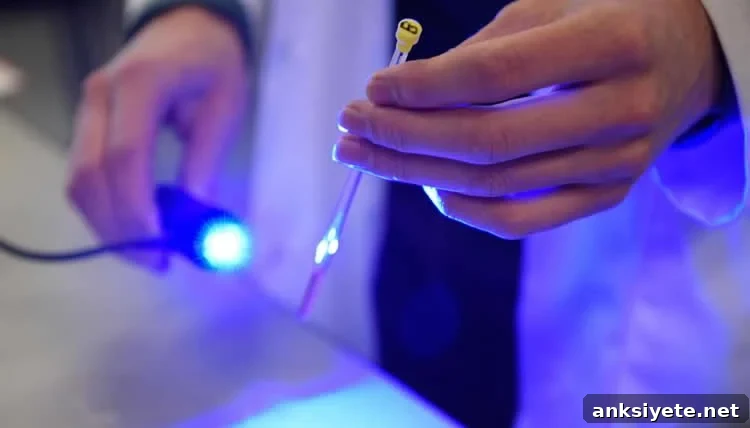
Scientists at the University of Bristol have created an artificial mimic of rhodopsin, the light-sensitive protein that initiates vision. This synthetic molecule, described in Science, could pave the way for new light-responsive artificial cells and novel approaches to controlling cellular behavior with light.
Researchers led by Professor Jonathan Clayden in the School of Chemistry at the University of Bristol, together with collaborators at the Universities of Manchester and Hull, designed and synthesized a synthetic molecule that reproduces key functional features of rhodopsin. Rhodopsin is the primary light-absorbing protein in retinal cells; when it absorbs photons, it undergoes structural changes that trigger the biochemical cascade underlying vision. The new artificial mimic reproduces the essential property of rhodopsin by switching between distinct shapes in response to specific wavelengths of light.
The team’s design drew inspiration from membrane-binding motifs found in certain antibiotic molecules. By incorporating these membrane-associating elements into a helical oligoamide scaffold and attaching a light-responsive chromophore, the researchers produced a foldamer that both inserts into phospholipid bilayers and transmits conformational change along its length. In other words, light-induced rearrangement of the chromophore produces a global structural response in the synthetic peptide foldamer bound within a membrane, similar in concept to the conformational change rhodopsin undergoes in retinal cells.
Importantly, the researchers found that these synthetic structures behave consistently in solution and when embedded in membranes. That correspondence simplifies the prediction and design of their behavior, a contrast to many natural membrane proteins whose properties often change dramatically between environments. This reliability in both solution and membrane phases improves the practicality of designing photoswitchable molecules for applications such as light-controlled artificial cells or synthetic membrane devices.
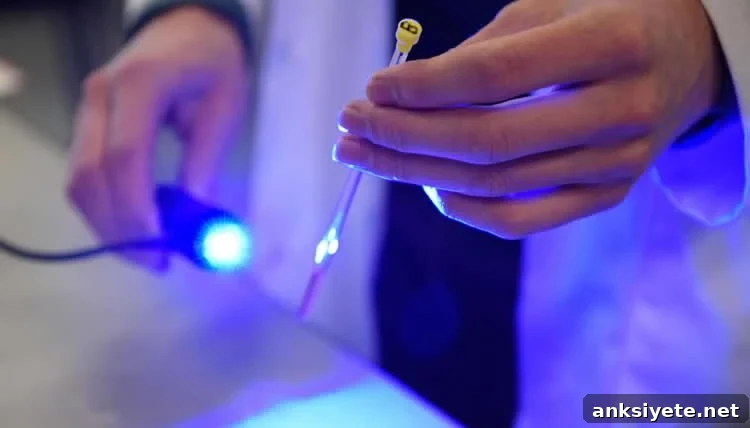
Professor Clayden commented on the significance of the work: “This is the first time an artificial mimic of rhodopsin has been created: a discovery that could lead to new ways of building light-sensitive artificial cells and could allow scientists to bypass the usual communication mechanisms used by cells.” The ability to trigger structural and functional changes in membrane-bound foldamers using light opens possibilities for constructing synthetic systems that respond to precise wavelengths, enhancing control for research and potential technological applications.
Source: Philippa Walker – University of Bristol
Image credit: School of Chemistry, University of Bristol
Original research: “Conformational photoswitching of a synthetic peptide foldamer bound within a phospholipid bilayer” by Matteo De Poli, Wojciech Zawodny, Ophélie Quinonero, Mark Lorch, Simon J. Webb and Jonathan Clayden. Published in Science. DOI: 10.1126/science.aad8352
Abstract
Conformational photoswitching of a synthetic peptide foldamer bound within a phospholipid bilayer
The dynamic properties of foldamers—synthetic molecules designed to mimic folded biomolecules—have largely been characterized in free solution. In this study, researchers report the design, synthesis, and conformational behavior of photoresponsive foldamers bound within a phospholipid bilayer that mimics a biological membrane phase. Each foldamer includes a chromophore that can be switched between two configurations by different wavelengths of light, attached to a helical oligoamide that promotes membrane insertion and communicates conformational change along the molecule. Light-driven structural changes in the chromophore are translated into global conformational changes, which are detected by monitoring solid-state 19F nuclear magnetic resonance signals from a remote fluorine-containing residue located one to two nanometers away. The behavior of these foldamers in the membrane phase is comparable to that of related compounds in organic solvents, indicating predictable and transferable conformational responses across environments.
Authors: Matteo De Poli, Wojciech Zawodny, Ophélie Quinonero, Mark Lorch, Simon J. Webb and Jonathan Clayden. Published online March 31, 2016. DOI: 10.1126/science.aad8352.
This advance in synthetic photochemistry and membrane biology highlights a promising route toward engineering light-sensitive artificial cells and membrane-bound devices. By combining membrane-targeting design elements with photoswitchable foldamers, the work strengthens our ability to translate optical inputs into predictable molecular-scale outputs, a capability relevant for synthetic biology, optogenetics-inspired technologies, and the development of responsive membrane materials.