
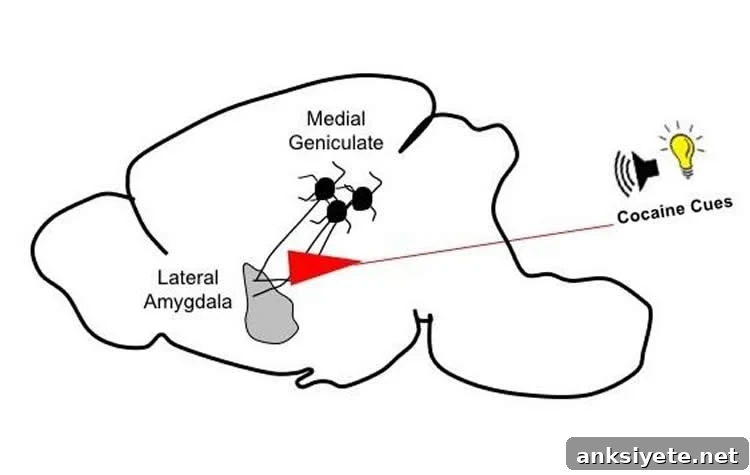
Summary: Disrupting memories that link environmental cues to drug use sharply reduces cocaine-seeking behavior in a rat model of addiction, according to new research.
Source: University of Pittsburgh.
Forty to 60 percent of people treated for substance use disorders experience relapse, posing a major barrier to long-term recovery. New findings from the University of Pittsburgh School of Medicine indicate that selectively disrupting memories that tie environmental cues to cocaine use significantly reduces drug-seeking behavior in rats, suggesting a promising target for therapies aimed at preventing relapse.
Since the discovery of classical conditioning by Ivan Pavlov in the 1890s, researchers have understood that the brain forms powerful associations between cues and behaviors—examples range from the scent of coffee triggering the desire for a cup to a visual sight producing a fear reaction. Therapeutic approaches that weaken or extinguish these cue–memory links, such as exposure therapy, are standard for treating phobias, PTSD and some aspects of addiction. However, exposure-based treatments often fall short for addiction because context plays a crucial role: extinction learning performed in a clinical setting may not generalize to the environments where drug use previously occurred, and the original cue–drug association can re-emerge in a new setting.
“The brain forms persistent cue-associated memories, but the precise circuits that store and drive these memories have been poorly defined,” said Mary Torregrossa, Ph.D., associate professor of psychiatry at the University of Pittsburgh School of Medicine and senior author of the study published in Cell Reports. “Our work identifies a key circuit involved in those memories and shows that disrupting that circuit in a preclinical model reduces relapse-like behaviors.”
In the study, rats were trained in a cocaine self-administration paradigm. Each time a rat pressed a lever it received a small infusion of cocaine paired with an audiovisual cue—a tone and light. Over repeated sessions the rats learned to associate the cue with the drug’s effects and developed robust cue-driven drug-seeking behavior, repeatedly pressing the lever when the cue was presented.
The researchers also modeled extinction training comparable to exposure therapy by repeatedly presenting the tone and light without delivering cocaine. While extinction reduced drug-seeking within the training context, it did not reliably prevent relapse when rats were moved to a different environment—mirroring clinical challenges where extinction learning often fails to generalize across contexts.
Electrophysiological recordings from rat brain tissue identified strengthened synaptic connections between the medial geniculate nucleus (MGN)—a thalamic relay for auditory information—and the lateral amygdala (LA) after cocaine-cue learning. The amygdala is a critical center for emotional memory formation and for linking sensory inputs to affective responses, which made the MGN-to-LA pathway a compelling candidate for encoding cue–drug associations.
To test whether this pathway causally drives cue-induced drug seeking, the team used optogenetics to selectively induce long-term depression (LTD) at MGN-to-LA synapses, effectively reversing the cocaine-induced potentiation. Rats whose MGN–LA cue memory traces were optogenetically weakened showed a marked reduction in lever pressing when the tone and light were presented. Crucially, this attenuation of cue-driven drug seeking persisted even when the animals were placed in a different environment, indicating that disrupting the specific memory trace can overcome context-dependent relapse.
“These results suggest that targeting the neural pathways that encode cue–drug associations could make extinction-based treatments more durable and less dependent on environmental context,” said Torregrossa. She noted that the findings point toward potential clinical strategies—pharmacological agents, neuromodulation techniques such as deep brain stimulation, or targeted behavioral interventions—that specifically weaken maladaptive cue memories formed during substance use.
About this research
Yanhua Huang, Ph.D., of the University of Pittsburgh was an additional author on the study.
Funding: The research was supported by National Institutes of Health grants K01DA031745, R01DA042029, DA035805, F31DA039646, T32031111, and by the Pennsylvania Department of Health.
Publication and source details
Source: Arvind Suresh, University of Pittsburgh
Publisher: Organized by NeuroscienceNews.com.
Image credit: Rich, T.M., et al., Cell Reports / Mary Torregrossa.
Original research: “Plasticity at Thalamo-amygdala Synapses Regulates Cocaine-Cue Memory Formation and Extinction” by Matthew T. Rich, Yanhua H. Huang, and Mary M. Torregrossa. Published in Cell Reports, January 22, 2019.
DOI: 10.1016/j.celrep.2018.12.105
Abstract
Plasticity at Thalamo-amygdala Synapses Regulates Cocaine-Cue Memory Formation and Extinction
Repeated drug use induces enduring changes in plasticity across the brain’s reward and memory circuits. Environmental cues associated with drugs can trigger craving and relapse, but the specific neural circuits that drive cue-related behaviors are not fully defined, limiting the development of targeted relapse-prevention therapies. Using a cocaine-plus-cue self-administration paradigm followed by cue re-exposure, the study demonstrates that the intensity of the drug–cue association corresponds to strengthened synapses between the medial geniculate nucleus (MGN) of the thalamus and the lateral amygdala (LA). Furthermore, optogenetically induced long-term depression of MGN–LA synapses reverses cocaine-induced potentiation of this pathway and is sufficient to suppress cue-induced relapse-like behavior.
Readers are encouraged to consider how targeting specific memory circuits might improve clinical approaches to addiction treatment and reduce relapse rates by making extinction learning more robust across contexts.