
Summary: Researchers at Kumamoto University found that older adults with mild cognitive impairment (MCI) have a notably reduced ability to memorize human faces in the short term compared with cognitively healthy peers. The study also found altered gaze patterns in MCI patients during face memorization, suggesting potential markers for early dementia detection.
Source: Kumamoto University.
Researchers in Japan report that elderly people with mild cognitive impairment (MCI) show specific deficits in short-term face memory and altered eye-scanning behavior compared with healthy older adults. These findings may help with earlier identification of dementia-related changes.
Alzheimer’s disease is the most common form of dementia, and identifying earlier stages is critical for delaying progression. Mild cognitive impairment (MCI) — particularly the amnestic type (aMCI) — is often considered a prodromal stage of Alzheimer’s disease. People with MCI experience declines in cognitive abilities such as memory and thinking, but these declines do not yet severely disrupt daily life.
Previous brain imaging studies have revealed structural and functional changes in regions that support memory and face processing, such as the fusiform face area and medial temporal lobe, in individuals with MCI. To investigate whether these neural changes correspond to measurable differences in behavior, researchers at Kumamoto University compared short-term memory and gaze behavior for faces and non-face objects in two groups: eighteen older adults diagnosed with aMCI and eighteen age-matched healthy controls.
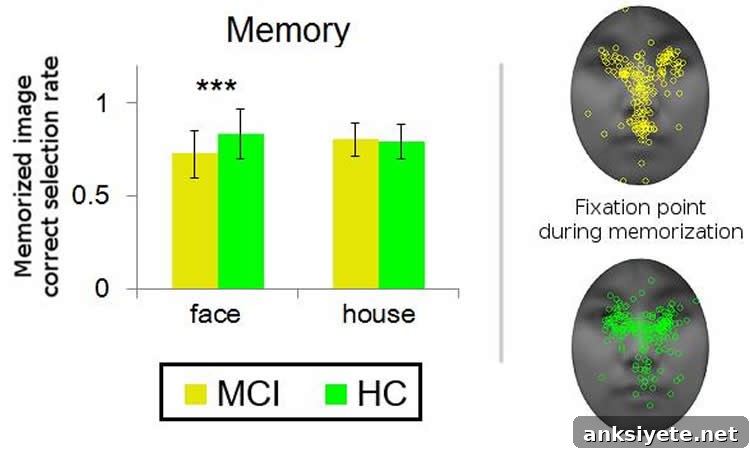
The team used a delayed-matching task presented in separate blocks for faces and for houses. In each block, participants were shown a single image to remember and, after a brief delay, were asked to identify the memorized image from a selection of new images. While participants memorized the images, the researchers recorded eye movements with eye-tracking equipment to analyze where observers focused their gaze during encoding.
The results showed a clear, face-specific memory deficit in the aMCI group. Participants with aMCI performed more poorly on the short-term memory task for faces than for houses, while healthy controls showed no significant performance difference between the two stimulus types. Eye-tracking data revealed notable differences in scanning patterns: healthy older adults concentrated more gaze time on the eye region of faces, whereas aMCI patients spent less time looking at the eyes and more time fixating on the mouth and a broader facial area.
These gaze shifts suggest that people with aMCI may alter their scanning strategy, possibly to compensate for deteriorating neural mechanisms involved in face processing. Professor Emeritus Kaoru Sekiyama, one of the study’s senior authors, commented: “Looking at the eyes is important for remembering the entirety of the face. MCI patients likely experience abnormal face processing due to deteriorating brain function. The more distributed gaze pattern may represent a compensatory response to this decline. We hope future studies will clarify this relationship.”
Funding: This work was funded by the Japan Society for the Promotion of Science.
Source: J. Sanderson, N. Fukuda — Kumamoto University (news release summarizing the research).
Publisher: NeuroscienceNews.com (news outlet reporting on the study).
Image Source: NeuroscienceNews.com image credited to Toshikazu Kawagoe.
Original research: The study, titled “Face-specific memory deficits and changes in eye scanning patterns among patients with amnestic mild cognitive impairment,” was conducted by Toshikazu Kawagoe, Masateru Matsushita, Mamoru Hashimoto, Manabu Ikeda, and Kaoru Sekiyama and published in Scientific Reports. DOI: 10.1038/s41598-017-14585-5.
Face-specific memory deficits and changes in eye scanning patterns among patients with amnestic mild cognitive impairment
Amnestic mild cognitive impairment (aMCI) is a prodromal stage of Alzheimer’s disease. Previous research has demonstrated functional and structural degradation of the fusiform face area — a core region for face processing — in addition to medial temporal lobe changes. The authors hypothesized that individuals with aMCI would show impaired face processing and/or face memory alongside abnormal eye scanning patterns similar to those seen in prosopagnosia. They tested eighteen patients with aMCI and eighteen age-matched healthy controls on perception and short-term memory tasks using visually presented faces and houses while recording gaze. Patients with aMCI exhibited reduced short-term memory for faces but not for houses, and their gaze patterns emphasized the mouth region more than the eye region compared with controls. These findings indicate a face-specific memory impairment in aMCI accompanied by altered eye-scanning behavior that may reflect underlying cerebral abnormalities in face-processing networks.
Key terms for search engines: mild cognitive impairment, MCI, amnestic MCI, face memory deficit, face recognition, eye-tracking, gaze patterns, early dementia detection, Alzheimer’s disease, short-term memory, fusiform face area.