
Most people assume strokes only affect the elderly, but new evidence shows that survivors of childhood cancer face a markedly increased risk of having a stroke at a young age — and of having another one after the first.
A study from the UC San Francisco Pediatric Brain Center reports that childhood cancer survivors who experience a first stroke have about twice the risk of a recurrent stroke compared with stroke survivors who did not have childhood cancer. The research identified cranial radiation therapy, hypertension and older age at the time of the first stroke as the strongest predictors of recurrence, findings that can help clinicians identify and monitor patients at highest risk.
The study supports the need to adapt secondary stroke prevention for this population and to screen rigorously for treatable risk factors such as high blood pressure. These results were published online August 26, 2015, in Neurology, the journal of the American Academy of Neurology.
“More children now survive cancer because of effective treatments,” said Sabine Mueller, MD, PhD, director of the UCSF Pediatric Brain Tumor Center and a co-author of the study. “We are increasingly seeing the long-term consequences of those life-saving therapies.”
The UCSF Pediatric Brain Center (PBC) combines expertise from the Pediatric Brain Tumor Center and the Pediatric Stroke and Cerebrovascular Disease Center to coordinate care, follow survivors long term and carry out research into how best to prevent and manage late effects of cancer treatment.
Methods and cohort: The investigators used retrospective data from the Childhood Cancer Survivor Study (CCSS), a cohort that has followed 14,358 people who were diagnosed with cancer before age 21 between 1970 and 1986 across the United States and Canada. To determine rates of stroke recurrence, researchers re-surveyed participants who had previously reported a first stroke, asking them to confirm the initial event and to report any subsequent strokes and their timing. The team then analyzed demographic information and prior cancer treatments to identify predictors of recurrent stroke.
Key results: Of 271 respondents who confirmed a first stroke, 70 reported a second stroke. The 10-year cumulative incidence of recurrent stroke after an initial event was 21 percent overall — about double the rate seen among stroke survivors in the general population. Among those who had received high-dose cranial radiation therapy (≥50 Gy), the 10-year recurrence rate was 33 percent.
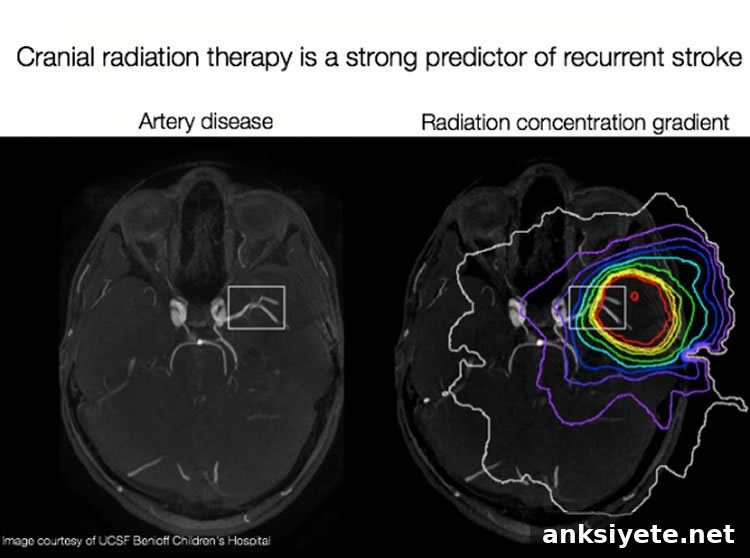
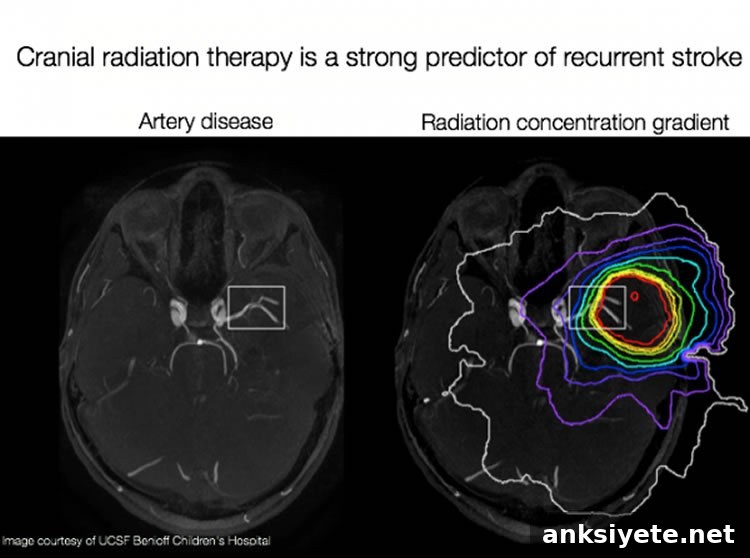
Prior research has established a strong link between cranial radiation and initial stroke risk. High-dose radiation appears to damage cerebral blood vessels over time, promoting narrowing and obstruction that can lead to ischemic events. “If a patient has already had a stroke, using aspirin or other antithrombotic measures may reduce clotting risk, but it does not reverse the underlying vessel injury caused by radiation,” said Heather Fullerton, MD, professor of neurology, founder of the UCSF Pediatric Stroke and Cerebrovascular Disease Center and the study’s first author.
Clinical implications: The findings have practical consequences for follow-up care of childhood cancer survivors. Current survivorship screening guidelines do not routinely require evaluation of cerebral blood vessels, despite the fact that vascular abnormalities are often visible on standard MRI studies. “Radiologists examining follow-up scans may focus on the original tumor site and miss changes affecting blood vessels,” Fullerton noted.
In response to the study’s results, UCSF has revised its internal protocols to include vascular screening and systematic assessment of modifiable risk factors such as hypertension for at-risk survivors, although such measures are not uniformly required nationwide. “Identifying patients at higher risk would allow referral to pediatric stroke specialists for tailored surveillance and prevention,” Mueller added. “That would be a major advance in long-term care for these children.”
Collaborators on the study included clinicians and researchers from UCSF, the Fred Hutchinson Cancer Research Center, St. Jude Children’s Research Hospital, the University of Texas and Memorial Sloan-Kettering Cancer Center. Key contributors listed by the authors include Robert R. Goldsby, Kayla Stratton, Wendy Leisenring, Gregory Armstrong, Leslie Robinson, Kevin Krull, Marilyn Stovall, R.E. Weathers and Charles Sklar.
Funding: The work was supported by the National Cancer Institute (U24 CA 55727), Cancer Center Support (CORE), the American Lebanese-Syrian Associated Charities, the National Center for Advancing Translational Sciences, the Frank A. Campini Foundation and a private donation from the LaRoche family.
Source: Lisa Marie Potter — UCSF
Image credit: UC San Francisco Pediatric Brain Center
Original research: Abstract for “Recurrent stroke in childhood cancer survivors” by Heather J. Fullerton et al., published online August 26, 2015, in Neurology. doi:10.1212/WNL.0000000000001951
Abstract
Recurrent stroke in childhood cancer survivors
Objective: To estimate the rate and identify predictors of recurrent stroke among survivors of pediatric cancer who experienced a first stroke.
Methods: The Childhood Cancer Survivor Study is a retrospective cohort with longitudinal follow-up that enrolled 14,358 survivors diagnosed before age 21.
Results: Among 329 respondents (74% response rate), 271 confirmed a first stroke at a median age of 19 years (range 0–53), and 70 reported a second stroke at a median age of 32 years (range 1–56). In multivariable analysis, independent predictors of recurrent stroke included cranial radiation therapy dose ≥50 Gy (vs none; hazard ratio [HR] 4.4; 95% confidence interval [CI] 1.4–13.7), hypertension (HR 1.9; 95% CI 1.0–3.5), and older age at first stroke (HR 6.4; 95% CI 1.8–23 for age ≥40 vs age 0–17 years). The 10-year cumulative incidence of late recurrent stroke was 21% (95% CI 16%–27%) overall and 33% (95% CI 21%–44%) for those treated with ≥50 Gy of cranial radiation.
Conclusion: Survivors of childhood cancer — especially those previously treated with high-dose cranial radiation — remain at high risk for recurrent stroke for decades after a first event. Although recurrent strokes often occur in young adulthood, hypertension, a well-established atherosclerotic risk factor, independently predicts recurrence in this population.