
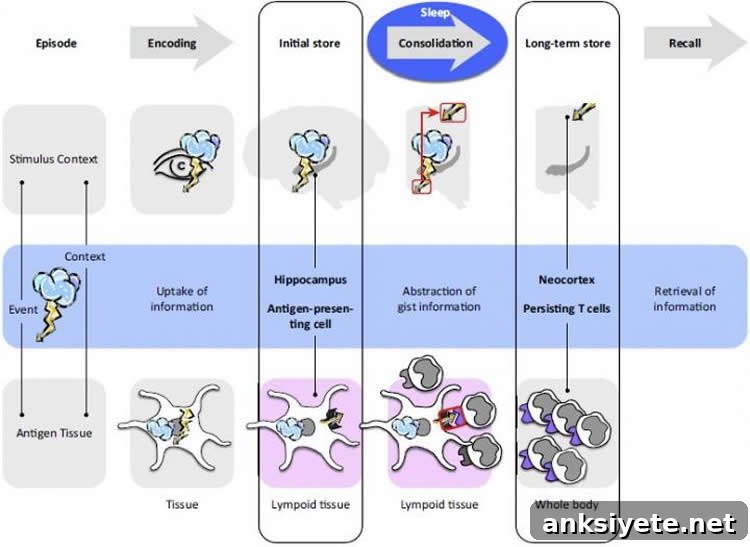
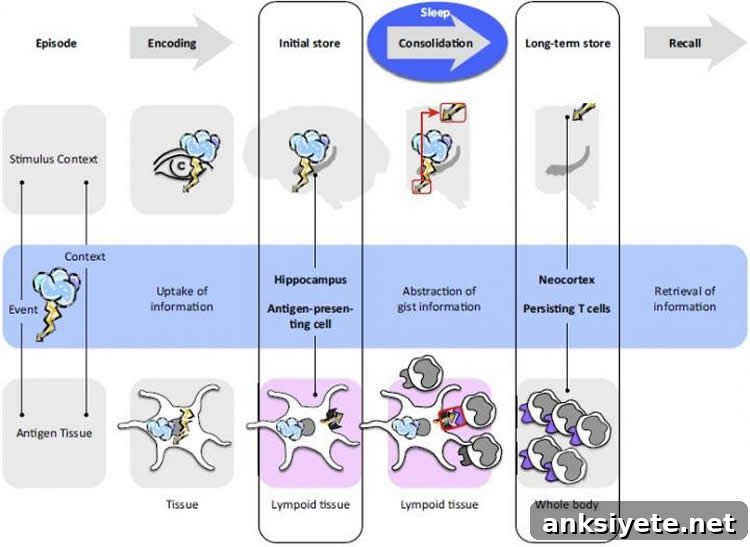
More than a century of research has shown that sleep supports the retention of memories for facts and events. New analysis suggests that deep, slow-wave sleep—the stage associated with consolidating fragile, newly formed memories into stable, long-lasting ones—may also reinforce the immune system’s memory of previously encountered pathogens.
In an Opinion article published September 29 in Trends in Neurosciences, as part of a special Neuroimmunology issue, researchers led by Jan Born of the University of Tuebingen propose a unifying idea: sleep supports long-term memory formation not only in the brain but across biological systems, including the immune system. “While it has been known for a long time that sleep supports long-term memory formation in the psychological domain, the idea that long-term memory formation is a function of sleep effective in all organismic systems is in our view entirely new,” Born explains. The authors argue that slow-wave sleep may play a central role in selecting and stabilizing the information the immune system retains.
The adaptive immune system encodes prior encounters with bacteria and viruses by storing fragments of those pathogens and creating memory T cells. These memory T cells can persist for months or years and are poised to recognize and respond quickly to a return of the same or similar pathogens. Importantly, memory T cells appear to capture an abstracted “gist” of the pathogen—focusing on peptide fragments that best represent the invader—so the immune response can detect related but not identical threats.
Human studies cited in the article show that the nights immediately after vaccination, when slow-wave sleep tends to be pronounced, are associated with sustained increases in memory T cells. This pattern supports the view that deep sleep contributes to the formation of long-term immunological memories that emphasize generalized, behaviorally and clinically useful information. By enhancing the selection and consolidation of relevant antigenic features, slow-wave sleep could help the immune system mount faster and more flexible responses to future infections.
Born and colleagues note several mechanisms that might underlie this sleep-related benefit. During sleep, hormonal and neural states change in ways that influence cellular interactions in lymphoid tissues. The authors highlight evidence that the hormones released during sleep foster productive communication between antigen-presenting cells and antigen-recognizing cells, a critical step for shaping effective memory. Without adequate sleep, these interactions may be impaired, and the immune system could focus on less useful parts of a pathogen’s proteins—areas that mutate easily and fail to confer broad protection.
“If we didn’t sleep, then the immune system might focus on the wrong parts of the pathogen,” Born warns. He points out that some viral proteins can readily mutate to evade responses targeted at highly specific regions. When sleep is insufficient, the reduced availability of antigen-presenting cells and altered hormonal support could lead to suboptimal memory formation, undermining long-term immunity.
The parallels the authors draw between neuronal and immunological memory suggest practical implications. A clearer model of how sleep influences the selection and stabilization of immune information could inform vaccine strategies that aim to produce durable, broadly protective memory T cells. Born notes the potential clinical impact: “In order to design effective vaccines against HIV, malaria, and tuberculosis, which are based on immunological memory, the correct memory model must be available. It is our hope that by comparing the concepts of neuronal and immunological memory, a model of immunological memory can be developed which integrates the available experimental data and serves as a helpful basis for vaccine development.”
Looking ahead, the researchers call for targeted experiments to determine exactly what kinds of antigenic information are selected during sleep and by what cellular and molecular mechanisms such selection occurs. Answering these questions will require coordinated work across immunology, sleep science, and systems neuroscience. Such interdisciplinary research could clarify how different sleep stages contribute to the consolidation and refinement of immunological memory and reveal when and how sleep interventions might strengthen vaccine responses or improve immune health more generally.
Although the Opinion piece synthesizes existing results rather than presenting new experimental data, it highlights a promising conceptual shift: treating sleep as a systemic organizer of biological memory. That shift opens new avenues for basic research and for translational work that seeks to optimize vaccination timing, improve clinical outcomes in immunocompromised patients, and better protect public health by recognizing sleep as a modifiable factor in immune resilience.
Funding: This work was primarily supported by the Deutsche Forschungsgemeinschaft.
Source: Joseph Caputo – Cell
Image Source: The image is credited to Westermann et al./Trends in Neurosciences 2015
Original Research: The research paper “System Consolidation during Sleep–A Common Principle Underlying Psychological and Immunological Memory Formation” appeared in Trends in Neurosciences, DOI: 10.1016/j.tins.2015.07.007