
Summary: Activation of noradrenergic neurons originating in the locus coeruleus and projecting to the spinal dorsal horn stimulates a distinct population of astrocytes, and that astrocyte activation promotes heightened pain sensitivity.
Source: Kyushu University
A research team in Japan has identified a previously unrecognized mechanism in spinal pain control: a selective group of astrocytes in the superficial dorsal horn that, when activated by descending noradrenergic neurons from the brainstem, drive mechanical hypersensitivity. This discovery highlights a new cellular target that could improve the effectiveness of treatments for chronic pain.
Neurons are the most widely known cells of the central nervous system, but the supporting glial cells play indispensable roles that extend far beyond “glue.” Among glial cell types, astrocytes are the most abundant and are essential for maintaining neuronal health, regulating synaptic signaling, and shaping sensory processing. Despite their importance, the diversity and region-specific functions of astrocyte subpopulations remain incompletely understood.
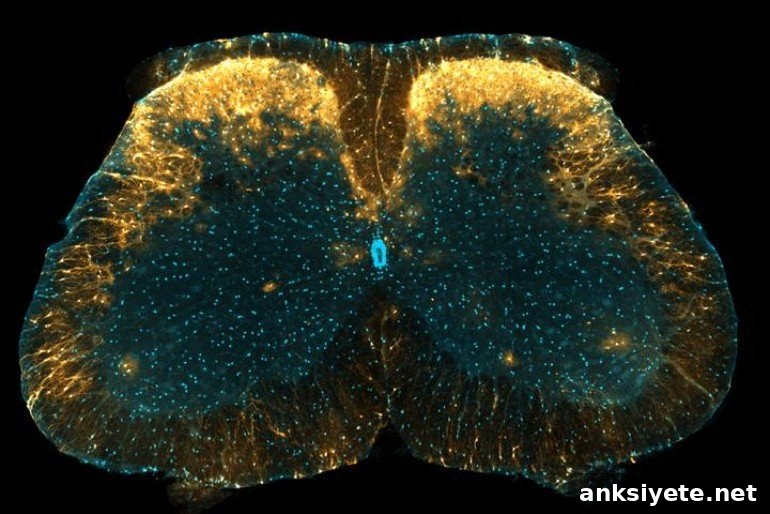
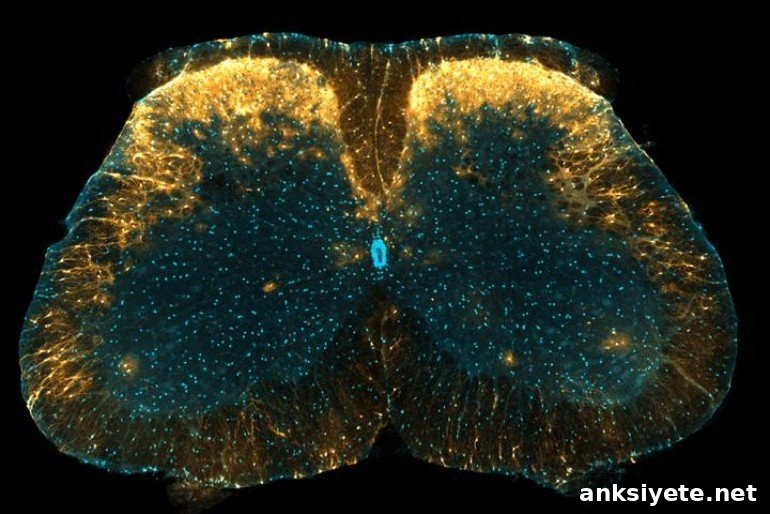
Led by Professor Makoto Tsuda at Kyushu University’s Graduate School of Pharmaceutical Sciences, the researchers characterized a distinct population of astrocytes in the outer two layers of spinal gray matter—commonly called the superficial laminae of the spinal dorsal horn. This region receives incoming sensory information such as touch, temperature, and painful stimuli from peripheral nerves and relays it to higher brain centers.
Using mouse models and a combination of in vivo imaging, genetic labeling, and chemogenetic manipulation, the team showed that noradrenergic (NAergic) neurons from the locus coeruleus (LC) can activate these superficial dorsal horn astrocytes. The astrocytes express specific molecular markers, including the transcriptional regulator Hes5 and α1A-adrenoceptors, which make them responsive to noradrenaline released by descending LC projections. Activation of this astrocyte population led to increased mechanical pain sensitivity in the animals.
These findings challenge the longstanding assumption that descending noradrenergic pathways from the locus coeruleus predominantly suppress spinal pain signals. Instead, the study demonstrates a facilitatory role for a defined astrocyte subset: LC-derived noradrenergic signaling can gate mechanosensory hypersensitivity through α1A-adrenoceptor–mediated activation of Hes5-positive astrocytes in the superficial dorsal horn.
To probe the therapeutic relevance of this pathway, the investigators used genetic approaches to blunt the astrocytes’ response to noradrenaline and then tested the efficacy of duloxetine, an antidepressant commonly prescribed for chronic pain that increases noradrenaline availability in the spinal cord by blocking its reuptake. Mice with reduced α1A-adrenoceptor signaling in the Hes5-positive astrocytes experienced a greater analgesic benefit from duloxetine, consistent with the idea that noradrenaline-driven astrocyte activation can limit the drug’s effectiveness.
Professor Tsuda summarizes the significance: the identification of this astrocyte subpopulation reveals an unexpected facilitating role for descending LC–noradrenergic control of spinal pain transmission. By selectively targeting noradrenergic signaling onto these astrocytes, it may be possible to enhance the pain-relieving effects of existing medications used to treat chronic pain.
The authors note that further work is needed to generalize these findings across different pain models and pharmacological agents. However, the study provides a clear proof of principle: spinal-cord astrocytes are not homogeneous, and specific astrocyte populations can critically influence how descending brainstem circuits shape sensory and pain processing.
About this pain research news
Source: Kyushu University
Contact: William J. Potscavage Jr. – Kyushu University
Image: The image is credited to Makoto Tsuda, Kyushu University
Original Research: Closed access. “Spinal astrocytes in superficial laminae gate brainstem descending control of mechanosensory hypersensitivity” by Yuta Kohro, Tsuyoshi Matsuda, Kohei Yoshihara, Keita Kohno, Keisuke Koga, Ryuichi Katsuragi, Takaaki Oka, Ryoichi Tashima, Sho Muneta, Takuya Yamane, Shota Okada, Kazuya Momokino, Aogu Furusho, Kenji Hamase, Takumi Oti, Hirotaka Sakamoto, Kenichiro Hayashida, Ryosuke Kobayashi, Takuro Horii, Izuho Hatada, Hidetoshi Tozaki-Saitoh, Katsuhiko Mikoshiba, Verdon Taylor, Kazuhide Inoue, and Makoto Tsuda. Nature Neuroscience
Abstract
Spinal astrocytes in superficial laminae gate brainstem descending control of mechanosensory hypersensitivity
Astrocytes are critical regulators of CNS function and are proposed to be heterogeneous in the developing brain and spinal cord. Here we identify a population of astrocytes located in the superficial laminae of the spinal dorsal horn (SDH) in adults that is genetically defined by Hes5. In vivo imaging revealed that noxious stimulation by intraplantar capsaicin injection activated Hes5+ SDH astrocytes via α1A-adrenoceptors (α1A-ARs) through descending noradrenergic signaling from the locus coeruleus. Intrathecal norepinephrine induced mechanical pain hypersensitivity via α1A-ARs in Hes5+ astrocytes, and chemogenetic stimulation of Hes5+ SDH astrocytes was sufficient to produce the hypersensitivity. Furthermore, capsaicin-induced mechanical hypersensitivity was prevented by the inhibition of descending locus coeruleus–noradrenergic signaling onto Hes5+ astrocytes. Moreover, in a model of chronic pain, α1A-ARs in Hes5+ astrocytes were critical regulators for determining an analgesic effect of duloxetine. Our findings identify a superficial SDH-selective astrocyte population that gates descending noradrenergic control of mechanosensory behavior.