
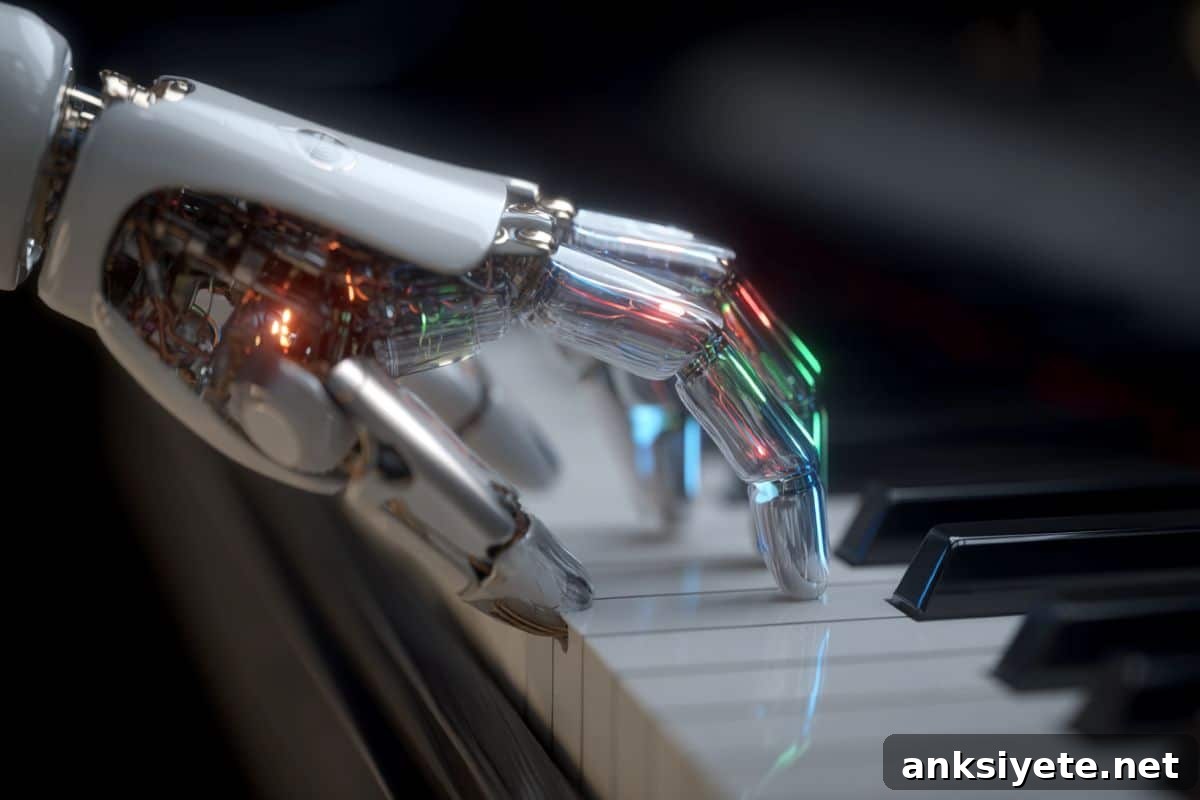
Summary: One of the toughest challenges for robots is not brute strength but fine finger control—tasks like clicking a mouse, cutting with scissors, or pressing individual piano keys. While robotic hands have improved at gripping, they have historically lacked reliable proprioception—the internal sense of where their fingers are in space. A collaborative research team has addressed this gap by creating a rigid-soft hybrid dexterous hand fitted with omnidirectional bending sensors that let the robot “feel” both pitch and yaw at its finger joints, enabling delicate, human-like manipulation.
Key Facts
- 18 Degrees of Freedom: The robotic hand includes 18 active joints, closely mirroring the complexity of human hand motion and enabling nuanced finger positioning.
- Optical Sensing: Each finger contains segmented PMMA (polymethylmethacrylate) optical fibers paired with a trichromatic (RGB) LED and chromatic detector. The system measures how different colors of light attenuate as the fibers bend to infer finger posture.
- Decoupling Motion: Because the fiber layout separates responses to bending in pitch versus yaw, the sensor avoids the coupling that plagues many soft sensors and can distinguish simultaneous multi-directional motions.
- High Accuracy and Repeatability: The sensor maintains an average measurement error of ±2.13° for pitch and ±2.34° for yaw under single bending, with low crosstalk between axes and strong repeatability across test cycles.
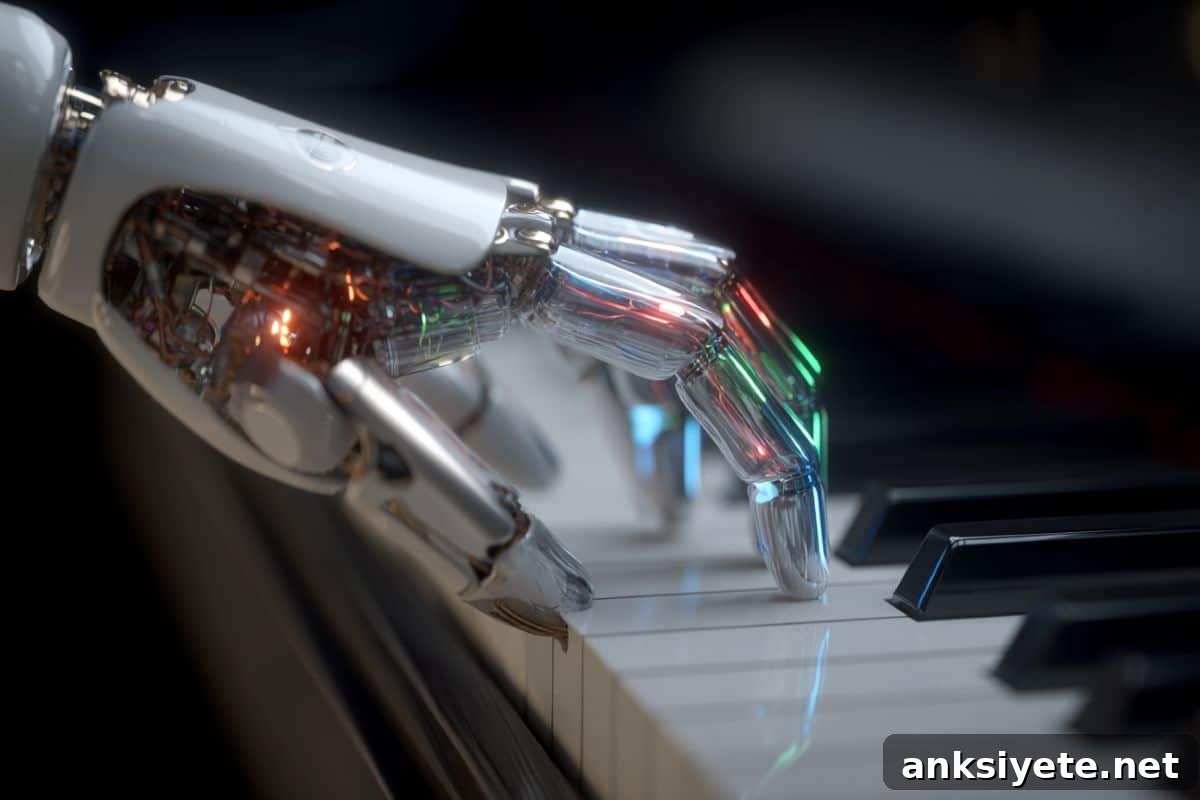
- Closed-Loop Demonstrations: The hand successfully demonstrated closed-loop posture control in three precision-demanding tasks: playing piano keys, operating a computer mouse, and cutting with scissors.
Overview
Robotic hands have advanced in grasping and pinching, but true dexterous manipulation—where fingers must coordinate subtle, multidirectional motions—still challenges many systems. Proprioception, the continuous sensing of joint angles and finger positions, is a primary limitation. Most soft sensors can detect a single bending direction or suffer from signal coupling when fingers move in more than one direction simultaneously. This research addresses that problem by integrating a soft optical sensing system within a rigid-flexible hand structure so the robot can perceive complex finger posture in real time.
The research team—based at Zhejiang University, Hangzhou Dianzi University, and Lishui University—built a five-finger rigid-flexible hand where each finger embeds an omnidirectional soft bending sensor. The sensing element uses segmented PMMA fibers illuminated by red, green, and blue LEDs. As the finger bends, different wavelengths attenuate in distinct ways depending on the bending direction. By analyzing these color-specific intensity changes, the system decouples pitch and yaw signals and reconstructs joint angles with low error.
Performance testing showed stable measurements across repeated cycles and low inter-axis interference: pure yaw only contributed a small percentage to the pitch signal and vice versa, with good signal-to-crosstalk ratios. That accuracy and robustness let the researchers close the control loop and demonstrate tasks that require subtle coordination rather than gross gripping strength.
Beyond laboratory metrics, the group used real-world demonstrations—manipulating scissors, clicking a mouse, and playing individual piano keys—to show that integrated rigid-soft design and omnidirectional optical sensing produce smoother, more reliable finger control. The authors emphasize that the advance is not merely a new sensor component but a practical approach to giving humanoid hands a more human-like internal awareness during complex motion.
Improved posture perception could make humanoid hands more capable in service robotics, industrial assembly, rehabilitation devices, and prosthetics where precise finger adaptation to fragile or variable objects is critical. The work also suggests safer, more natural human-robot interactions by enabling finer modulation of contact forces and finger trajectories.
Funding Information
This research was supported by the National Natural Science Foundation of China (No. 52475573), the Natural Science Foundation of Zhejiang Province (No. LTGY23E050002), the National Key Research and Development Program of China (No. 2023YFC2811500), the Science and Technology Innovation Project of the General Administration of Sport of China (24KJCX074), the Key Research and Development Programme of Zhejiang (No. 2024C03259, No. 2023C03196), and the Fundamental Research Funds for the Central Universities.
Key Questions Answered:
A: Cutting requires continuous, subtle adjustments in both side-to-side (yaw) and up-and-down (pitch) directions. Robots that sense only one axis tend to let the blade slip or jam. The omnidirectional sensors in this hand measure both axes concurrently, enabling the robot to adjust its grip dynamically, as a human would.
A: The sensor behaves like a glowing fiber: bending the fiber changes how light travels and which wavelengths attenuate most. By emitting red, green, and blue light and measuring each channel’s intensity change, the system decodes the bending direction and magnitude.
A: Yes. The sensors are soft and integrate into flexible finger structures, making them suitable for prosthetics that need durable, natural-feeling feedback to support fine motor tasks like typing or playing instruments.
Editorial Notes:
- This article was edited by a Neuroscience News editor.
- The journal paper was reviewed in full by the editorial staff.
- Context and clarifications were added by staff to help readers understand the technical results and implications.
About this robotics and neurotech research news
Author: Yuan Wang
Source: AIRCAS
Contact: Yuan Wang – AIRCAS (email: [email protected])
Image: Image credited to Neuroscience News
Original Research: Open access. Title: Soft sensor for omnidirectional posture perception in humanoid dexterous hands by Liang Zhong, Xiaoqing Tian, Jiyong Wang, Xian Song, Jianfeng Li & Yuxin Peng. Published in Microsystems & Nanoengineering. DOI: 10.1038/s41378-026-01179-3
Abstract
Soft sensor for omnidirectional posture perception in humanoid dexterous hands
This study reports an omnidirectional soft bending sensor designed for humanoid dexterous hands to enable accurate posture perception during delicate manipulation. Inspired by human proprioception, the authors developed a humanoid hand with 18 active degrees of freedom and five rigid-flexible fingers. Each finger integrates segmented PMMA optical fibers, a trichromatic LED, and a chromatic detector to measure the pitch and yaw of metacarpophalangeal joints. The sensor delivers stable, repeatable measurements and supports closed-loop control in demanding tasks such as using scissors, operating a computer mouse, and playing the piano. The technology advances multi-DoF motion sensing for robotic hands and points toward improved dexterity in applications ranging from service robotics to prosthetics.