
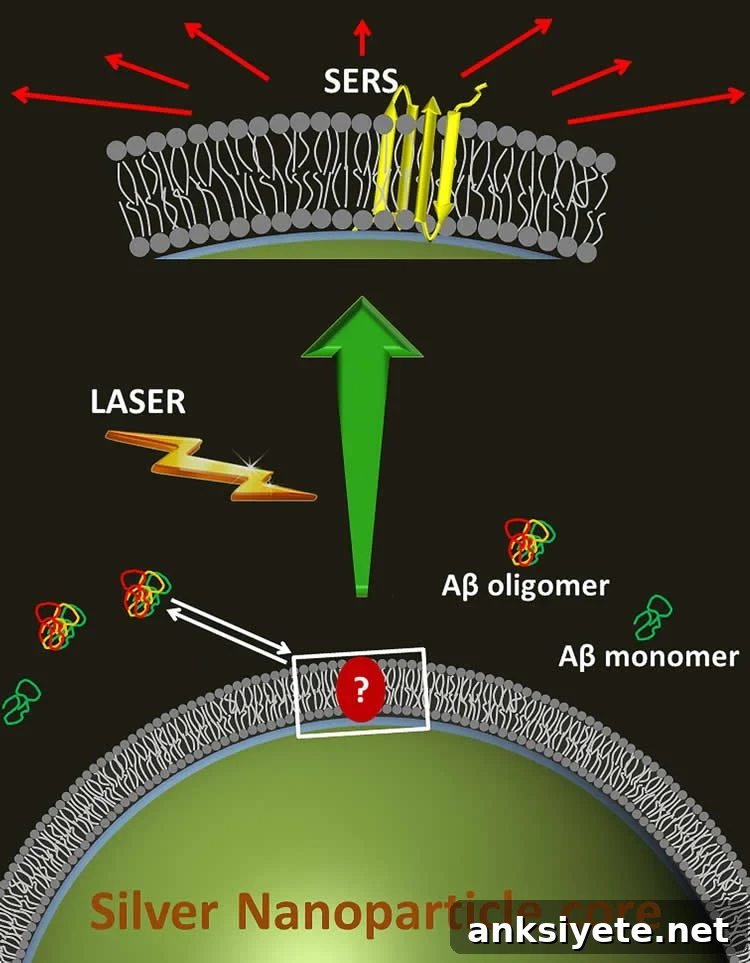
Using a novel approach that combines laser illumination with lipid-coated silver nanoparticles, researchers captured direct molecular-level snapshots of amyloid‑β as it interacted with a cell‑like membrane.
Although the origins of Alzheimer’s disease remain debated, many experts agree that certain forms of the amyloid‑β peptide that can disrupt cell membranes are central to the pathology. Designing therapies against this threat has been hindered by limited knowledge of the membrane‑bound peptide’s structure. This new study offers one of the clearest views yet of how a membrane‑attached form of amyloid‑β folds and positions itself, information that could guide drug design.
“Everyone wants to find the key to treat Alzheimer’s, but until now we didn’t know precisely what the lock looks like,” says Sudipta Maiti, co‑leader of the work. “This study gives us a plausible look at that lock. It may not be the entire story, but it’s our best structural clue so far.” If confirmed, the observed conformation could make rational design of inhibitors or stabilizers more feasible.
The revealed structure resembles a beta‑hairpin but with an unexpected twist: the peptide forms a beta‑turn flanked by two beta‑sheet regions, producing a near‑orthogonal orientation of backbone hydrogen bonds compared with mature fibrils. Lead contributor Debanjan Bhowmik explains, “We expected a hairpin‑like fold, but the twist we observed creates a beta‑hairpin architecture that could allow these amyloid‑β assemblies to form pore‑like structures in membranes.” Such porin‑like assemblies provide a viable structural explanation for how amyloid‑β oligomers might perforate cell membranes and exert toxicity.
The results, published in ACS Nano by a combined team from the Tata Institute of Fundamental Research (TIFR), the Indian Institute of Science (IISc), and the University of Toronto, were enabled by a tailored version of Raman spectroscopy. The team adapted surface‑enhanced Raman spectroscopy (SERS) so it could detect the very weak vibrational signals of membrane‑bound protein at low micromolar concentrations without physically immobilizing the molecules.
Their key innovation was to encapsulate silver nanoparticles within a lipid bilayer that mimics the outer membrane of a cell. Amyloid‑β peptides spontaneously bind to the lipid coating as they would to a cell membrane; the underlying silver nanoparticle then strongly enhances the Raman signal from the membrane‑attached peptides. Co‑author Gilbert Walker summarizes: “The peptide is deceived by the membrane mimic and adheres to it, while the silver core amplifies and lights up the molecular signature so we can read its conformation.”
This approach provided residue‑level secondary structure information through isotope shifts in the Raman spectra. The spectroscopic data—supported by solid‑state NMR for the identified beta‑sheet regions—distinguish the membrane‑attached oligomer from the mature, lower‑toxicity fibrils and point to a structural basis for membrane pore formation.
The research highlights effective collaboration across disciplines: materials and nanoparticle expertise, advanced spectroscopic methods, and structural biology all contributed essential insights. “Contemporary science breaks down barriers,” says Jaydeep Basu of IISc. “This work exemplifies how teams combine strengths to address complex problems.” The finding represents a meaningful step toward understanding the membrane‑associated forms of amyloid‑β that are implicated in Alzheimer’s disease, and it opens an experimental route to study other membrane proteins that are difficult to characterize by conventional methods.
Funding: Supported by the Indian Department of Biotechnology, the International Advanced Research Centre for Powder Metallurgy & New Materials, the Indian Department of Science and Technology, and the Natural Sciences and Engineering Research Council.
Source: Sudipta Maiti – Tata Institute of Fundamental Research
Image credit: Debanjan Bhowmik/TIFR
Abstract
Cell‑Membrane‑Mimicking Lipid‑Coated Nanoparticles Confer Raman Enhancement to Membrane Proteins and Reveal Membrane‑Attached Amyloid‑β Conformation
Determining structures of membrane‑bound proteins is essential to understand their functions in health and disease. The authors introduce a surface‑enhanced Raman spectroscopy method that determines the conformation of membrane‑bound proteins at low micromolar concentrations and in the presence of membrane‑free species. Rather than immobilizing molecules, the approach relies on spontaneous binding to lipid bilayer‑encapsulated silver nanoparticles. Applied to membrane‑attached oligomers of amyloid‑β40 (Aβ40), isotope‑shifted Raman spectra provided residue‑level secondary structure information. The data reveal a beta‑turn flanked by two beta‑sheet regions; complementary solid‑state NMR confirms beta‑sheet formation in these regions. The membrane‑attached oligomer shows a striking, near‑orthogonal backbone hydrogen‑bond orientation compared with mature Aβ fibrils, consistent with a porin‑like beta‑barrel arrangement and offering a structural basis for proposed Aβ oligomer toxicity mechanisms.