
Summary: Researchers report that the medial prefrontal cortex aligns incoming visual information with recently acquired percepts, helping maintain a stable visual experience even during brief interruptions such as blinks.
Source: DPZ.
Every five seconds we close our eyes to blink and moisten them. During these fleeting moments, no light reaches the retina, yet our perception remains continuous and the world does not appear to go dark. Researchers Caspar Schwiedrzik and Sandrin Sudmann, neuroscientists at the German Primate Center and the University Medical Center Göttingen, together with collaborators in the United States, examined where and how the brain preserves this short-term perceptual memory. Their studies in epilepsy patients identify a specific brain region that plays a central role in linking prior visual information to current input, shedding light on how perception and memory interact to produce stable visual experiences.
Although we constantly blink and shift our eyes and head, we experience the environment as a cohesive and stable scene. This requires the brain to hold recent visual information briefly and integrate it with incoming sensory data so perception remains uninterrupted. Schwiedrzik and colleagues hypothesized that the medial prefrontal cortex (mPFC) — a region involved in short-term memory and decision-making — contributes critically to this stabilization process.
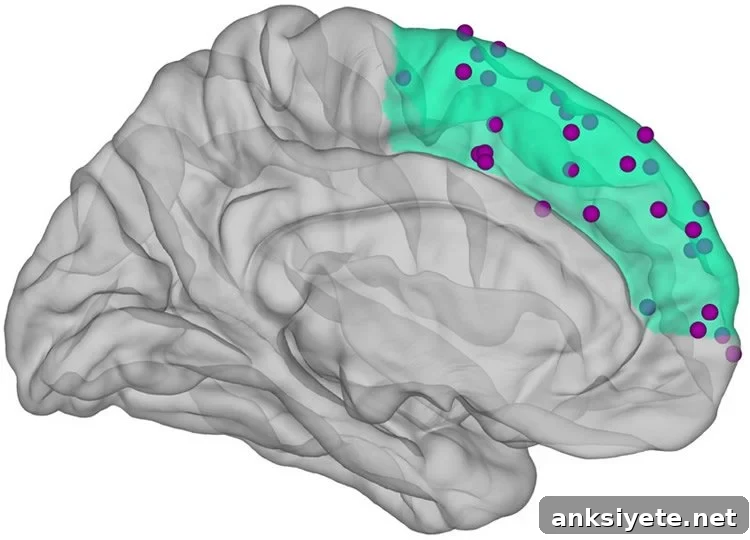
At New York University, the researchers took advantage of a clinical opportunity to study the mPFC directly in patients undergoing treatment for epilepsy. As part of clinical monitoring, electrodes were temporarily implanted in these patients’ brains, allowing intracranial recordings while they performed perceptual tasks. Participants viewed a lattice of dots and reported the perceived orientation (for example, horizontal or vertical). After a short interval, a second dot lattice was shown and subjects again reported its orientation. When both reports matched, this was taken as evidence that the subject had used the memory of the first percept to shape the perception of the second. Neural activity in the prefrontal cortex was recorded throughout the task. In one case, a patient with a prior surgical removal of part of the superior frontal gyrus showed a marked inability to retain the first visual percept, suggesting a causal role for this region in perceptual memory.
“Our findings show that the medial prefrontal cortex calibrates current visual input with previously experienced information, enabling a more stable perception of the world even during brief interruptions such as blinks,” says Caspar Schwiedrzik, first author of the study. The researchers note that this mechanism applies beyond simple low-level features: higher-level attributes such as facial expressions also influence subsequent perception, meaning prior percepts bias how we interpret the next stimulus we see.
The study demonstrates that the prefrontal cortex contributes to perception itself and to context-dependent behavior, integrating past and present sensory information rather than acting solely at a post-perceptual decision stage. In future work, the team plans to investigate additional factors that shape perceptual memory, including how confidence in one’s own perception affects the retention and influence of prior percepts.
Source: DPZ
Publisher: Organized by Neuroscience News
Image credit: Caspar M. Schwiedrzik
Original Research: Abstract for “Medial prefrontal cortex supports perceptual memory” by Caspar M. Schwiedrzik, Sandrin S. Sudmann, Thomas Thesen, Xiuyuan Wang, David M. Groppe, Pierre Mégevand, Werner Doyle, Ashesh D. Mehta, Orrin Devinsky, and Lucia Melloni. Published in Current Biology, September 24, 2018.
DOI: 10.1016/j.cub.2018.07.066
DPZ (2018). Why It Doesn’t Go Dark When You Blink. Neuroscience News. Published September 25, 2018. Republished summary based on the original study in Current Biology.
Abstract
Medial prefrontal cortex supports perceptual memory
Our visual environment is continuously changing, but perception tends to be stable and unified. One proposed mechanism is that the brain preserves an implicit perceptual memory that biases perception toward recently experienced states. While sensory cortices have been suggested to hold such short-term memories, the role of higher-order areas, particularly the prefrontal cortex (PFC), has been less clear. The PFC possesses properties — such as long neural time constants, invariance, and large receptive fields — that could allow it to stabilize perception across variable input. Previous neuroimaging work linked dorsomedial PFC activity to perceptual memory, but it remained uncertain whether this association reflected sensory integration or post-perceptual decision processes. To address this, the authors recorded intracranial activity in six epilepsy patients performing sequential orientation judgments on ambiguous stimuli known to elicit perceptual memory. Activity in dorsomedial PFC in the high-gamma band (70–150 Hz) correlated with perceptual memory. This effect was anatomically specific to dorsomedial PFC and functionally specific to memory of prior percepts. A patient with a lesion in this region exhibited impaired perceptual memory, supporting a causal role. Overall, the data indicate that dorsomedial PFC integrates current sensory input with preceding percepts, helping to stabilize visual experience despite ongoing variability in the environment.