
Summary: Deficiency of the Ste20‑like kinase (SLK) reduces dendritic branching and leads to a progressive loss of inhibitory synapses. Because reduced SLK levels are observed in brain tissue from people with epilepsy, these findings may point to new treatment approaches for this neurological disorder.
Source: University of Bonn
Researchers at the University of Bonn have clarified the role of the kinase SLK in neuronal development. When SLK is lacking, neurons develop fewer branches and become harder to inhibit, a change that is also detectable in epileptic brain tissue.
Kinases like SLK regulate many cellular processes by attaching phosphate groups to proteins, altering their behavior. SLK, part of the Ste20/Hippo kinase pathway, was already known for roles in embryonic development, cell growth and migration—processes that are fundamental to neuron maturation. The new study, published in the Journal of Neuroscience, addresses SLK’s specific function in neurons and its consequences for neural circuitry.
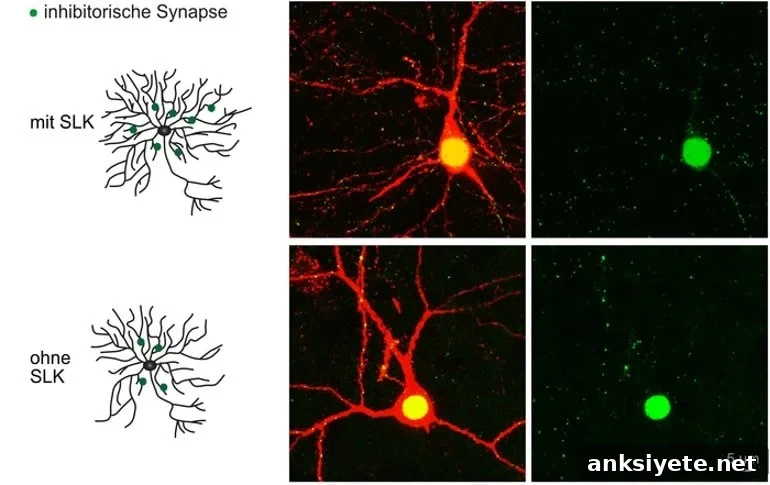
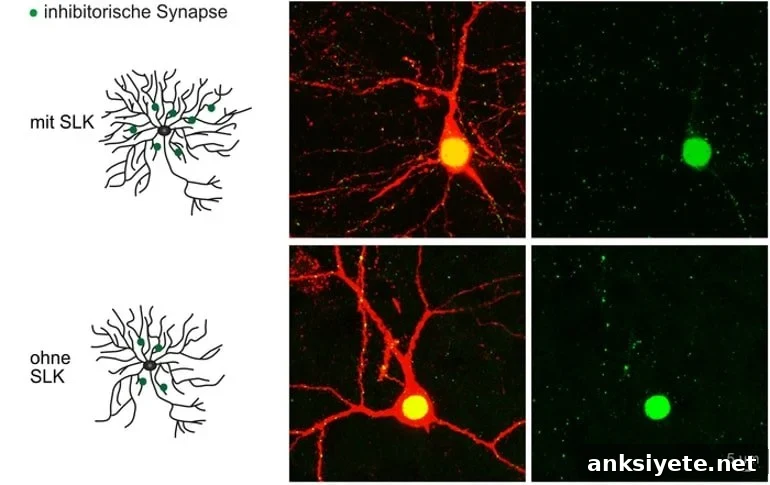
Using mouse models, the team reduced SLK expression in cortical neurons and examined how this affected dendritic architecture and synaptic balance. The result was a clear change in dendritic morphology: the smallest, higher‑order branches—those third-order branches and beyond—were markedly reduced. These fine branches normally host many excitatory synapses, while the thicker, primary dendrites carry a larger share of inhibitory synapses.
SLK deficiency makes neurons more excitable
Dendrites form a branching arbor studded with synapses, the contact points that relay electrical signals between neurons. The observed pruning specifically affected the finer distal branches rather than the main proximal branches. Although those small branches are associated with excitatory synapses, the researchers did not find a compensatory increase in excitatory synapse density. Nevertheless, neurons lacking SLK were more easily excited, suggesting other mechanisms were involved.
The critical change emerged on the thicker, primary dendrites: inhibitory synapses—those that decrease the likelihood a neuron will fire—declined progressively after the first days of postnatal life. Initially normal in number, these inhibitory contacts began disappearing over time in SLK‑deficient neurons, producing a lasting shift in excitation‑inhibition balance toward hyperexcitability. This loss of inhibition offers a plausible cellular explanation for the heightened neuronal activity seen during epileptic seizures.
Importantly, the researchers detected reduced SLK expression in dysmorphic neurons from human epileptogenic brain lesions, linking the mouse findings to human disease. In epilepsy, large networks of neurons become overactive; a progressive loss of inhibitory synapses could make these networks increasingly prone to runaway excitation.
Explanation for declining drug efficacy?
The work also offers a potential explanation for why antiepileptic drugs sometimes lose effectiveness over time. Many current therapies aim to boost inhibitory signaling to counteract excessive excitation. But if inhibitory synapses are progressively lost due to SLK deficiency, strategies that simply stimulate those remaining inhibitory receptors may become ineffective. In such cases, targeting excitatory input—reducing excitation directly—could be a more promising therapeutic approach.
Funding: This research was supported by the German Research Foundation (DFG) through the Collaborative Research Center 1089 and Research Unit 2715, and received further support from the BMBF and the Else Kröner‑Fresenius Foundation.
About this neuroscience research news
Author: Johannes Seiler
Source: University of Bonn
Contact: Johannes Seiler – University of Bonn
Image credit: Institut für Neuropathologie/Uni Bonn
Original Research (closed access): “Ste20‑like kinase is critical for inhibitory synapse maintenance and its deficiency confers a developmental dendritopathy” by Susanne Schoch, Anne Quatraccioni and colleagues. Journal of Neuroscience.
Abstract (condensed)
Dendritic size and complexity shape how neurons integrate synaptic input into action potential output, but the molecular controls that sculpt dendritic arbors are not fully understood. The conserved Ste20/Hippo pathway, and specifically Ste20‑like kinase (SLK), was investigated for a neuronal role. SLK is highly expressed during neuronal development and regulates cytoskeletal dynamics in other cell types, yet its neuronal function was previously unclear.
In developing mouse cortical neurons, SLK is essential for the proper formation of higher‑order dendrites (third order and beyond) in both sexes. SLK knockdown did not affect excitatory neurotransmission but produced a selective, progressive loss of inhibitory synapses after postnatal day 15, causing an excitation‑inhibition imbalance. Correspondingly, human epileptogenic cortical lesions displayed reduced SLK levels in dysmorphic neurons, suggesting clinical relevance.
Overall, these findings establish SLK as a key regulator of dendritic complexity during development and of inhibitory synapse maintenance, with implications for understanding and potentially treating disorders characterized by neuronal hyperexcitability such as epilepsy.
SIGNIFICANCE STATEMENT
Decreased SLK levels in dysmorphic neurons from human epileptogenic lesions, together with mouse studies, demonstrate that SLK is required both for forming the dendritic tree and for maintaining inhibitory connections that restrain neuronal firing. Loss of SLK thus contributes to a developmental dendritopathy and progressive reduction of inhibition, mechanisms relevant to epileptogenesis and therapeutic strategy.