
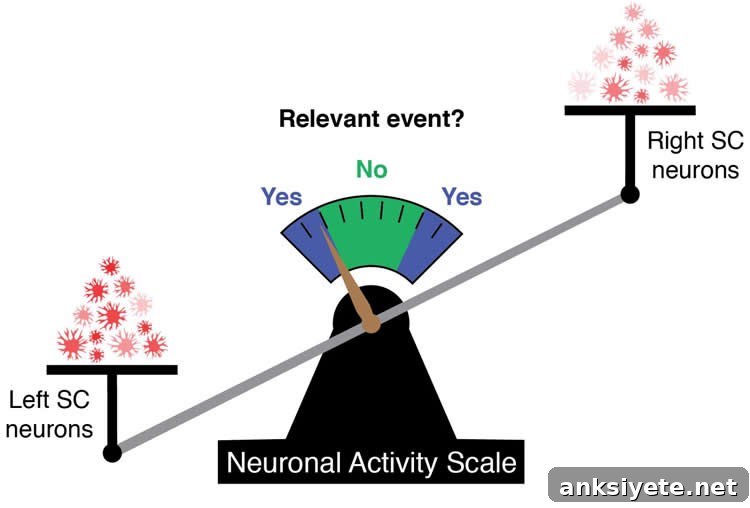
Summary: Differences in activity between the left and right superior colliculi allow researchers to predict whether an animal detected a visual event.
Source: NIH/NEI.
Researchers at the National Eye Institute (NEI) report that neurons in the superior colliculus — a conserved midbrain structure found in all vertebrates — play a central role in detecting visual objects and events. Rather than identifying what an object is, the superior colliculus appears to signal whether something is present at all. By recording and comparing simultaneous activity from the left and right superior colliculi, the investigators could predict when an animal perceived an event. The findings were published in the journal Nature Neuroscience. NEI is part of the National Institutes of Health.
Seeing an object involves more than the eyes: the visual system must filter incoming signals, classify them, and decide whether they correspond to an actual object or event. These operations take place across multiple brain areas, from the retina and visual cortex to evolutionarily older structures such as the superior colliculus. For stimuli that are hard to detect — for example, a dimly colored chair in poor light — tiny changes in neural signals can determine whether an animal avoids the obstacle or not. This study demonstrates that the superior colliculus carries the critical signal that underlies the decision that “something is there” in the visual field.
“While it has long been known that the superior colliculus contributes to perception, we wanted to understand precisely how it controls perceptual choice and to describe that mechanism with a predictive mathematical model,” said James Herman, Ph.D., lead author of the study.
“The superior colliculus plays a foundational role in our capacity to detect events,” said Richard Krauzlis, Ph.D., principal investigator in the Laboratory of Sensorimotor Research at NEI and senior author on the paper. “This work shows that a specific population of midbrain neurons can drive behavior and that a commonly used computational model can predict behavior from those neural signals.”
The process by which sensory information is transformed into an action or report — for instance, whether to release a lever when a visual change occurs — is called perceptual decision-making. Much research in this field applies mathematical decision models to relate controlled sensory stimuli to animal or human behavior. Yet it has been difficult to show that those models actually reflect computations performed by neurons in the brain during decision-making.
In this project, the investigators applied an “accumulator threshold model” to link neural activity in the superior colliculus to behavior. The accumulator model proposes that evidence builds over time until it reaches a decision threshold, triggering a choice. Because individual neurons can accumulate signals gradually, the team used measured neuronal activity, rather than the stimulus itself, as the input to their behavioral model.
Two monkeys were trained on a covert attention task. While holding a lever, each monkey was cued to attend to one side of visual space and to respond if that cued side exhibited a subtle color change. If the non-cued (foil) side changed color, the correct response was to ignore it and continue holding the lever. During these trials the researchers simultaneously recorded spiking activity from neurons in both the right and left superior colliculi.
Although both colliculi responded when color changes occurred, the critical finding was that the animal’s response depended on the difference in activity between the two sides. When the activity on the cued side rose sufficiently above activity on the opposite side and crossed a specific threshold, the monkey released the lever to report the cued event. The relative level of moment-by-moment spiking across the left and right superior colliculi therefore predicted perceptual reports.
To test causality, the team manipulated activity on one side of the superior colliculus. They applied reversible interventions that either slightly reduced neuronal firing (using a local drug) or increased firing (using small electrical stimulation). Strengthening the signal on the colliculus representing the cued side improved detection of cued color changes and reduced mistaken responses to foil changes. Weakening that signal produced the opposite effect. Each behavioral change was consistent with a simple adjustment of the accumulator threshold in the computational model.
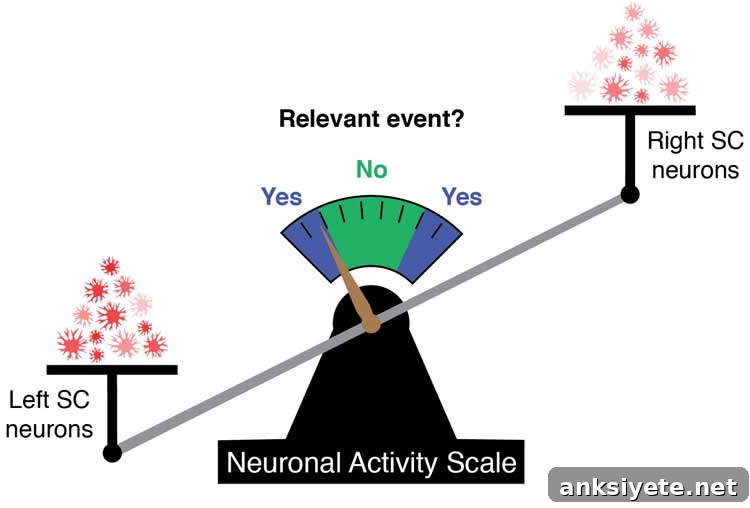
The researchers chose a color-change stimulus partly because the superior colliculus does not directly process color; that information is handled by other visual areas and then relayed to the superior colliculus. The study therefore supports the idea that the superior colliculus serves as a decision node: it compares incoming sensory information across the two hemispheres and, when the difference reaches a threshold, triggers a behavioral report that something has occurred in the visual field.
“It’s striking that despite the sophisticated processing in the cerebral cortex, these evolutionarily older midbrain structures remain central to the kinds of visual detection we rely on routinely,” Herman added.
“For tasks that ask only whether an event happened — not what the event was — superior colliculus activity appears both necessary and sufficient for the perceptual report,” Krauzlis said.
Although the same accumulator-threshold principle applied across animals, the precise pattern of neural activity and the threshold value were unique to each monkey. In other words, each animal had its own neural ‘signature’ or behavioral code in the superior colliculus.
Funding: This study was funded by the NIH/National Eye Institute.
Source: Lesley Earl – NIH/NEI.
Publisher: Organized by NeuroscienceNews.com.
Image credit: James Herman, Ph.D., National Eye Institute.
Original research: “Midbrain activity can explain perceptual decisions during an attention task” by James P. Herman, Leor N. Katz & Richard J. Krauzlis, published in Nature Neuroscience, November 26, 2018.
DOI: 10.1038/s41593-018-0271-5
Midbrain activity can explain perceptual decisions during an attention task
The authors introduce a decision model that interprets the relative levels of moment-by-moment spiking activity from the right and left superior colliculus to distinguish relevant from irrelevant stimulus events. The model explains detection performance in a covert attention task, both in intact animals and when performance is perturbed by causal manipulations. This provides a specific example of how midbrain activity could support perceptual judgments during attention tasks.