
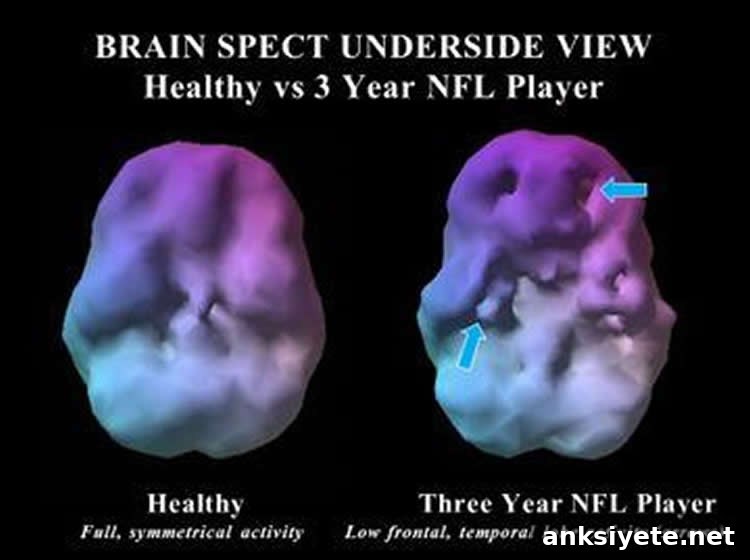
Advanced brain imaging and predictive analytics reveal reduced blood flow in specific regions of the brain in former and current NFL players, and link these changes to cognitive and behavioral problems, reports the Journal of Alzheimer’s Disease.
The identification of chronic traumatic encephalopathy (CTE) in autopsy studies of former National Football League (NFL) players has heightened concern about the long-term effects of repeated head trauma. In a major step toward studying these effects in living individuals, researchers used advanced cerebral perfusion imaging and machine learning to detect abnormal patterns of low blood flow in the brains of professional football players. These findings, published in the Journal of Alzheimer’s Disease, point to new possibilities for earlier diagnosis, monitoring, and targeted treatment of brain injury related to contact sports.
“This report opens the study of traumatic brain injury to well established brain imaging approaches,” said George Perry, PhD, Editor in Chief of the Journal of Alzheimer’s Disease. “The findings suggest that brain hypoperfusion may play a role in the development of the clinical changes seen in NFL players.”
The investigators used single photon emission computed tomography (SPECT), a functional imaging method that measures cerebral blood flow, to examine the largest group of active and retired NFL athletes studied to date. The sample included 161 players with an average age of 52. By mapping perfusion across all brain regions and applying machine learning algorithms, the team was able to distinguish players with abnormal perfusion patterns from healthy control subjects with high accuracy—reported at 92–94%.
“Without functional imaging studies like SPECT, it is very difficult to know if brain trauma is present and which areas are affected,” explained lead author Daniel G. Amen, MD, of Amen Clinics, Inc. “Structural scans can appear normal while function is impaired. Functional SPECT allows us to pinpoint specific brain regions with reduced blood flow and to track whether those regions improve with targeted brain rehabilitation.”
Co-author Bennet Omalu, MD, who first described CTE, noted that imaging studies like this extend the ability to detect injury in living patients. “What our current work is doing in addition to other imaging modalities builds the foundation between identifying the negative effects of head trauma on the brain while the patient is still alive so that we can intervene with better treatments,” he said.
On average, the NFL players showed reduced blood flow in 36 brain regions. Of those, six regions most strongly differentiated players with football-related brain injury from healthy controls: the anterior superior temporal lobes, rolandic operculum, insula, superior temporal poles, precuneus, and the cerebellar vermis. These areas are involved in memory, emotion, attention, and learning; dysfunction in these regions can produce the cognitive and psychiatric symptoms commonly reported after repeated head trauma. In this cohort, 83% of players reported memory problems and 29% had a history of depression.
Lead investigator Cyrus A. Raji, MD, PhD, of the University of California Los Angeles Medical Center, emphasized the study’s broader significance: “The convergence of a critical research question of high national interest, functional neuroimaging, and new computer-based predictive analytics makes this study both intriguing and impactful. It is of key importance not only for the neurological safety of football players, but for the general public as well.”
Clinical and research implications of these findings are multi-fold. Functional imaging that reveals hypoperfusion can help clinicians identify which brain regions are affected in living patients, guide individualized rehabilitation strategies aimed at restoring blood flow and function, and provide objective measures to track recovery or response to interventions. The application of machine learning enhances the ability to detect subtle, widespread patterns that may not be evident on routine imaging or clinical exam alone.
While additional studies are needed to validate these results across larger and more diverse populations, this work highlights the potential of combining cerebral perfusion imaging with advanced analytics to improve detection and management of traumatic brain injury related to contact sports. Earlier identification of functional deficits may allow for earlier intervention, better monitoring, and improved outcomes for athletes and others at risk.
Source: Daphne Watrin – IOS Press
Image Source: The image is credited to University of California Los Angeles Medical Center, USA.
Original Research: The study appears in the Journal of Alzheimer’s Disease (week of April 25, 2016).