
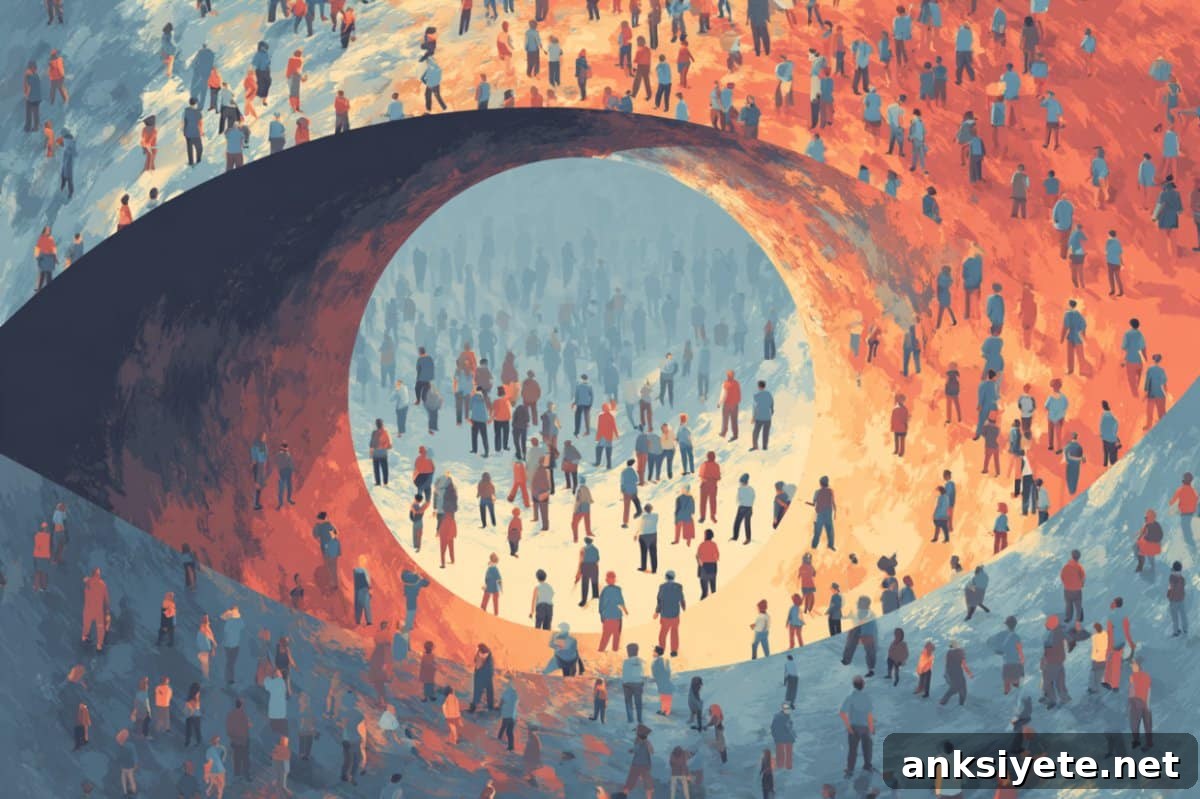
Summary: A new study challenges the common belief that society is steadily becoming more polarized. It shows that people’s impressions of deep division often arise from the degree of agreement inside their own social circles. The researchers present a new approach that separates actual opinion divergence from how polarized people feel society is.
The analysis finds that tight agreement within one’s close network makes broader society appear more polarized, even when overall public opinion is relatively moderate. Recognizing these subjective “political lenses” can help reduce perceived polarization and improve democratic decision-making on shared challenges.
Key Facts:
- Subjective lenses: Strong agreement among friends, family, or in-group members can make the rest of society look more divided than it actually is.
- New analytic method: The team developed a framework to disentangle actual ideological differences from perceived polarization in survey data.
- Policy relevance: Misperceptions of division can hinder cooperation on pressing issues such as climate change, public health, and environmental protection.
Source: Complexity Science Hub
Are opinions on controversial issues as divided as many people think?
Researchers at the Complexity Science Hub (CSH), the Leibniz Centre for Tropical Marine Research (ZMT) in Bremen, and the University of California Merced examined this question in a study published in PNAS Nexus.
Public discourse often assumes that society is splitting into opposing camps on topics ranging from climate policy to immigration and public health. Prior studies that attempted to measure ideological polarization have produced mixed or contradictory results. To clarify these contradictions, Peter Steiglechner (CSH, formerly ZMT), Agostino Merico (ZMT), and Paul E. Smaldino (University of California Merced) investigated whether common perceptions of polarization reflect objective opinion divergence or subjective experience shaped by social identity.
“When we consider contentious political questions, we typically notice that people close to us—family, friends, or political allies—often share similar views,” says Peter Steiglechner, first author of the paper. “At the same time, we may feel that society as a whole is sharply divided. Our work tests whether that feeling always matches the underlying distribution of opinions.”
Separating Perception From Reality
Unlike earlier research that focused mainly on objective measures of opinion spread, this study proposes a formal framework that distinguishes actual ideological divergence from subjective perceptions. To make the method intuitive, the authors use the metaphor of a political “lens”: a mental filter shaped by the range of opinions encountered within one’s in-group.
If the opinions inside an individual’s circle cover a broad range, the lens is “thicker” and the wider society appears less divided. Conversely, a “thinner” lens—created when an in-group is highly homogeneous—makes other positions seem farther away and heightens the perception of polarization.
How In-Group Consensus Skews Perception
The study demonstrates that perceived polarization depends not only on how opinions differ across society, but also on how much variance exists inside identity groups. As in-group variance decreases and members grow more alike, people inside that group view dissenting opinions as more distant. That shift in perception can create an impression of growing polarization that may not be mirrored by objective measures.
“Put simply, the more uniform my immediate network’s views are on a topic like climate change, the more polarized society may seem to me—even if the population at large is not becoming more extreme,” explains Agostino Merico.
Because in-group dynamics evolve differently across political or social groups, perceptions of polarization can vary widely across segments of the population. “People may disagree about how divided society is, and even about which issues are divisive,” adds Steiglechner.
Implications for Democracy and Policy
The authors argue that their framework advances the way we assess polarization by incorporating asymmetric, identity-driven perceptions. This matters because perceived polarization influences public debate and policymaking. When citizens and policymakers believe society is deeply split, it can undermine cooperation and slow collective responses to major problems such as climate change, food security, or public health crises.
“To understand rising social tensions and political instability, we must study both objective opinion distributions and the psychological lenses that shape subjective experience,” says Paul Smaldino, co-author of the study. “Changing perceptions—by exposing people to a wider range of views within and beyond their networks—could be a key strategy for reducing the sense of polarization.”
Funding: The research received funding from the German Research Foundation as part of the priority programme ‘Sea Level and Society.’
About this social neuroscience research news
Author: Eliza Muto
Source: Complexity Science Hub
Contact: Eliza Muto – Complexity Science Hub
Image: The image is credited to Neuroscience News
Original Research: Open access.
“How opinion variation among in-groups can skew perceptions of ideological polarization” by Agostino Merico et al. PNAS Nexus
Abstract
How opinion variation among in-groups can skew perceptions of ideological polarization
Many people perceive society as increasingly polarized, but empirical studies measuring ideological divergence have produced mixed results. This paper offers a formal framework that accounts for how social identities shape subjective perceptions of polarization.
The authors show that when members of an in-group become more homogeneous on a topic (that is, when variance within the group declines), they tend to see dissenting opinions as more distant. As a result, these individuals may report greater perceived polarization than an impartial observer would detect.
Applying the framework to survey data on German attitudes toward climate change, the study finds that perceived polarization can depend as much on changes in in-group variance as on actual opinion divergence across society. The direction and strength of this effect can shift over time and differ between partisan groups.
This approach explains why people sometimes report higher levels of ideological polarization than surveys indicate, independently of social segregation, cognitive biases that reinforce polarization, or affective attitudes toward out-groups.