How a Single Gene Mutation Drives Complex Pain

featured 71992

Summary: Researchers emphasize the need to examine individual, social, and environmental influences to better understand disparities in treatment and the lived experience of sickle cell disease. Source: Wiley One understated change in a single gene, inherited from both parents, causes lifelong anemia and recurrent pain for an estimated 20 million people worldwide, most of whom … Read more


41% of Teens Can’t Spot Online Health Misinformation

featured 85834

Summary: A new study reports that 41% of teenagers struggle to distinguish between real and fake health-related news. Source: Frontiers New research shows that many teenagers find it difficult to distinguish between accurate and misleading health messages online. In the study, only 48% of participants judged accurate, neutrally worded health messages to be more trustworthy … Read more

OpenScope Project Uncovers New Insights into Brain Function

featured 103666

Summary: The OpenScope program is investigating neural activity through four new projects that examine psilocybin’s effects, motion perception, visual texture recognition, and how the brain registers subtle changes in appearance. Using state-of-the-art imaging and recording techniques in mice, researchers will map how neurons and neural circuits support these complex functions. OpenScope provides open, global access … Read more

Frequent Sex Linked to Better Cognitive Function in Older Adults

featured 41721

Summary: A recent study found that older adults who engage in sexual activity more frequently tend to score higher on certain cognitive tests. Source: Coventry University. Frequent sexual activity is associated with better performance on specific cognitive tests in older adults, according to research by Coventry and Oxford universities. In the study, researchers observed that … Read more

New Study Challenges Long-Held Theories About Hearing

featured 86626

Summary: New research challenges long-standing ideas about how we perceive sound. The study shows that many sensory cells in the inner ear respond together to low-frequency sounds, providing the brain with simultaneous input that may make low-frequency perception more reliable and robust. Source: Linköping University Researchers at Linköping University in Sweden, together with collaborators at … Read more

High Cognitive Scores Linked to Increased Risk of Depression Relapse

featured 116707

Summary: “Brain fog”—the memory lapses and difficulty concentrating reported by up to 90% of people with major depressive disorder—has long been viewed as a possible early warning sign of relapse. A large new study challenges that assumption and reveals a surprising, more complex relationship between cognition and future depression risk. Tracking nearly 1,800 participants, researchers … Read more

How the Brain Communicates Across Multiple Channels

featured 27351

The human brain employs distinct frequency bands to route information between lower and higher cortical areas. In the visual system, the cortex receives and processes visual input and relays it from lower to higher regions. Information also travels in the reverse direction: higher areas send signals to lower areas to guide perception and attention. How … Read more

Neuroimaging: How Ideology Shapes Racial Perception

featured 72159

Summary: Researchers identify how activity in the anterior insula contributes to the way political ideology shapes perception of race. Source: Cornell University How does political belief shape the way people perceive race? Previous work by Amy Krosch, an assistant professor of psychology in the College of Arts and Sciences, showed that White people who identify … Read more

Psilocybin May Relieve Depression Without a Psychedelic Trip

featured 73242

Summary: A new mouse study challenges the widely held belief that psilocybin’s antidepressant effects depend on its psychedelic experience. Blocking the receptor responsible for hallucinations did not prevent psilocybin from restoring reward-seeking behavior in stressed mice. Source: University of Maryland Researchers at the University of Maryland School of Medicine (UMSOM) report that psilocybin—the active compound … Read more

Ion Channel Marks Newborn vs Mature Neurons in Adult Brain

featured 50802

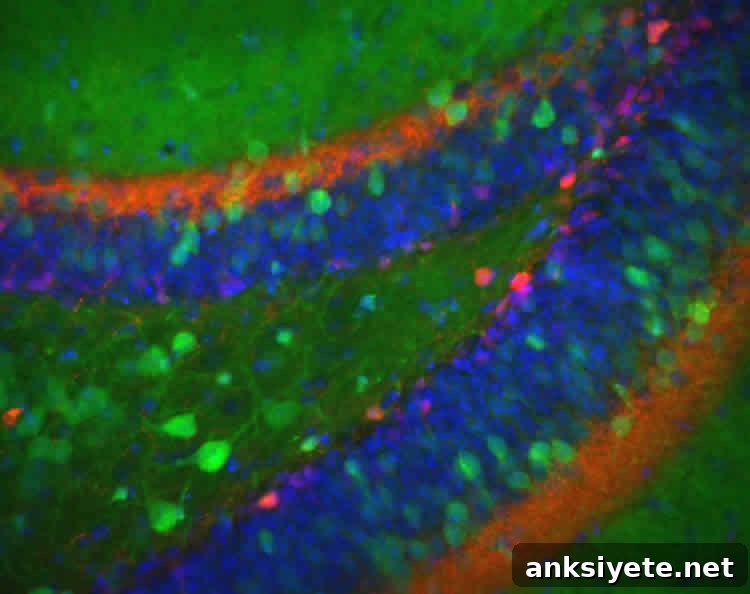
Summary: New research from the University of Alabama at Birmingham shows that newborn granule cells in the dentate gyrus become less excitable after roughly three weeks, a change that is essential for the low excitability characteristic of mature neurons. Source: UAB The dentate gyrus, a region of the hippocampus involved in memory formation, is one … Read more