
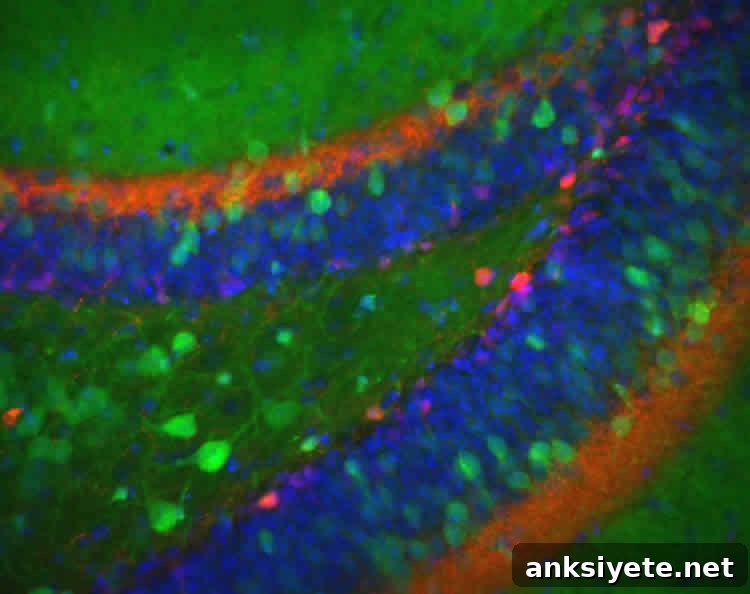
Summary: New research from the University of Alabama at Birmingham shows that newborn granule cells in the dentate gyrus become less excitable after roughly three weeks, a change that is essential for the low excitability characteristic of mature neurons.
Source: UAB
The dentate gyrus, a region of the hippocampus involved in memory formation, is one of only two brain areas in the adult mammal where new neurons continue to be generated.
The dentate gyrus sits within a hippocampal circuit that receives processed sensory and spatial information from the cortex. By integrating these inputs, the dentate gyrus helps create distinct representations of experiences, a process important for forming and separating memories.
Central to the dentate gyrus’s computational role is sparse neural activity: only a small fraction of granule cells fire at any given time. This sparsity depends on powerful inhibitory networks and intrinsically low excitability of the principal neurons, the dentate granule cells. Paradoxically, young, adult-born granule cells are highly excitable during early development, and this high excitability declines as cells mature. Until now, the molecular and cellular mechanisms that reduce excitability during granule cell maturation were not well understood.
Researchers at UAB, led by Linda Overstreet-Wadiche, Ph.D., and Jacques Wadiche, Ph.D., have identified key roles for G protein–mediated signaling and the late maturation of a specific potassium channel in shaping granule cell excitability. Their findings are reported in the Journal of Neuroscience. The study’s first author is Jose Carlos Gonzalez, Ph.D., a postdoctoral fellow in the Overstreet-Wadiche laboratory.
G proteins act as intracellular molecular switches that translate signals from cell-surface receptors into changes in cellular activity. Ion channels in the neuronal membrane control the flow of ions and thereby set the electrical properties of the cell. The UAB team found that intact G protein signaling is necessary to maintain the low intrinsic excitability of mature dentate granule cells. A particular potassium channel, the G protein–activated inward rectifier potassium channel (GIRK), is constitutively active in mature granule cells and contributes to their reduced excitability by lowering the resting membrane potential and affecting other electrophysiological properties.
Newborn granule cells, approximately 10–12 days old, lack functional GIRK channel activity. Around three weeks of age, functional GIRK channels begin to appear in these maturing neurons, and GIRK activity becomes coupled to G protein signaling via the GABAB receptor. GABA (gamma-aminobutyric acid) is the primary inhibitory neurotransmitter in the brain: when inhibitory neurons release GABA, it binds to receptors on target neurons and reduces their activity.
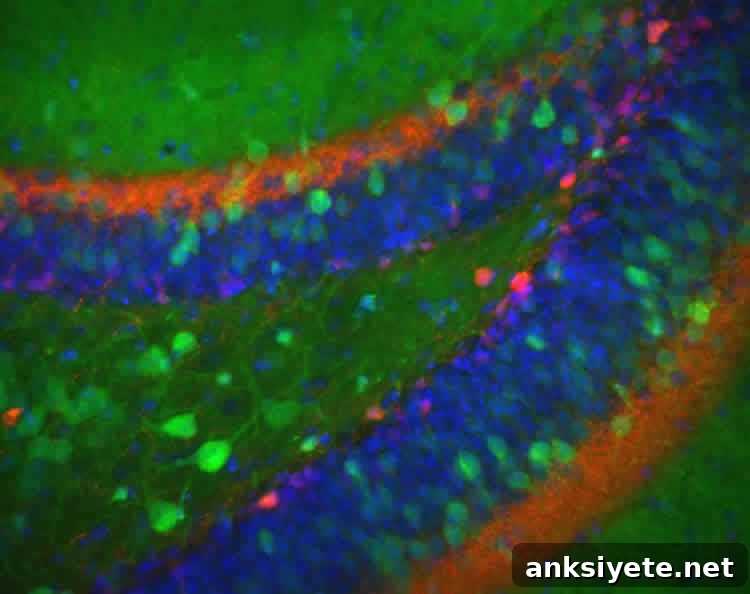
The study demonstrates two complementary mechanisms by which GIRK channels lower excitability in mature dentate granule cells. First, constitutive (ongoing) GIRK activity produces a more negative resting membrane potential and reduces the cell’s intrinsic responsiveness to depolarizing input. Second, phasic (synaptic) activation of GIRK channels provides additional inhibition: GABA released at somatodendritic synapses activates GABAB receptors on granule cells, which in turn recruit G protein signaling to open GIRK channels and transiently suppress excitability.
To determine which classes of inhibitory interneurons drive this phasic GABAB receptor–GIRK inhibition, the investigators examined inputs from three well-known interneuron subtypes, identified by marker expression. They found that nNOS-expressing interneurons are the principal source of phasic GABAB/GIRK inhibition onto granule cells. Somatostatin (SST)-expressing interneurons contributed a smaller amount of inhibition, while parvalbumin (PV)-expressing interneurons did not produce detectable GABAB/GIRK-mediated inhibition in this context.
These findings clarify how a specific signaling pathway helps enforce the dentate gyrus’s low excitability and sparse activity patterns. According to the authors, this mechanism not only supports normal cognitive functions such as pattern separation, but it also helps limit excessive activity that could lead to seizures. The identification of a late-developing GIRK-mediated brake on excitability explains a longstanding question about why dentate granule cells maintain a more negative resting membrane potential than many other neuron types.
Study title: “Constitutive and Synaptic Activation of GIRK Channels Differentiates Mature and Newborn Dentate Granule Cells.” Authors: Jose Carlos Gonzalez (first author), S. Alisha Epps, Sean J. Markwardt, Jacques I. Wadiche and Linda Overstreet-Wadiche. The research was conducted in the UAB Department of Neurobiology.
Co-authors include Sean J. Markwardt and S. Alisha Epps. Markwardt is currently employed outside academia and Epps holds an academic appointment. Support for the work was provided by National Institutes of Health grants NS064025, NS065920 and NS075162.
Funding: National Institutes of Health grants NS064025, NS065920 and NS075162.
Abstract (concise summary)
This study shows that intact G protein–mediated signaling and activity of G protein–activated inward rectifier potassium channels (GIRKs) are major determinants of the low intrinsic excitability that distinguishes mature dentate granule cells from younger, adult-born neurons. In mature granule cells, constitutive GIRK activity and GABAB receptor–linked GIRK signaling reduce resting membrane potential and intrinsic excitability. Newborn adult-born granule cells initially lack functional GIRK channels; both constitutive and phasic GABAB/GIRK signaling emerge after several weeks of maturation. Phasic GABAB/GIRK activation arises primarily from nNOS-expressing interneurons, with lesser input from SST-expressing interneurons and negligible contribution from PV-expressing interneurons. These findings indicate that maturation of GIRK channel activity converts early developmental GABAB receptor signaling into mature inhibitory control that helps enforce sparse dentate gyrus activity.
Significance statement
By revealing how constitutive and synaptic GIRK channel activity establishes the low resting membrane potential and input resistance of mature dentate granule cells, this work identifies a key mechanism that contributes to the sparse activity necessary for dentate gyrus computations, including pattern separation. The delayed maturation of GIRK-mediated inhibition in adult-born neurons highlights a developmental window during which excitability is higher, and shows how GABAB/GIRK signaling eventually becomes an important brake on granule cell firing.