
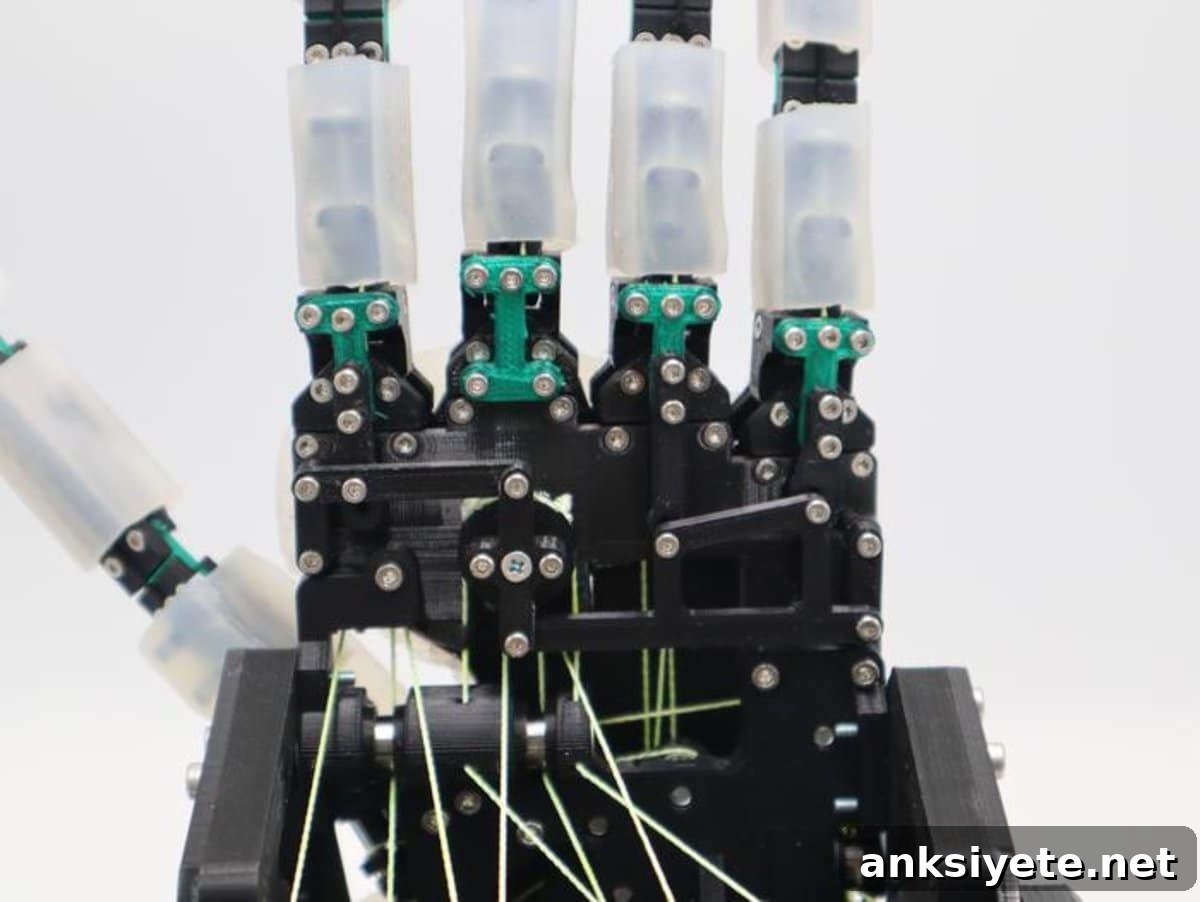
Summary: A new study from EPFL demonstrates how a soft, compliant robotic hand—built from silicone skin, springs, and flexible joints—can self-organize reliable grasps without detailed environmental sensing or elaborate control software. The ADAPT hand (Adaptive Dexterous Anthropomorphic Programmable sTiffness) successfully picked up 24 different objects with a 93% success rate using only four programmed motions. Its mechanical compliance allowed the hand to adapt naturally to diverse shapes and sizes, producing human-like grasps in many cases.
Traditional rigid robot hands need precise position data and tight control loops to grasp objects. By contrast, the ADAPT hand relies on distributed mechanical intelligence: compliant skin, tunable springs, and flexible joints that passively absorb uncertainty and reshape contact interactions. This approach reduces dependence on complex sensing and control, while still producing robust, repeatable grasps across a wide range of objects.
“When a person reaches for a bottle, they usually don’t need exact measurements or perfect vision to grasp it,” explains Kai Junge from EPFL’s Computational Robot Design & Fabrication (CREATE) Lab. “Human hands exploit compliance at the skin, muscles, and joints to tolerate uncertainty. Our goal was to transfer that distributed mechanical intelligence to a robotic hand.”
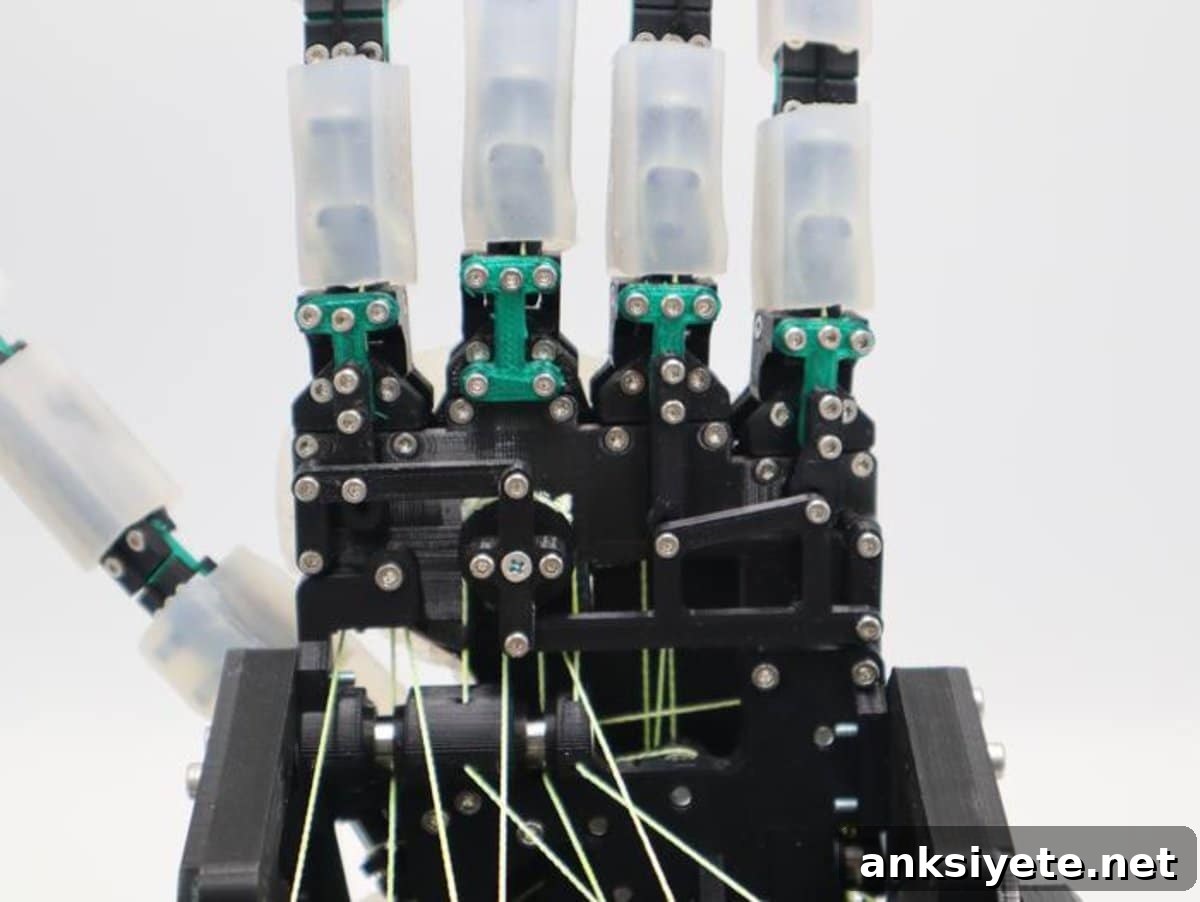
The ADAPT hand uses relatively simple compliant elements: silicone strips wrapped around fingers and wrist, spring-loaded joints whose stiffness can be adjusted, and a bendable arm. Instead of actuating every joint separately, the design concentrates 12 motors in the wrist to drive 20 joints; the remainder of the motion and adaptation arises passively from the soft materials and springs. This distributed compliance enables ‘self-organized’ grasps that emerge automatically as the hand interacts with an object.
In controlled experiments, the ADAPT hand executed automated pick-and-place trials and achieved strong robustness. Across more than 300 analyzed grasps and a stress test exceeding 800 grasps, the compliant design consistently outperformed an equivalent rigid configuration. In a focused test with 24 everyday items, the device achieved a 93% grasp success rate while producing grasps that were, on average, 68% similar to natural human grasps.
Key facts
- Self-organized grasping: 93% success rate on 24 varied objects using only four programmed motion waypoints.
- Distributed mechanical intelligence: Compliance in silicone skin, springs, and joints allows passive adaptation without continuous feedback.
- Simplified actuation: 12 motors located in the wrist drive 20 joints; springs and soft materials supply the rest of the mechanical behavior.
- Performance testing: Over 300 grasps analyzed and an 800+ grasp stress test show robust behavior compared with a rigid hand.
Open-loop control with passive adaptation
The ADAPT hand operates primarily in open-loop mode: it follows four general waypoints to approach and lift an object. Any fine adjustments needed to establish a stable grasp occur passively through the hand’s compliant elements rather than by adding sensor-driven corrections. This passive, bottom-up adaptation lets the hand cope with uncertain object positions and varied geometries—from a small bolt to a curved banana—without task-specific programming.
Combining compliance with sensing and AI
While the study’s intent was to quantify how much robustness compliance alone can provide, the team now plans to combine that mechanical resilience with closed-loop sensing and learning. Adding pressure sensors embedded in the silicone skin and integrating AI-based control will enable the ADAPT hand to retain its tolerance to uncertainty while gaining improved precision and responsiveness. Such a hybrid approach could make compliant robots safer and more effective in human-centered or unpredictable environments.
About this robotics research news
Author: Celia Luterbacher
Source: EPFL
Contact: Celia Luterbacher – EPFL
Image: The image is credited to CREATE Lab EPFL
Original Research: Open access. “Spatially distributed biomimetic compliance enables robust anthropomorphic robotic manipulation” by Kai Junge et al., published in Communications Engineering.
Abstract
Spatially distributed biomimetic compliance enables robust anthropomorphic robotic manipulation
Human dexterity arises from compliant interactions produced by skin, muscles, and the structural distribution of materials in the hand. Mimicking this spatially distributed compliance in an anthropomorphic robotic hand can substantially improve open-loop manipulation robustness and encourage human-like behaviors. The ADAPT hand contains configurable compliant elements on its skin, fingers, and wrist. After measuring the individual and combined effects of these compliant components versus a rigid baseline, the research team conducted automated pick-and-place experiments. Results show grasping robustness that approaches theoretical geometric limits and withstands extensive stress testing. The hand achieved a 93% success rate when grasping 24 diverse items in a constrained environment and demonstrated self-organizing, passive adaptation that produces a variety of grasp types, with a 68% similarity to natural human grasp patterns.