Genetic Causes of Cerebral Palsy Explained
featured 68540

Summary: Researchers have identified mutations in single genes that appear to explain some cases of cerebral palsy that are not the result of birth injury. Source: WUSTL Cerebral palsy has traditionally been attributed to factors such as in utero infection, premature birth or brain injury around the time of delivery—often linked to oxygen deprivation. Yet … Read more

New Study Reveals How to Thrive

featured 43295

Summary: Researchers conclude that thriving is driven by a personal sense of growth and the experience of mastering meaningful skills or goals. Source: University of Portsmouth. What it takes to thrive — not just survive — often comes down to feeling positive about life and yourself, and developing competence in something meaningful. Whether a teenager … Read more

Engineered Polymer Nanotube Network Mimics Neurons

featured 22919

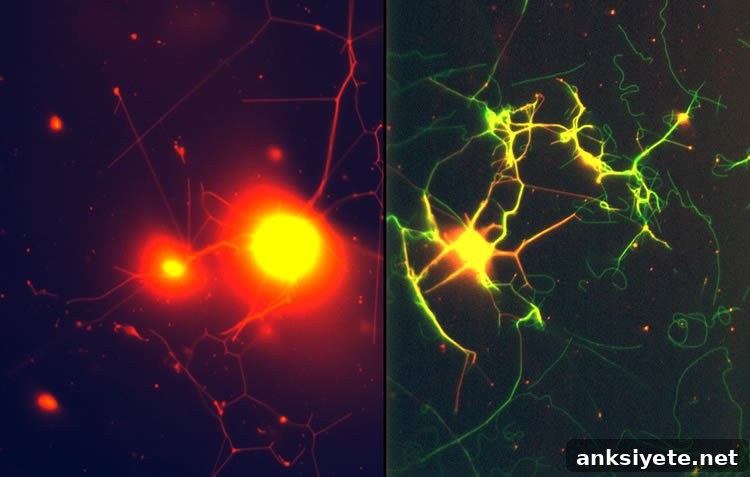
Crowdsurfing motor proteins create possible prosthetic interface. Researchers at Sandia National Laboratories have engineered interconnected networks of polymer nanotubes that mimic the branching architecture of a nerve, complete with many protruding filaments that could collect or transmit electrical signals. These lab-grown networks combine biologically driven motion with synthetic polymers, producing complex assemblies that conventional manufacturing … Read more

New Study Links Parkinson’s Disease to Neuroticism

featured 73306

Summary: New research shows that higher levels of the personality trait neuroticism are associated with a greater risk of developing Parkinson’s disease. Source: Florida State University Researchers at the Florida State University College of Medicine report that neuroticism — a personality trait marked by a tendency to experience negative emotions and stress — is consistently … Read more

Why Alcohol Makes You Hungry: The Science Behind the Munchies

featured 55316

Summary: New mouse research indicates a shared brain circuit may help explain why heavy alcohol use and intense cravings for high‑fat “junk” foods often occur together. Source: APS Researchers presenting at the American Physiological Society annual meeting report that overlapping neural circuitry could underlie both binge eating of high‑fat foods and binge alcohol consumption. Scientists … Read more

New MRI Technique Speeds Multiple Sclerosis Diagnosis

featured 27474

Researchers at the University of Nottingham and Nottingham University Hospitals NHS Trust have successfully tested a new way of using clinical MRI scanners to look for evidence of multiple sclerosis (MS) in the brain. Multiple sclerosis is a chronic neurological condition that affects roughly 100,000 people in the UK and presents with a wide range … Read more

Detect Parkinson’s Using Emotional Brain Responses

featured 107091

Summary: Researchers have achieved near-perfect accuracy in detecting Parkinson’s disease by analyzing brain responses to emotional images and videos using EEG recordings combined with artificial intelligence. The study shows that people with Parkinson’s process emotions differently—responding more to emotional intensity than to whether an emotion is pleasant or unpleasant—and have particular difficulty recognizing fear, disgust … Read more

How One Gene Shapes Human Brain Development

featured 13893

USP9X Gene Essential to Early Human Brain Development, University of Adelaide Study Finds New research from the University of Adelaide confirms that the gene USP9X, long linked to intellectual disability, plays a crucial role during the earliest stages of human brain development. Researchers at the University of Adelaide have studied USP9X for more than a … Read more

New Study Links Gene Mutation to Increased Intelligence

featured 82605

Summary: A rare genetic mutation that causes blindness also appears linked to above-average cognitive performance, according to a new study. Source: University of Leipzig Synapses are the connection points where neurons communicate. Disruptions to this communication, for example through altered synaptic proteins, can impair neural signaling and lead to neurological disorders. Depending on the severity, … Read more

Study Links Altered Brain pH to Cognitive Disorders

featured 100909

Summary: An international collaboration of 131 researchers from 105 laboratories across seven countries reports that altered brain pH and elevated lactate are common features in many animal models of neuropsychiatric and neurodegenerative disorders. The large-scale study points to disrupted brain energy metabolism as a shared endophenotype across conditions including schizophrenia, autism spectrum disorders, bipolar disorder, … Read more