
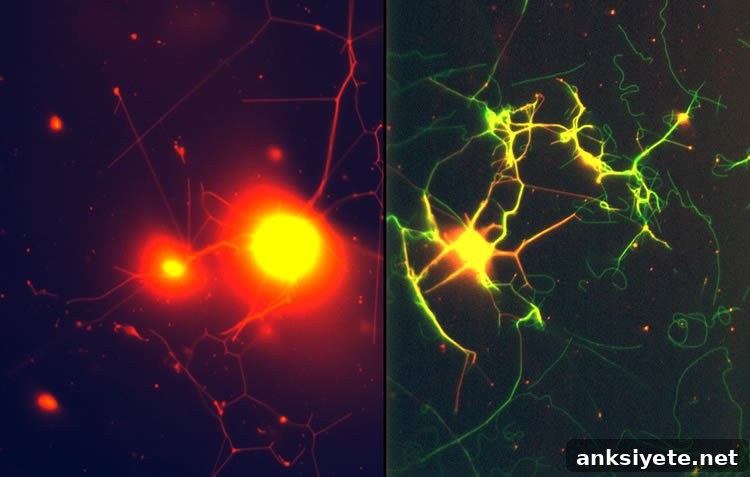
Crowdsurfing motor proteins create possible prosthetic interface.
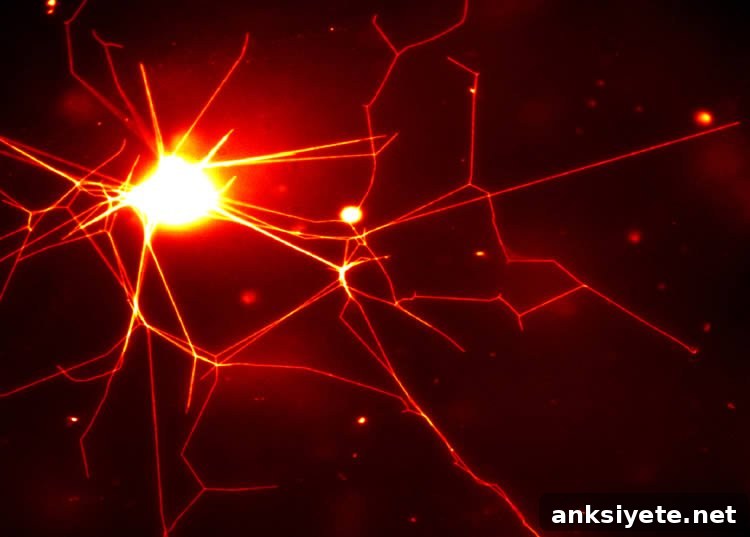
Researchers at Sandia National Laboratories have engineered interconnected networks of polymer nanotubes that mimic the branching architecture of a nerve, complete with many protruding filaments that could collect or transmit electrical signals. These lab-grown networks combine biologically driven motion with synthetic polymers, producing complex assemblies that conventional manufacturing cannot reproduce.
“This is the first demonstration of naturally occurring proteins assembling chemically created polymers into complex structures that modern machinery can’t duplicate,” said George Bachand of Sandia National Laboratories, highlighting the novelty of the approach.
Co-author Wally Paxton emphasized the long-term biomedical potential: “This is foundational science, but one possibility we see, way down the road, is to use soft artificial structures like these to painlessly interface with the body’s nerve structures.” Today’s prosthetic interfaces typically rely on rigid electrodes that can provoke inflammation when they penetrate nerve tissue. The polymer networks developed here could, in future applications, extend or bridge nerves and provide a far gentler, softer interface between tissue and prosthetic devices.
Proteins like Disney’s enchanted brooms
Their method begins by changing how kinesin motor proteins behave. Kinesin are tiny, naturally occurring molecular motors found in every human cell; they ferry cellular cargo along protein tracks called microtubules. To illustrate their persistence, the researchers compare kinesin to the enchanted brooms in Disney’s Fantasia, which tirelessly carry buckets up and down stairs.
In the lab, the team immobilized the “shoulder” region of kinesin proteins onto a glass surface so their bodies could not move, while their “legs” remained free to walk. These anchored motors then propelled microtubules across the surface, effectively carrying the filaments along like an audience crowdsurfing a performer on outstretched hands.
When these moving microtubules encounter large polymer microspheres introduced into the system, a mechanical interaction begins. The microtubules are pre-coated with an adhesive, and as they move past the spheres, they extract thin polymer nanotubes from the sphere surface. Those nanotubes lengthen as the kinesin motors continue to pull, an action the researchers liken to strands of melted cheese stretching as a slice of pizza is pulled away from a pan.
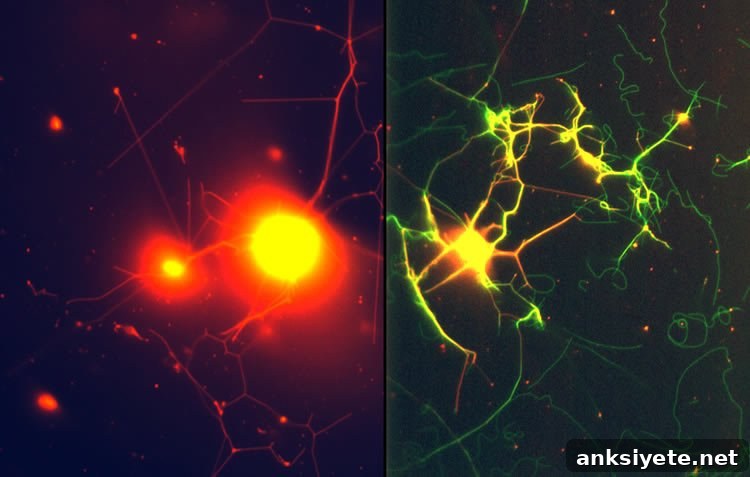
As the polymer nanotubes grow and crosslink, they assemble into large, highly branched networks that visually resemble a city’s lights seen from high above. Network sizes range from several hundred micrometers up to tens of millimeters, and individual tubes measure on the order of 30 to 50 nanometers in diameter. The motor-driven assembly is dynamic and robust: polymer networks formed in this way persisted for more than 24 hours after assembly, substantially longer than comparable lipid-based networks.
“One goal of our work is to make an artificial, highly branched neural structure,” Bachand explained. “The next step is, can we wire them together? The answer is, the motors should do it naturally. And two such networks, joined together, would have self-healing built into them. The motors never stop running until they run out of fuel. A neural branch breaks, and then a motor can act on that area to produce a new branch.” This inherent activity suggests the networks could reorganize and repair themselves as long as motor proteins remain active.
The team also demonstrated that quantum dots can be incorporated into these polymer nanotube networks and remain stably attached. That stability indicates the possibility of transmitting information optically as well as electrically through the structures, expanding potential communication modalities for future neural interfaces or nanoscale devices.
Funding: The work was supported by the Department of Energy’s Office of Basic Energy Sciences and conducted in part at the Center for Integrated Nanotechnologies, an Office of Science user facility.
Source: Neal Singer, Sandia National Laboratories. Image credit: Sandia National Laboratories.
Original research: The work is reported in the paper “Dynamic assembly of polymer nanotube networks via kinesin powered microtubule filaments” by Walter F. Paxton, Nathan F. Bouxsein, Ian M. Henderson, Andrew Gomez, and George D. Bachand, published in the journal Nanoscale (published online April 24, 2015).
Abstract
Dynamic assembly of polymer nanotube networks via kinesin powered microtubule filaments
The study demonstrates that collections of kinesin nanomotors can actively extract and assemble nanotubes from polymer vesicles composed of poly(ethylene oxide-b-butadiene). The combined forces of multiple motors acting on a microtubule filament are sufficient to overcome the energy barrier needed to pull polymer nanotubes from these vesicles. Despite higher force requirements compared to extracting nanotubes from lipid vesicles, the motors successfully produced large-scale polymer networks that displayed increased robustness, persisting beyond 24 hours after assembly. The researchers found that transport of materials on polymer membranes is substantially different from that on lipid networks: polymer mobility within nanotubes is constrained by one-dimensional confinement, which reduces diffusivity and immobilizes adsorbed quantum dots, in contrast to the fluid transport seen on lipid tubules.
Feel free to share this Neuroscience News.