
Summary: A new noninvasive imaging approach combines acoustic imaging techniques and advanced inversion algorithms to map stiffness changes in the brain’s white and gray matter after head injury.
Source: Acoustical Society of America
Waveguide Elastography: Noninvasive Mapping of Brain Stiffness After Head Injury
Researchers are refining a noninvasive technique to measure mechanical stiffness along fibrous pathways in the brain. By revealing differences in stiffness within gray and white matter, this approach can provide new diagnostic insight into traumatic brain injury (TBI) and other pathologies.
At the 179th Meeting of the Acoustical Society of America, held virtually Dec. 7–10, Anthony J. Romano of the U.S. Naval Research Laboratory will present on waveguide elastography and its application to studying TBI. His session, titled “An overview of mixed-model inversion and its application to the study of traumatic brain injury,” is scheduled for Dec. 9 at noon Eastern U.S.
Romano adapted signal-processing and inversion techniques originally developed for antisubmarine acoustics and nondestructive evaluation to biomedical imaging. The result, waveguide elastography, integrates magnetic resonance elastography (MRE) and diffusion tensor imaging (DTI) with combined isotropic and anisotropic inversion algorithms to estimate mechanical properties along neural fiber pathways.
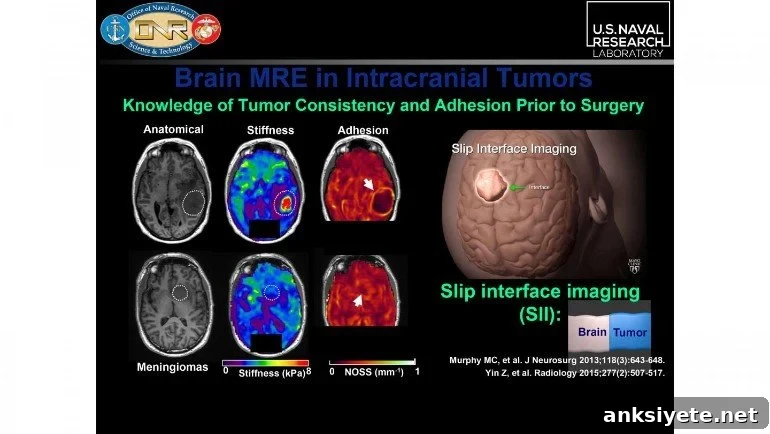
Magnetic resonance elastography measures elastic wave motion inside tissues by vibrating the skull and imaging the resulting displacement field. Those measured displacements reflect tissue response to the applied vibrations; using the equations of motion, investigators convert displacement and strain measurements into stiffness estimates. Because stiffness metrics are typically less sensitive to noise than raw displacement, stiffness maps derived from MRE can be a more robust diagnostic signal.
Diffusion tensor imaging maps the directional diffusion of water molecules and thereby reveals the orientation and integrity of fibrous structures such as myelinated axons in white matter. White matter’s aligned axonal bundles act like mechanical waveguides, allowing shear waves to propagate more readily along fiber directions than across them. In contrast, gray matter lacks a dominant fiber orientation and behaves more isotropically, exhibiting similar mechanical properties in all directions unless disrupted by an inclusion or lesion.
By combining DTI-derived fiber orientation with MRE displacement fields, waveguide elastography applies distinct inversion models to different tissue types: isotropic shear-wave inversion for gray matter and anisotropic (orthotropic) inversion along fiber axes for white matter. This mixed-model inversion framework estimates stiffness parameters that describe how the tissue resists deformation along and across fibers, offering a spatially resolved picture of mechanical properties linked to tissue microstructure.
“It was an ‘aha!’ moment when I realized I could use these imaging modalities with my inversion algorithms to evaluate both gray and white matter inside the brain,” Romano said. That insight led to applying submarine-acoustic analysis methods to biomedical elastography, where wave propagation and material inversion are central challenges.
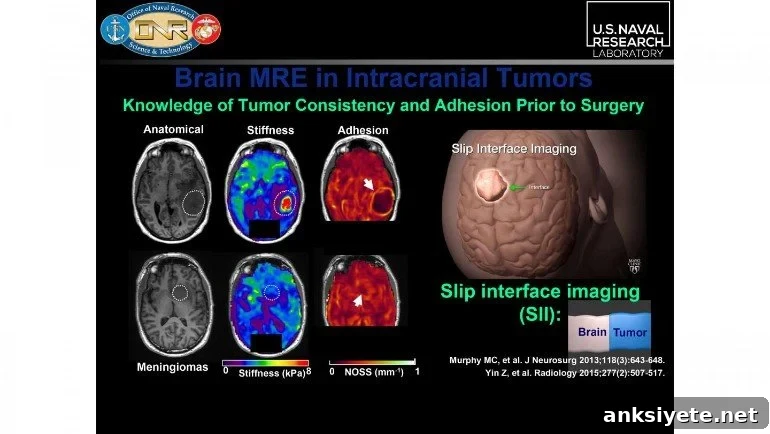
Romano and colleagues are applying waveguide elastography in an observational study of collegiate ice hockey players at the University of Delaware. The team scanned players before, during, and after the season and observed significant increases in measured stiffness as the season progressed. Those stiffness changes correlated with head impacts and concussive events experienced by players, suggesting that stiffness mapping can detect tissue changes associated with repeated head trauma.
The researchers emphasize that stiffness is a complementary metric to conventional imaging: it provides a mechanical perspective on tissue health that may reveal subtle changes not visible on anatomical scans. Because white matter transmits anisotropic shear waves along axons, assessing directional stiffness can help distinguish microstructural alterations in fiber tracts from isotropic changes in gray matter.
Waveguide elastography relies on robust inversion algorithms that respect the distinct mechanical behaviors of different brain tissues. In practice, this means assigning an isotropic shear-wave equation to gray matter regions and an orthotropic inversion model to white matter regions identified by DTI. The combined approach improves the physiological relevance of stiffness estimates and reduces the risk of misinterpreting wave motion that arises from fiber-guided propagation.
Beyond sport-related brain injury, this mixed-model imaging strategy has potential applications in monitoring neurodegenerative conditions, tracking recovery after injury, and improving our understanding of how mechanical properties of brain tissue change with disease or aging. Because the method is noninvasive and uses standard MRI hardware with specialized processing, it can be integrated into clinical and research workflows where MRE and DTI are available.
About this TBI research news
Source: Acoustical Society of America
Contact: Press Office – Acoustical Society of America
Image: Image credit: Anthony J. Romano
Original Research Presentation: Findings to be presented at the 179th Meeting of the Acoustical Society of America