
Imaging patients soon after traumatic brain injury (TBI) improves detection of cerebral microhemorrhages, a new study of military service members reports in Radiology.
Cerebral microhemorrhages—tiny areas of bleeding in the brain—occur directly after TBI and can contribute to serious secondary problems such as swelling, ischemia, or stroke. Detecting and tracking these microbleeds early can offer important information about injury severity, likely progression, and recovery potential.
Traumatic brain injury is common: the Centers for Disease Control and Prevention estimates about 1.7 million TBI cases occur annually in the United States. Among deployed military personnel, the Institute of Medicine has reported that roughly 20–23 percent of service members deployed to Afghanistan and Iraq sustained TBI during their service. This study focused on military patients because delays in imaging after injury are common in that population.
Dr. Gerard Riedy, M.D., Ph.D., chief of neuroimaging at the National Intrepid Center of Excellence at Walter Reed National Military Medical Center, notes that many service members were scanned months or even years after their injuries. Those delays reduced the likelihood of detecting cerebral microhemorrhages, which can interfere with timely diagnosis and treatment.
Study design and findings: The research team used susceptibility-weighted imaging (SWI), an MRI technique that enhances the visibility of blood products and is highly sensitive to hemorrhage, to evaluate 603 military service members with chronic TBI. The median time from injury to imaging in the cohort was 856 days. Overall, 7 percent of participants were found to have at least one cerebral microhemorrhage.
Participants were grouped by time since injury—from less than three months to more than a year. Detection rates varied sharply by imaging interval: 24 percent of those scanned within three months of injury showed microhemorrhages, compared with only 5.2 percent of those imaged more than one year after injury. The authors attribute this reduction to gradual changes in iron-containing breakdown products (such as hemosiderin) that alter the magnetic properties that SWI relies on, making older microbleeds progressively harder to identify.
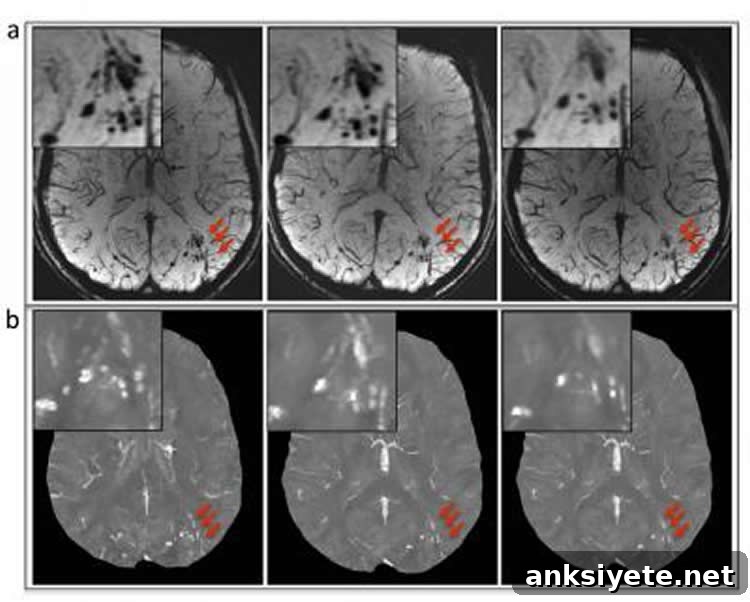
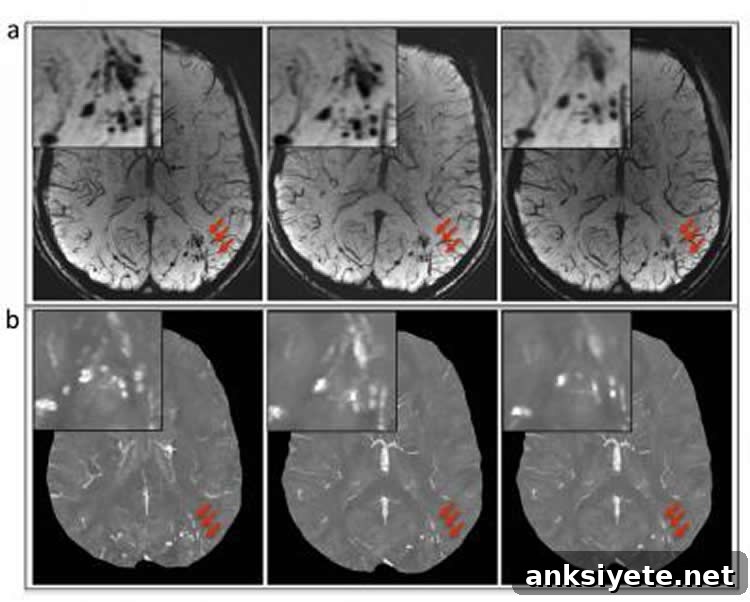
The study also compared SWI with conventional gradient-recalled-echo (GRE) MRI and found SWI to be substantially more sensitive. In this cohort, 77 percent of the microhemorrhages seen on SWI appeared more conspicuous than on conventional GRE images. Higher spatial resolution and stronger susceptibility contrast on SWI are likely responsible for that improvement, enabling clearer detection of small hemorrhagic foci.
Longitudinal monitoring in a subset of patients demonstrated measurable changes over time. Thirteen of the patients with microhemorrhages underwent follow-up imaging. Quantitative susceptibility mapping (QSM), which derives numerical measures of magnetic susceptibility from MRI data, showed a decrease in the number and magnetic signal of microhemorrhages at follow-up. Mean microhemorrhage counts fell from 13.7 ± 16.6 at baseline to 9.8 ± 12.8 at follow-up (P = .019). QSM-derived measurements also declined over time: total microhemorrhage volume decreased by an average of −0.85 mm3 per day ± 1.59 (P = .039), and mean magnetic susceptibility fell by −0.10 parts per billion per day ± 0.14 (P = .016). These findings suggest hemosiderin and other iron products undergo gradual evolution in the chronic stage, reducing the conspicuity of older microbleeds on susceptibility-sensitive MRI sequences.
Clinical implications: Early MRI with susceptibility-sensitive sequences can reveal microbleeding that may otherwise go undetected when imaging is delayed. Detecting cerebral microhemorrhages soon after TBI could help explain acute symptoms, better stratify injury severity, guide follow-up and rehabilitation strategies, and potentially influence acute management decisions. The authors emphasize that improved access to MRI—ideally including field-deployable or early post-injury imaging when feasible—would support earlier detection and more timely care for patients with TBI.
Funding: The research was funded by the Center for Neuroscience and Regenerative Medicine and by Congressionally Directed Medical Research Programs.
Source and image credit: Linda Brooks, Radiological Society of North America. Image credit: Radiological Society of North America.
Original research: “Imaging Cerebral Microhemorrhages in Military Service Members with Chronic Traumatic Brain Injury” by Wei Liu, Karl Soderlund, Justin S. Senseney, David Joy, Ping-Hong Yeh, John Ollinger, Elyssa B. Sham, Tian Liu, Yi Wang, Terrence R. Oakes, and Gerard Riedy. Published online September 15, 2015 in Radiology.
Abstract
Purpose: To detect cerebral microhemorrhages in military service members with chronic TBI using susceptibility-weighted MR imaging and to monitor microhemorrhage evolution with quantitative susceptibility mapping.
Materials and Methods: Institutional review board approval and HIPAA compliance were obtained. All participants received two-dimensional GRE MR imaging and three-dimensional multiecho flow-compensated GRE processed to produce SWI and QSM. Two radiologists independently identified microhemorrhages. A subset of patients underwent follow-up imaging, and comparisons of microhemorrhage number, size, and magnetic susceptibility between baseline and follow-up were made using paired statistical tests.
Results: Of 603 patients, 43 had cerebral microhemorrhages, with six excluded from further analysis for artifact. On SWI, 77 percent of detected microhemorrhages appeared more conspicuous than on conventional GRE. In 13 patients with follow-up imaging, QSM showed fewer microhemorrhages at follow-up than baseline (mean 9.8 ± 12.8 vs 13.7 ± 16.6; P = .019). QSM-derived measures decreased over time: total volume declined by −0.85 mm3 per day ± 1.59 (P = .039) and mean magnetic susceptibility decreased by −0.10 ppb per day ± 0.14 (P = .016).
Conclusion: The number of microhemorrhages and QSM-derived quantitative measures declined over time, indicating continued, subtle evolution of hemosiderin products in the chronic stage and underscoring the value of early susceptibility-weighted imaging for detecting microbleeds after TBI.