
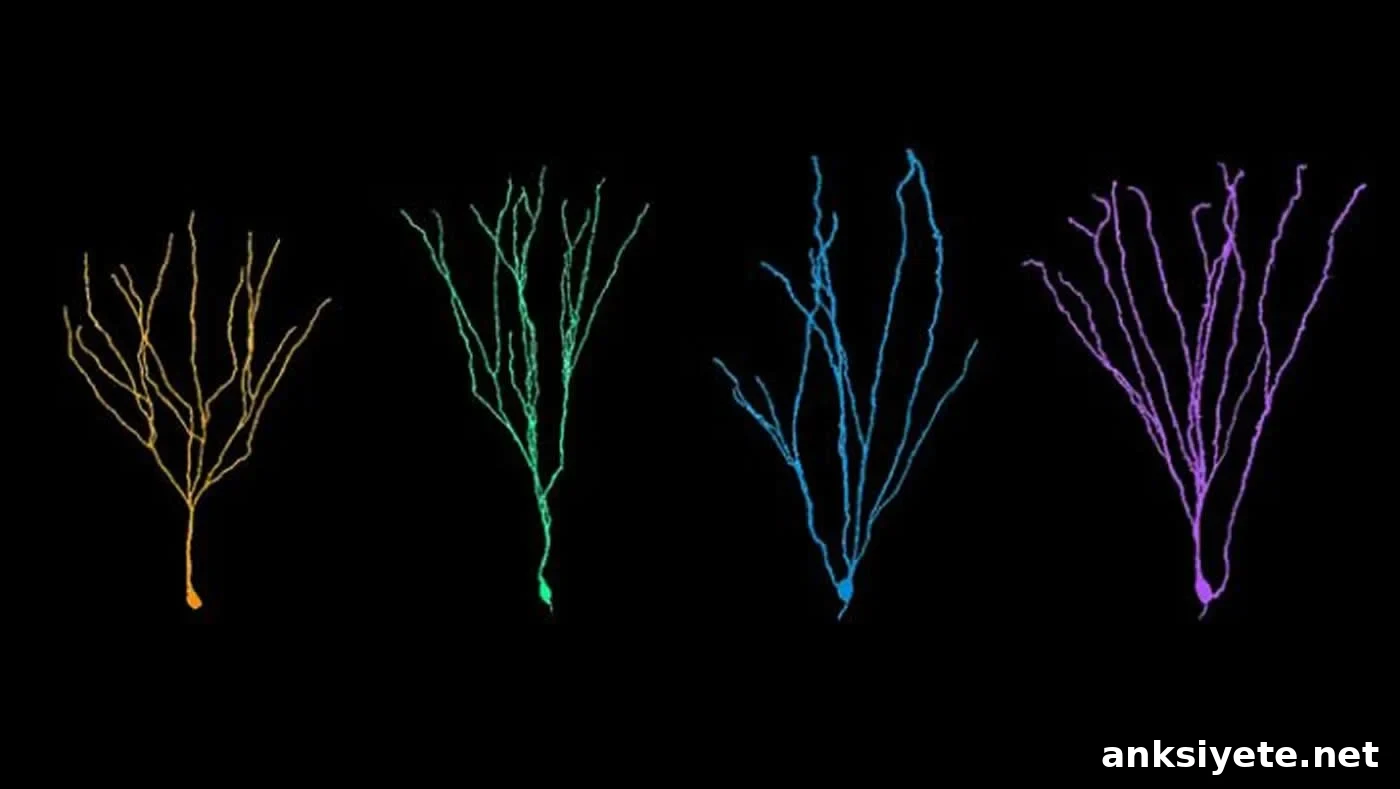
Summary: Neurons generated during adult neurogenesis in the dentate gyrus continue to grow and mature over many months, becoming larger and more complex than neurons born in infancy. These long-maturing adult-born neurons likely contribute disproportionately to hippocampal plasticity and may serve distinct functional roles throughout life.
Source: SfN
Adult-born neurons continue developing for months and sustain brain plasticity
New neurons produced in the adult dentate gyrus—a hippocampal region essential for distinguishing similar memories—do not simply reach maturity within a few weeks and then remain static. Research in rats published in Journal of Neuroscience shows that although adult-born neurons pass through the conventional early developmental stages, they undergo additional, prolonged growth that makes them morphologically distinct from neurons generated during infancy.
Using a retrovirus to label dividing cells, researchers tracked neurons born in the adult rat dentate gyrus at ages ranging from 2 to 24 weeks. The retroviral labeling made it possible to visualize the neurons born on the day of injection and follow their structural development over time. As expected, adult-born neurons progressed through a standard early developmental window: by roughly six weeks, they displayed many features associated with a relatively mature neuronal phenotype. However, at around seven weeks, investigators observed renewed growth activity—signs such as thicker dendrites and larger nuclei suggested the start of a second wave of maturation.
This later phase of development continued for months. By 24 weeks after birth, adult-born neurons had substantially more dendritic branches, higher spine density, enlarged presynaptic terminals (mossy fiber boutons), and additional putative contacts with inhibitory neurons compared with neonatally-born neurons of similar age. The presence of more mushroom spines and a second primary dendrite among older adult-born neurons indicates greater synaptic complexity and potentially more powerful synaptic influence within hippocampal circuits.
These anatomical differences imply that adult-born neurons may provide unique or amplified contributions to hippocampal processing, particularly to the dentate gyrus’s role in pattern separation and memory discrimination. Because adult-born cells continue to mature and change long after their initial formation, they represent a persistent source of cellular plasticity even as the overall rate of neurogenesis declines with age.
About this research
Publication: Journal of Neuroscience
Organization: SfN (Society for Neuroscience)
Media contact: Calli McMurray – SfN
Image credit: Cole, Espinueva et al., JNeurosci 2020
Original research
Title: “Adult-Born Hippocampal Neurons Undergo Extended Development and Are Morphologically Distinct From Neonatally-Born Neurons” by John Darby Cole, Delane Espinueva, Désirée R. Seib, Alyssa M. Ash, Matthew B. Cooke, Shaina P. Cahill, Timothy O’Leary, Sharon S. Kwan and Jason S. Snyder.
Access: Closed access
Abstract (rephrased)
Adult-born granule neurons in the hippocampus navigate early critical periods for survival and plasticity during immature stages. It has been commonly assumed that by about two months of age these neurons reach full maturity and become functionally equivalent to the broader dentate gyrus population. That assumption raises questions about how adult-born neurons might influence hippocampal function later in life when neurogenesis declines. To address this, the investigators labeled dividing cells with a retrovirus to reveal functionally relevant morphological features of adult-born neurons between 2 and 24 weeks post-birth in male rats.
The study confirmed that from 2 to 7 weeks post-mitosis neurons grow and attain many mature characteristics. Yet several morphological hallmarks at the 7-week point—larger nuclei, increased dendrite thickness, and more dendritic filopodia—predicted further development. Between 7 and 24 weeks, adult-born neurons continued to elaborate their dendritic arbor, acquired an additional primary dendrite, increased their density of mushroom spines, and developed larger mossy fiber presynaptic terminals. When compared directly to neonatally-born neurons, the older adult-born cells exhibited greater spine density, larger presynaptic structures, and more potential efferent filopodial contacts onto inhibitory neurons.
By modeling rates of cell birth and subsequent growth across the lifespan, the authors estimate that adult neurogenesis contributes roughly half of the dentate gyrus cells and the majority of its spines. Thus, the protracted development of adult-born neurons supplies an extended reserve of structural plasticity that persists even after cell production slows, and enduring differences from neonatally-born neurons may endow adult-born cells with distinctive functional roles once mature.
Significance statement (summarized)
Neurogenesis in the adult hippocampus supports memory and emotional processing. While immature adult-born neurons are often thought to be the most behaviorally relevant, the sharp decline in neurogenesis with age raises uncertainty about their role later in life. This study demonstrates that newborn neurons in rats mature over many months and end up with distinct structural features compared to neurons born in infancy. Extended growth means that adult-born neurons provide a lasting source of hippocampal plasticity, potentially shaping behavior and cognition well into older age.