
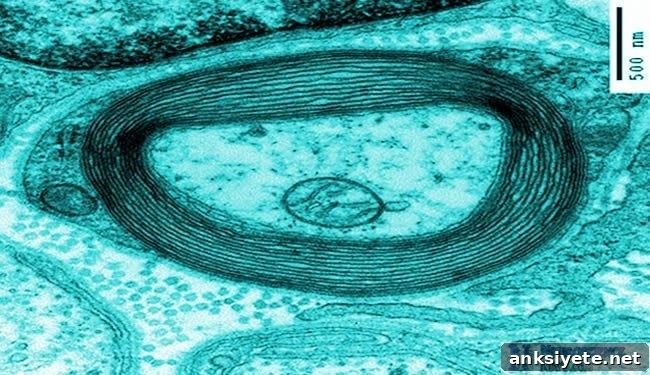
The Erk protein has been identified as a critical regulator of myelination in the peripheral nervous system. In a study from the University of North Carolina at Chapel Hill, researchers found that ERK signaling is essential for Schwann cells to form the insulating myelin sheath that enables rapid nerve impulse conduction between the brain and the limbs.
Using genetic techniques to remove the Erk gene specifically during peripheral nervous system development in mice, the team discovered that neurons themselves remained largely intact, while Schwann cells suffered severe developmental failure. These glial cells, which wrap axons with myelin, were profoundly impaired at multiple stages of their maturation when ERK signaling was absent.
Scientists link protein to the insulation of the nervous system’s wiring
This finding is particularly relevant because multiple neurodevelopmental disorders have been associated with mutations in the developmental cascade that includes ERK and related MAP kinase proteins.
The UNC investigators, reporting in the journal Neuron on Jan. 13, 2011, showed that ERK’s role in an intact, developing animal differs from insights previously obtained from in vitro experiments. Those cell-culture studies have offered important molecular detail, but the complexity of a growing organism – with neurons extending axons into developing limbs, Schwann cells maturing in concert, and dynamic biochemical signaling between cell types – cannot be fully reproduced in a Petri dish, the authors emphasize.
Close to 10,000 papers have explored the MAP kinase signaling cascade, and because this pathway is so intricate, selectively disabling key genes in a living animal has been technically challenging. By applying targeted genetic strategies, the researchers succeeded in knocking out Erk in the developing peripheral nervous system of mice, allowing them to observe the in vivo consequences.
Surprisingly, neurons in these mutant mice appeared relatively normal, but the Schwann cells were markedly affected. “These cells were just devastated at every stage of development,” said senior author William D. Snider, MD, professor of neurology and cell and molecular physiology and director of the UNC Neuroscience Center. The loss of ERK signaling disrupted the process by which Schwann cells wrap axons with myelin, which is essential for efficient electrical conduction along peripheral nerves.
Understanding how ERK and the broader MAP kinase pathway control myelination has direct implications for several human conditions. For example, neurofibromatosis, a genetic disorder in which Schwann cell growth is deregulated and tumors form along peripheral nerves, involves alterations in this signaling cascade. With nearly 30 mutations in the MAP kinase pathway now identified in connection with neurodevelopmental disorders, the study reinforces the urgent need to define the pathway’s functions in living tissues.
Lead author Jason M. Newbern, PhD, a postdoctoral research associate at the UNC School of Medicine, stressed that in vivo studies are essential to determine how ERK signaling shapes cell behavior during development. The team plans to extend their work to the central nervous system to assess how ERK loss affects brain development, since cognitive deficits in neurodevelopmental disorders are often linked to central rather than peripheral deficits. They also aim to create models that reproduce pathway overactivity, as occurs in diseases like neurofibromatosis, to better understand how excessive ERK signaling drives pathological changes.
Notes about the research
The research was supported by the National Institutes of Health and by a National Research Service Award to Dr. Newbern. Co-authors from Dr. Snider’s laboratory at UNC include Xiaoyan Li (research scientist), Sarah E. Shoemaker (postdoctoral research associate), Jiang Zhou (research scientist), Yaohong Wu (chief technician), Daniel Bonder (graduate student), and Steven Hollenback (technician). Additional co-authors include Dr. Jian Zhong from Cornell and Dr. Gary Landreth from Case Western Reserve University School of Medicine.
Contact: Les Lang University of North Carolina School of Medicine
Source: UNC School of Medicine News