
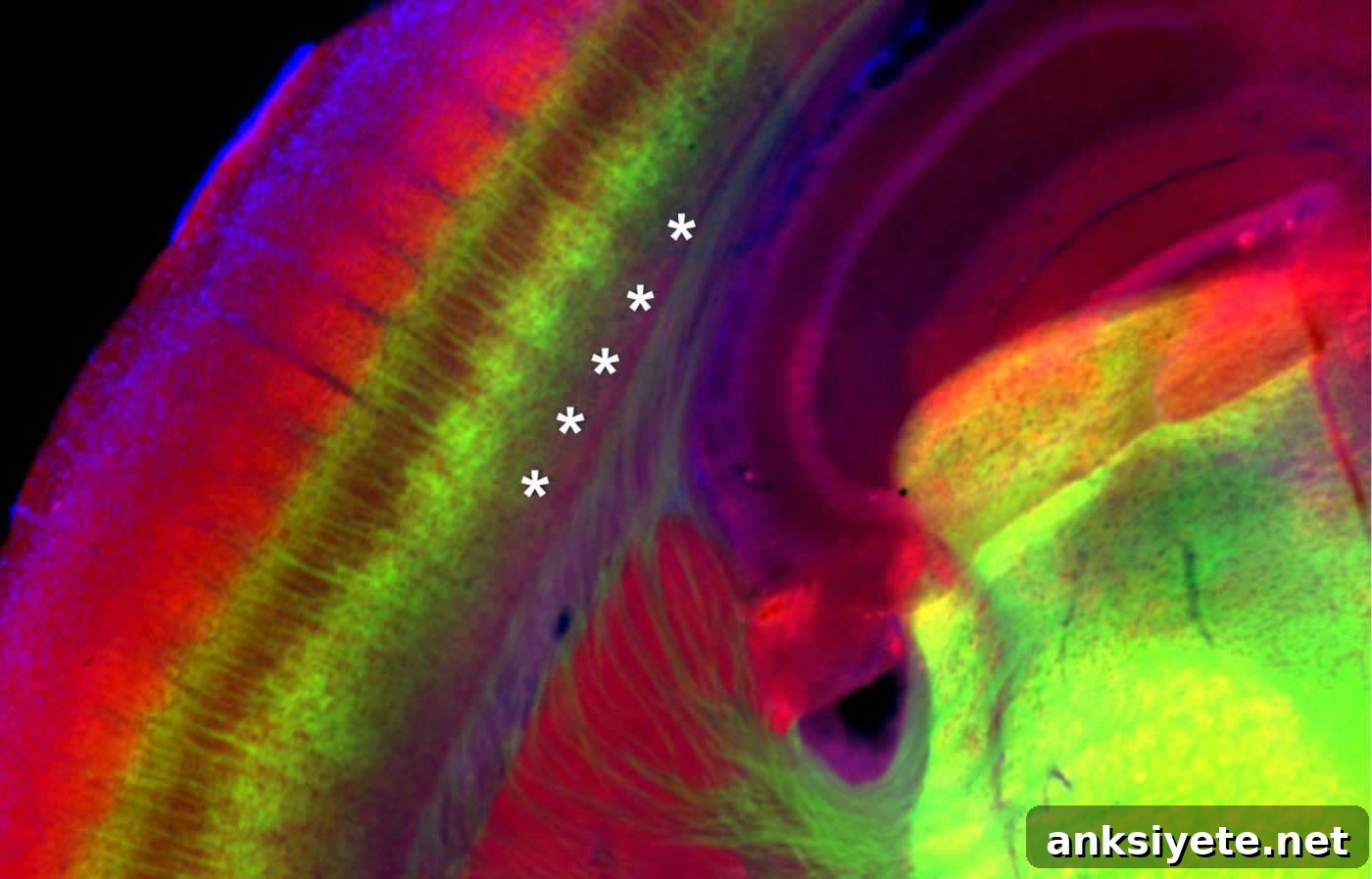
Summary: Researchers have identified a previously unrecognized set of barrel-like structures located two cortical layers deeper than the well-known whisker barrels.
Source: Brown University.
For nearly five decades, neuroscientists have relied on the mouse whisker-barrel system as an exemplary model for how sensory information is mapped and processed by the mammalian brain. A new study from Brown University reports a major refinement to that picture: researchers have discovered a matched set of barrel-like modules in layer 6 of the somatosensory cortex—two layers beneath the classical layer 4 whisker barrels—revealing additional structure in the circuits that link the cortex with the thalamus.
Although humans do not use whiskers, this discovery sheds light on a fundamental cortical-thalamic communication motif that applies broadly across mammals. Layer 4 barrels, identified in 1970, were long thought to be the principal cortical targets of somatosensory thalamic input. The newly described “infrabarrels” in layer 6 suggest the deepest cortical layer may have an unexpectedly organized and significant role in routing information to and from the thalamus.
“These infrabarrels may reveal a circuit architecture that was previously unappreciated,” said Barry Connors, professor of neuroscience at Brown and senior author of the study.
The research team, led by Shane Crandall (now an assistant professor at Michigan State University) and Connors, set out to characterize how layer 6 is organized and how it participates in cortical-thalamic signaling. Layer 6 is diverse and often enigmatic; neurons there send outputs back to the thalamus and also to other cortical areas. Understanding its substructure is therefore critical to understanding how the cortex selects and regulates sensory information.
“We focused on layer six, the deepest layer of neocortex,” Crandall said. “Our results reveal discrete neocortical circuit modules specialized for linking long-range inputs with specific outputs, providing a framework for the functional organization of this layer.”
A layered map of sensory processing
The appeal of the whisker-barrel system is its clarity: each whisker maps to a distinct pathway through the brainstem and thalamus to a single barrel in layer 4 of the somatosensory cortex. More generally, the somatosensory cortex contains topographic maps for sensory inputs across the body—for example, unique sets of neurons process touch from a fingertip versus the elbow. In addition to receiving thalamic inputs, the cortex sends substantial feedback to the thalamus, which likely helps regulate attention to incoming signals.
“The cortex is not just a passive recipient of thalamic signals; it constantly regulates what information is emphasized,” Connors explained.
Discovery of infrabarrels and their cell types
To reveal layer 6 organization, the investigators used genetically modified mice that express different fluorescent proteins in specific neuronal subtypes. By labeling corticothalamic (CT) neurons—layer 6 neurons that project back to the thalamus—they observed that these CT cells clustered into discrete, barrel-like units in layer 6 that align vertically beneath the classical layer 4 barrels. The researchers dubbed these structures “infrabarrels.”
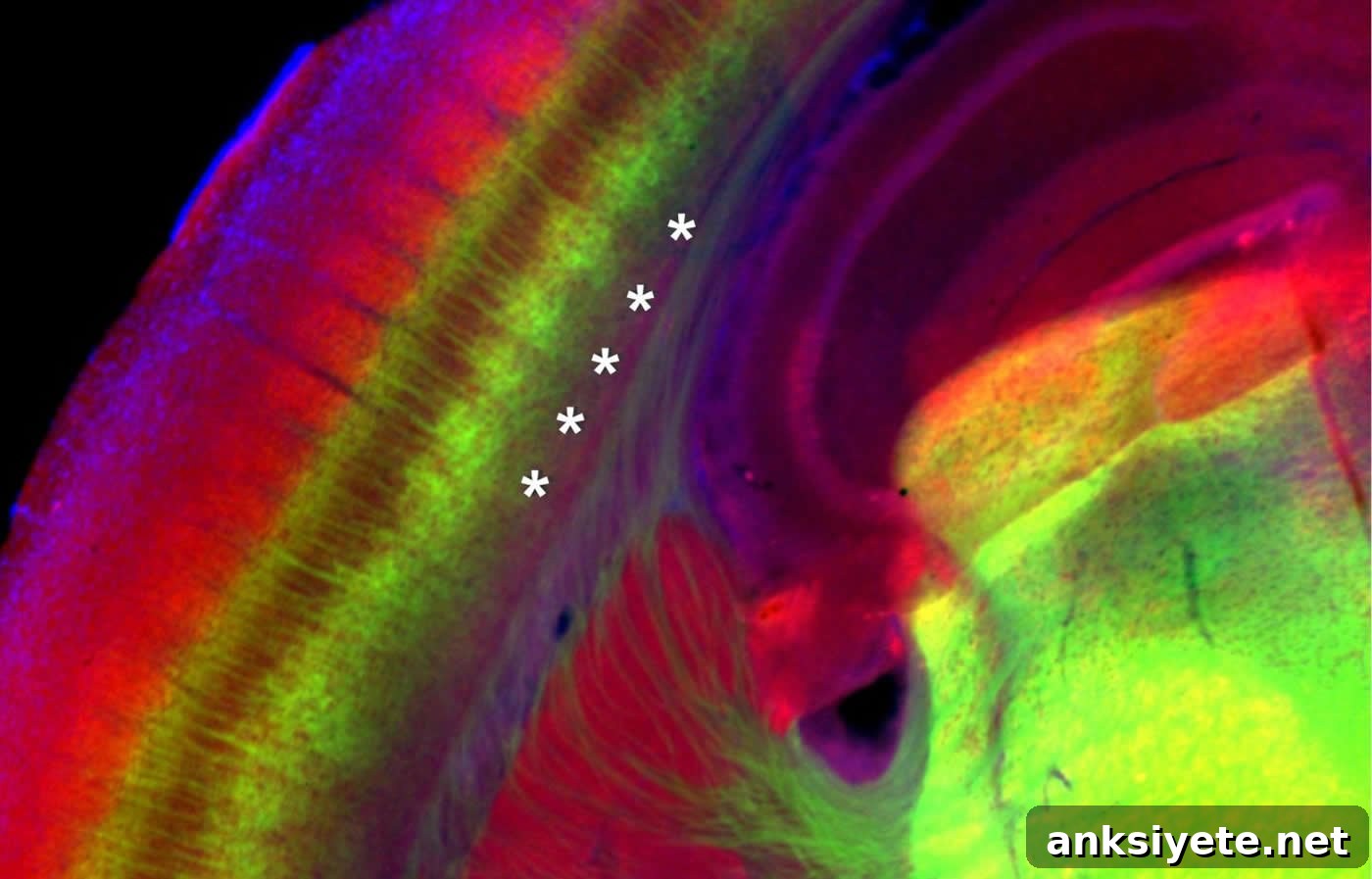
Using optogenetics—controlling defined neurons with light—the team probed how thalamic inputs engage different layer 6 neuron types. They found a notable division of labor: somatosensory thalamic inputs strongly excited corticocortical (CC) neurons that are concentrated between infrabarrels, while they produced much weaker excitation of the CT neurons clustered within infrabarrels. CC neurons interconnect cortical areas, whereas CT neurons send signals back to the thalamus.
These results indicate that layer 6 contains two partially segregated excitatory networks arranged by the infrabarrel pattern. One network (CT cells inside infrabarrels) appears positioned to route cortical output back to the thalamus, and the other (CC cells between infrabarrels) receives substantial direct thalamic input and likely distributes that input within the cortex.
Additional experiments revealed that CT neurons are intrinsically less excitable than neighboring CC neurons, suggesting that both synaptic inputs and intrinsic membrane properties shape how CT cells respond in vivo. Together, these synaptic and intrinsic mechanisms help explain the typically low firing rates observed in many corticothalamic neurons.
Implications and next questions
By revealing infrabarrels as discrete layer 6 circuit modules aligned with layer 4 barrels, the study expands the canonical view of columnar organization in the somatosensory cortex. The findings suggest that sensory information flows into the cortex via multiple, parallel channels and that layer 6 contributes to both distributing thalamic input within cortex and returning regulated feedback to the thalamus.
Future work will explore which cortical targets the thalamus-driven CC cells influence and how infrabarrel circuitry affects sensory processing, attention, and behavior.
The study’s authors are Shane R. Crandall, Saundra L. Patrick, Scott J. Cruikshank, and Barry W. Connors. Funding was provided by the National Institutes of Health (grants K99-NS096108, F32-NS084763, P20-GM103645, R01-NS050434, R01-NS100016) and the National Science Foundation (award 1632738).
Published research: “Infrabarrels Are Layer 6 Circuit Modules in the Barrel Cortex that Link Long-Range Inputs and Outputs,” Cell Reports, Crandall et al. Published online December 12, 2017. DOI: 10.1016/j.celrep.2017.11.049
Brown University. Discovery Deepens Understanding of Brain’s Sensory Circuitry. Neuroscience News. December 12, 2017.
Abstract
Infrabarrels Are Layer 6 Circuit Modules in the Barrel Cortex that Link Long-Range Inputs and Outputs
Highlights
• Layer 6a of the somatosensory cortex contains infrabarrel structures aligned with layer 4 barrels.
• Corticothalamic (CT) neurons cluster within infrabarrels while corticocortical (CC) neurons are densest between them.
• Somatosensory thalamic inputs selectively target CC cells more strongly than CT cells.
• Intrinsic and synaptic properties combine to regulate CT neuron responsiveness.
Summary
The rodent somatosensory cortex features well-defined columnar modules—barrel columns—centered on layer 4 barrels. Using cell-type-specific genetic labeling, the authors identified infrabarrels in layer 6 that align with layer 4 barrels. CT neurons and their axons cluster within infrabarrels; CC neurons are concentrated between them. Optogenetic mapping showed robust thalamic innervation of CC cells but weaker input to CT cells. CT neurons also exhibit lower intrinsic excitability, indicating that both input strength and cell-intrinsic properties contribute to their low firing rates observed in vivo. Overall, infrabarrels act as discrete cortical circuit modules linking long-range thalamic inputs with distinct cortical outputs.