
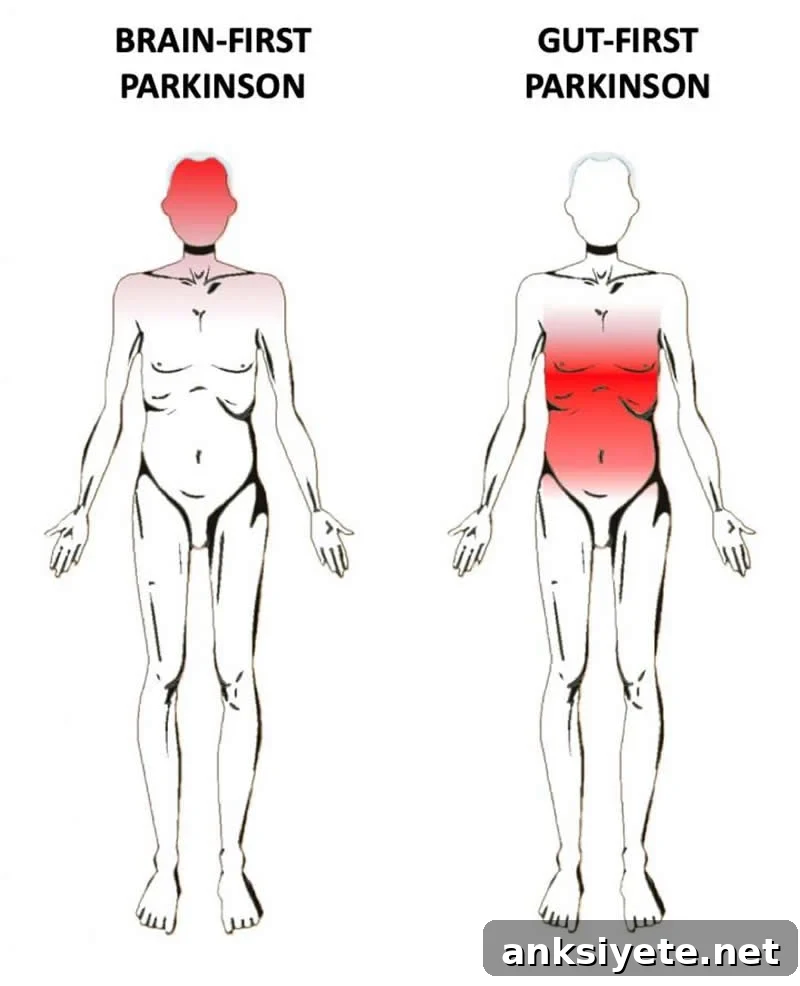
Summary: Research suggests Lewy body disorders—including Parkinson’s disease and dementia with Lewy bodies—may encompass two distinct subtypes. One appears to begin in the peripheral nervous system of the gut and travel to the brain; the other begins in the brain or enters through the olfactory system and then spreads to the brainstem and peripheral nervous system.
Source: IOS Press
Does Parkinson’s disease (PD) begin in the brain or in the gut? In a recent paper published in the Journal of Parkinson’s Disease, researchers propose that PD can be classified into two primary subtypes: a “gut-first” form that starts in the enteric or peripheral nervous system and spreads to the brain, and a “brain-first” form that originates in the brain (or enters via the olfactory system) and later involves the peripheral autonomic nervous system.
Per Borghammer, MD, PhD, DMSc, of Nuclear Medicine & PET at Aarhus University Hospital, Denmark, together with Nathalie Van Den Berge, MSc, PhD, of the Department of Clinical Medicine at Aarhus University, review evidence supporting two different pathways for disease onset. They argue that Lewy body disorders (LBD)—which include Parkinson’s disease (PD) and dementia with Lewy bodies (DLB)—likely contain at least two distinct phenotypes: (1) a gut-first phenotype in which prominent damage to the peripheral autonomic nervous system appears before measurable damage to brain structures such as dopaminergic neurons; and (2) a brain-first phenotype in which central nervous system pathology and nigrostriatal dopaminergic dysfunction are evident before the peripheral autonomic nervous system becomes involved.
“Some autopsy and pathological studies have suggested that PD pathology may begin in peripheral nerves of the gut or nose and then propagate into the brain via neural connections,” Dr. Borghammer explained. “However, other studies fail to find pathology at expected entry points, such as the dorsal motor nucleus of the vagus. Framing PD as having both gut-first and brain-first subtypes helps reconcile these differing observations into a unified theory about disease origins.”
Dr. Van Den Berge added, “The debate is often presented as a binary choice—either all PD starts in the gut or all starts in the brain. Yet the evidence supports both scenarios in different patients. We should therefore consider that both pathways may be valid and operate in distinct subgroups of patients.”
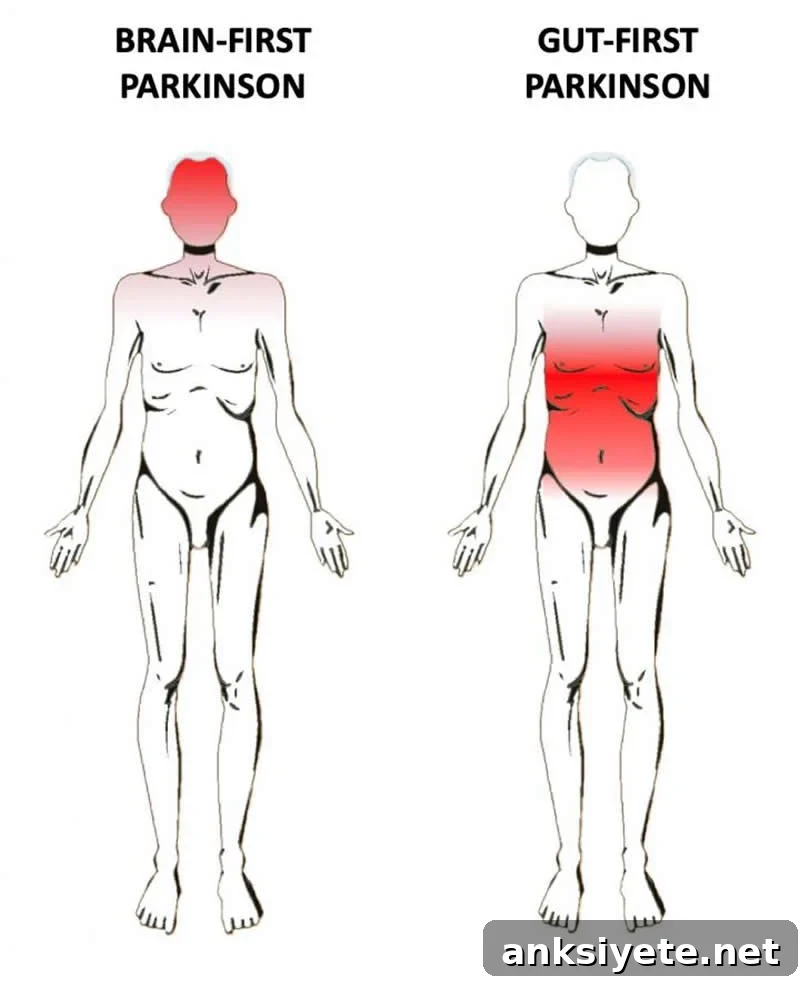
The review compiles evidence from human neuroimaging, histological studies, and animal models. Overall, imaging and tissue studies are largely consistent with the brain-first versus body-first framework. If confirmed, this distinction would mean PD is more complex and heterogeneous than previously appreciated. For example, therapies aimed at preventing or modifying gut-related pathology—such as probiotics, fecal microbiota transplantation, or anti-inflammatory gut-targeted treatments—might benefit patients whose disease is gut-first, but may have limited effect in individuals with a brain-first onset.
“If the brain-first vs body-first hypothesis is correct, we need to intensify research into the specific risk factors and triggers for these two subtypes,” noted Dr. Van Den Berge.
Dr. Borghammer emphasized the implications for precision medicine: “These subtypes are likely to require different prevention and treatment strategies. It may be possible to prevent gut-first cases by targeting the gut environment, whereas brain-first cases will need alternative approaches. Therefore, identifying subtype-specific biomarkers in individual patients is crucial.”
Parkinson’s disease is a progressive neurodegenerative disorder that impairs movement, balance, and muscle control. It is the second most common age-related neurodegenerative disease, affecting roughly three percent of people by age 65 and up to five percent of those older than 85. Historically, PD was viewed primarily as a disorder of the midbrain characterized by degeneration of pigmented dopaminergic neurons in the substantia nigra. More recent work, however, shows that PD varies widely between patients and likely comprises multiple biological subtypes with distinct clinical trajectories and underlying mechanisms.
Source:
IOS Press
Media Contacts:
Diana Murray – IOS Press
Image Source:
Image credit: Lundbeck Foundation.
Original Research (Open access):
“Brain-First versus Gut-First Parkinson’s Disease: A Hypothesis.” Per Borghammer and Nathalie Van Den Berge. Journal of Parkinson’s Disease. DOI: 10.3233/JPD-191721.
Abstract (summary)
Parkinson’s disease is a heterogeneous disorder likely composed of multiple subtypes. Pathological aggregation and spread of misfolded alpha-synuclein across neural networks are central to disease development. One hypothesis holds that alpha-synuclein pathology begins in the enteric or peripheral nervous system and reaches the central nervous system via retrograde transport along the vagus nerve. However, neuropathological findings are not uniform: some patients show no pathology in vagal entry points such as the dorsal motor nucleus. The authors propose dividing PD into two subtypes: a PNS-first (gut-first) subtype, often associated with REM sleep behavior disorder (RBD) during the prodromal phase and marked autonomic dysfunction before dopaminergic involvement; and a CNS-first (brain-first) subtype, typically RBD-negative early on and characterized by early nigrostriatal dopaminergic dysfunction before substantial autonomic involvement. Imaging and histological evidence reviewed in the paper support this framework and offer a hypothesis-generating model for future studies on PD etiopathogenesis.