
Your Brain Treats Other People’s Personal Space Almost Like Its Own
Summary: New behavioral research shows that people react to stimuli in another person’s peripersonal space as if those stimuli were approaching their own body.
Source: Kumamoto University
Overview: Peripersonal space (PPS) is the immediate zone surrounding a person’s body that the brain monitors closely when interacting with objects and other people. Recent neuroscientific studies in primates revealed that some neurons respond not only when something invades a subject’s own PPS but also when it infringes on another individual’s PPS. To investigate whether this “PPS remapping” affects human behavior, Dr. Wataru Teramoto of Kumamoto University conducted controlled experiments measuring how quickly people respond to visual and tactile signals when they are alone, standing near a partner, or presented with a lifelike artificial arm. The results indicate that people detect stimuli near a partner’s body as rapidly as they detect stimuli near their own body.
Experimental design and tasks
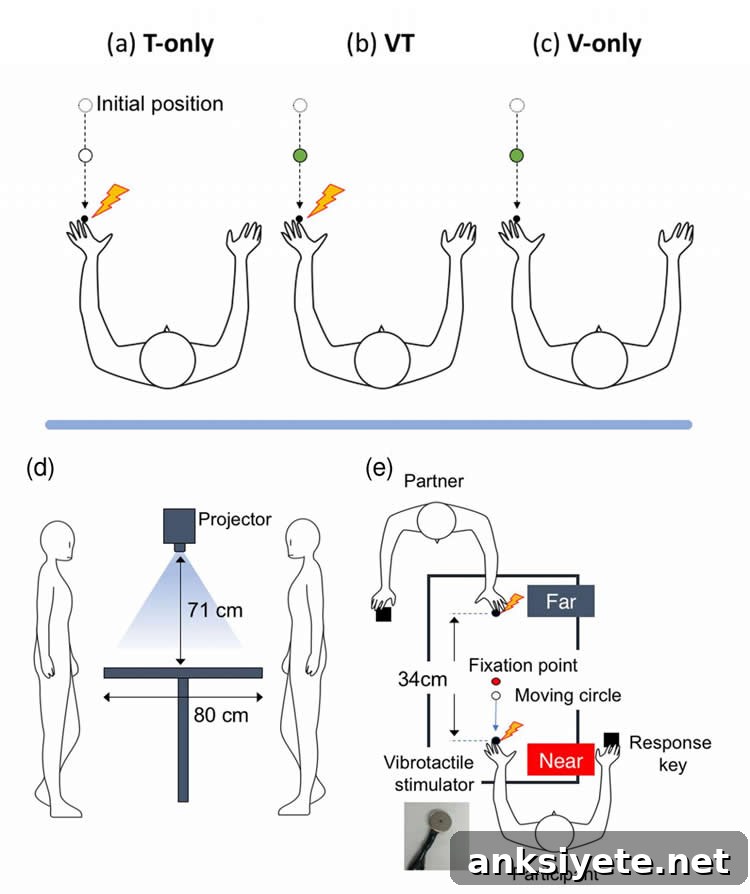
The experiments tested three categories of stimuli: tactile only (a brief vibration on the participant’s left index finger), visual only (a moving disk projected onto the tabletop that changed color), and visuotactile (a simultaneous combination of both). Participants were instructed to press a button with their right hand as quickly as possible when they detected any of the targets.
Trials were performed under three social conditions: the participant alone, the participant paired with another person seated across the table, or the participant paired with a rubber (fake) arm in place of a partner. Visual stimuli moved either toward or away from a body part. In the alone condition, approaching stimuli entered the participant’s own near space (their PPS) and receding stimuli moved away into far space. In the partner condition, some approaching stimuli entered the other person’s PPS, which spatially corresponded to the participant’s far space.
Key findings
When participants completed the task alone, they detected approaching visual stimuli in their own near space more rapidly than receding stimuli, consistent with typical PPS sensitivity to looming or approaching objects. Crucially, when participants performed the same task with a partner sitting across from them, reaction times were shortened not only for stimuli that approached the participant’s own hand but also for stimuli that approached the partner’s hand even though those stimuli occupied what would otherwise be the participant’s far space. This pattern demonstrates a behavioral signature of PPS remapping: the brain appears to respond to another person’s near space in a manner similar to how it responds to one’s own near space.
The effect persisted in several control conditions. It remained present when the partner was an unfamiliar person, indicating that familiarity was not required for the shared PPS response. However, replacing the partner with a rubber arm eliminated the remapping effect, suggesting that the presence of a real other person is important for this phenomenon. In further tests, the remapping was observed even when the body part targeted by the visual stimulus differed between the participant and the partner, implying a flexible, body-part independent component to the shared representation.
Interpretation and implications
These behavioral results support the idea that humans can share representations of peripersonal space or related attention and arousal mechanisms with others. In practical terms, the brain does not limit its vigilance to the immediate surroundings of one’s own body; it can extend a form of monitoring to the space near other people, allowing quicker responses to events that threaten or involve those individuals. This capacity could have adaptive value in social interactions and cooperative tasks that require joint attention or shared action planning.
Dr. Teramoto noted that further investigation is needed to clarify aspects that this study did not fully resolve, such as how distance influences responses to receding stimuli and whether there are directional preferences in the remapping mechanism. Additional work may also explore underlying neural signals, individual differences, and how social context or relationship ties modulate shared PPS representations.
Funding: Supported by the Japan Society for the Promotion of Science.
Source and publisher: Reporting based on work at Kumamoto University and coverage organized by NeuroscienceNews.com.
Image credit: Dr. Wataru Teramoto (image provided by the research team).
Original research: Study titled “A behavioral approach to shared mapping of peripersonal space between oneself and others” by Wataru Teramoto, published in Scientific Reports. DOI: 10.1038/s41598-018-23815-3
Abstract (summary)
This study tested whether humans behaviorally remap peripersonal space between themselves and others. Participants placed their left hand on a tabletop while a white disk either approached or receded from that hand in near or far space. A vibrotactile stimulator on the index fingertip provided tactile targets, and participants detected targets that were tactile only, visual only, or both. When tested alone, participants showed faster detection times when the visual disk approached their own hand in near space. In contrast, when a partner sat across the table, participants responded faster both to stimuli approaching their own hand and to stimuli approaching the partner’s hand—even though the latter were located in the participant’s far space. The effect did not occur when a rubber arm replaced the partner but did occur when different body parts were involved in the interaction. The findings indicate that humans can share peripersonal space representations or related attentional/arousal mechanisms with other people.