
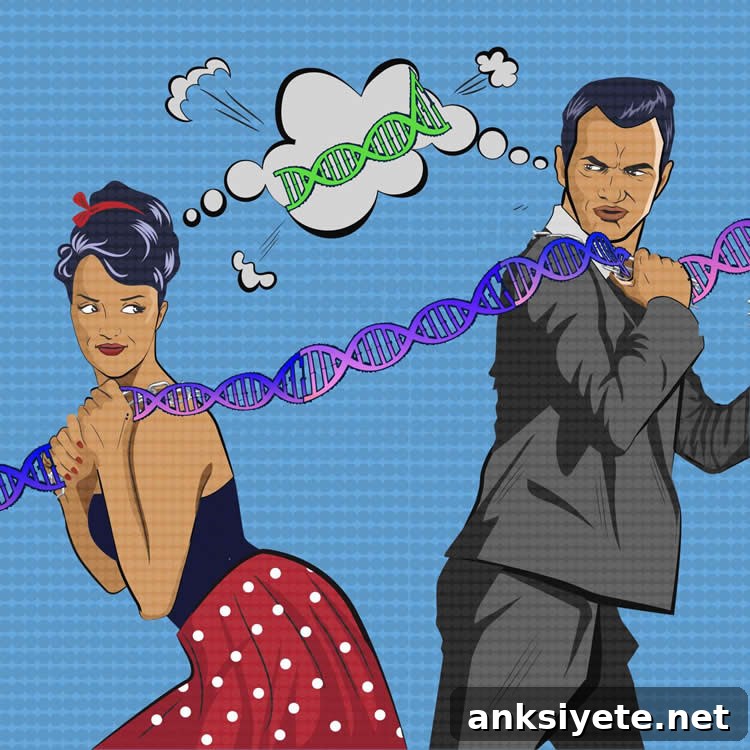
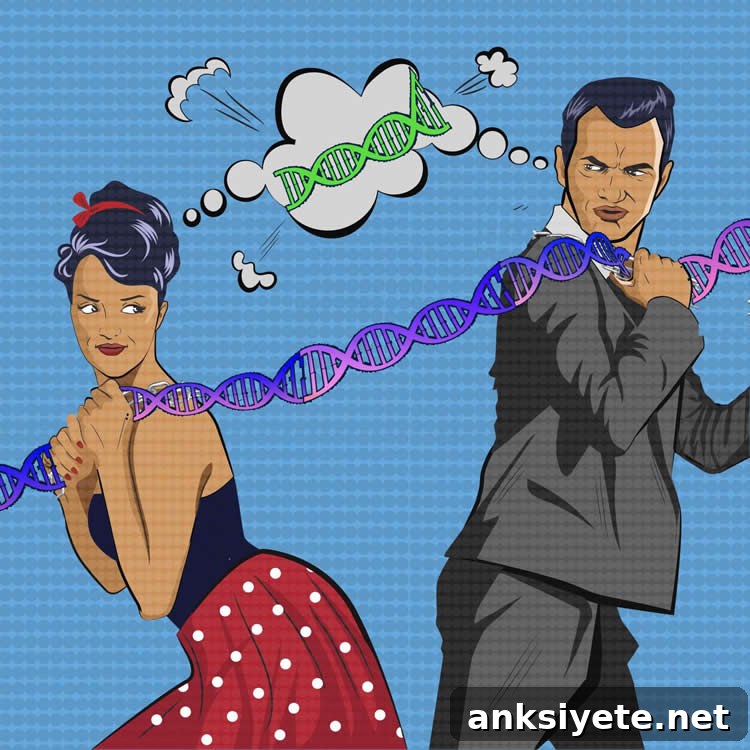
Summary: New research shows that many genes are expressed differently in males and females, suggesting that the sexes follow largely separate—but connected—evolutionary paths.
Source: Weizmann Institute of Science
Sex-biased Gene Expression Shapes Human Evolution and Health
Key finding: Thousands of human genes are expressed at different levels in men and women, and many of these sex-biased genes tolerate harmful mutations at higher rates than genes expressed equally in both sexes. This pattern helps explain differences in disease prevalence, drug responses, and aspects of fertility.
Researchers at the Weizmann Institute of Science discovered that roughly 6,500 protein-coding genes show sex-biased expression in at least one human tissue. By analyzing extensive gene-expression data, they found that genes more active in only one sex often experience weaker purifying selection, which allows deleterious mutations to persist in the population. The study, published in BMC Biology, maps these sex-differential expression patterns across multiple tissues and connects them to evolutionary and medical implications.
Why sex-specific genes can retain harmful mutations
Evolutionary biologists Shmuel Pietrokovski and Moran Gershoni originally investigated why some fertility-impairing mutations remain relatively common. They showed in prior work that mutations affecting genes expressed exclusively during sperm formation can persist because women—who do not express those sperm-specific genes—can still carry and pass those mutations to offspring. Building on this idea, the current study broadened the scope to genes that are not strictly fertility genes but still show distinct expression patterns between men and women.
Using data from the GTEx project, which measured gene expression across many tissues from nearly 550 adult donors, the researchers performed a comprehensive survey of roughly 20,000 protein-coding genes. They identified sex-biased expression across 53 tissues and examined how natural selection acts on these genes. The main pattern: the more a gene’s expression is biased toward one sex, the weaker the evidence that natural selection removes harmful variants in that gene.
Differences are widespread and sometimes unexpected
Many differences aligned with known biological distinctions: genes involved in muscle development tend to be more active in men, while genes linked to fat storage are more active in women. Other findings revealed less obvious patterns. For example, several genes with female-biased expression appear strongly active in the left ventricle of the heart in women. One such gene related to calcium handling shows high expression in younger women and declines sharply with age, suggesting a role in cardiovascular protection before menopause and a possible link to increased heart disease and osteoporosis risk afterward.
Some genes expressed in mammary tissue were detected in both sexes; roughly half of those were also active in men. Given that men possess breast tissue that is largely nonfunctional, the authors propose that some of these genes may act to suppress lactation in males. Another gene with female-biased brain expression may help protect neurons from Parkinson’s disease—consistent with the higher prevalence and earlier onset of Parkinson’s in men—though its exact function remains to be clarified.
Women also show distinct expression patterns in the liver affecting drug metabolism, providing molecular support for clinical observations that men and women can respond differently to medications.
Evolutionary interpretation
The study supports a framework in which human evolution acts not only on gene sequences but also on gene expression patterns. Because males and females share the same genome, sex differences often arise from when, where, and how strongly genes are turned on or off. Pietrokovski and Gershoni argue that selection can be less stringent on genes that are harmful only to one sex, particularly males. One long-standing evolutionary explanation is that because females typically have a more limited reproductive output than males, the survival and reproductive success of females may exert stronger selective pressure on alleles that affect both sexes. As a result, mutations harmful primarily in males can persist at higher frequencies.
Implications for medicine and fertility
The comprehensive map of sex-differential gene expression highlights specific genes and tissues that could explain sex disparities in disease incidence, drug responses, and reproductive health. The observation that many sex-biased genes experience reduced selection efficiency—including some essential for fertility—offers a potential explanation for the surprisingly high incidence of infertility in humans. The authors emphasize the need to incorporate sex-specific gene expression into medical research and treatment planning to better understand disease risks and therapeutic outcomes for men and women.
Study details and acknowledgments
The research analyzed RNA-sequencing data from 544 adults across 53 tissues to generate a detailed atlas of sex-differential gene expression. The study authors are Moran Gershoni and Shmuel Pietrokovski, and the results are reported in BMC Biology. Funding and support for Prof. Pietrokovski’s work came from the Leo and Julia Forchheimer Center for Molecular Genetics and the estate of Georges Lustgarten. Prof. Pietrokovski holds the Herman and Lilly Schilling Foundation Professorial Chair.
Abstract — condensed
This study mapped sex-differential gene expression across many human tissues and found thousands of genes with sex-biased activity. Sex-specific transcription is associated with reduced selection efficiency and an accumulation of deleterious mutations, including in some genes important for reproduction. These findings reveal how differential gene expression contributes to sexual dimorphism, disease susceptibility, and human evolutionary dynamics.