
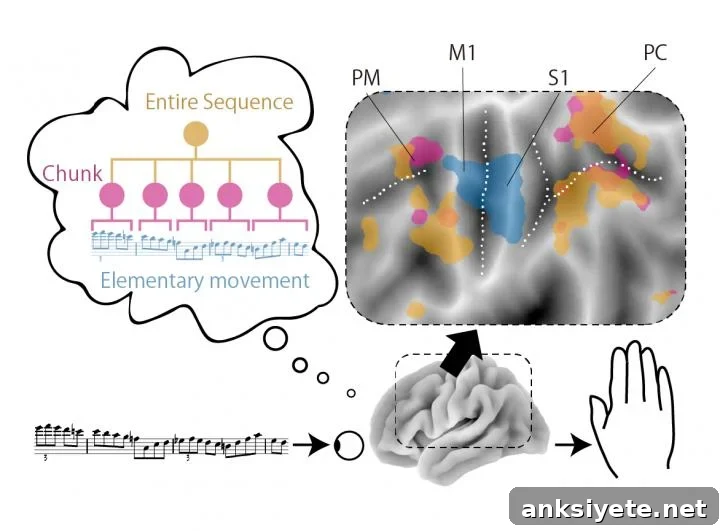
Summary: Humans encode motor sequences using a three-level hierarchical organization.
Source: NICT
Researchers at the National Institute of Information and Communications Technology (NICT), Japan, together with collaborators at Western University, Canada, have visualized how the human cerebral cortex represents hierarchical motor sequences during skilled finger movements.
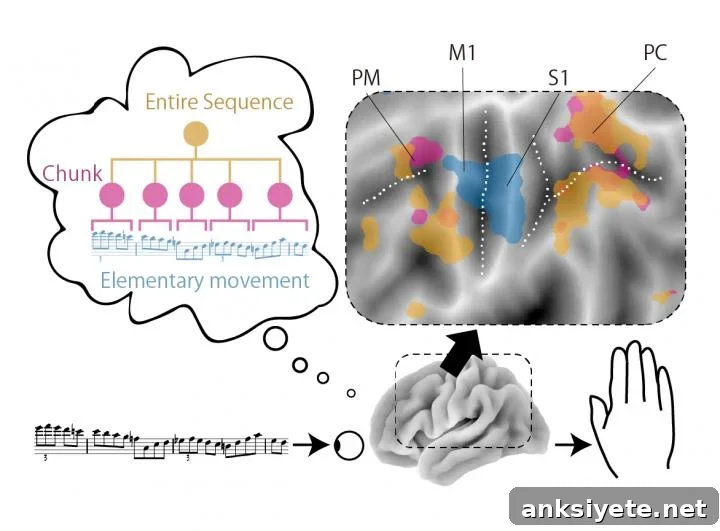
Using high-resolution fMRI and advanced pattern analysis, the team showed that representations of sequential actions are distributed across multiple cortical areas. Contrary to a simple anatomical separation of hierarchy, the study found that primary motor cortex (M1) uniquely represents individual finger movements, while premotor and parietal cortices encode higher-order sequence information such as movement chunks and whole sequences. These findings provide the first detailed cortical map of hierarchical sequence representation in humans and suggest new directions for neural decoding and brain–computer interface (BCI) applications.
The results were published as Yokoi and Diedrichsen, “Neural Organization of Hierarchical Motor Sequence Representations in the Human Neocortex” in Neuron on July 22, 2019.
Achievements
Long, complex motor sequences—like musical solos or multi-step daily tasks—are commonly organized into smaller, nested units to aid learning, memory, and execution. Despite this widely held idea, the neural implementation of hierarchical motor organization remained poorly understood. In this study, Atsushi Yokoi (CiNet, NICT) and Jörn Diedrichsen (Brain and Mind Institute, Western University) provide direct evidence for how hierarchical sequence structure is reflected in cortical population activity.
The researchers trained human participants to memorize and perform eight distinct sequences of 11 finger presses. Because the task required holding and producing multiple lengthy sequences from memory, participants naturally relied on hierarchical organization. Behavioral analyses showed that participants represented the sequences at three levels: (1) individual finger presses; (2) short chunks consisting of two or three presses; and (3) full sequences composed of four such chunks. Machine learning and representational fMRI techniques were then applied to identify how these levels appeared in cortical activity patterns.
As predicted, activity in primary motor cortex correlated specifically with which finger was pressed, regardless of the finger’s position within a sequence. Higher-order motor regions—premotor and parietal cortices—contained information about the sequential context: they reflected both chunk-level structure and whole-sequence identity. In other words, premotor and parietal areas “knew” what had occurred before and what would follow a given press, whereas M1 encoded the immediate motor output.
Importantly, the study revealed the organizational detail of these higher-order representations. Rather than forming distinct, non-overlapping anatomical zones for each hierarchical level, chunk and sequence representations overlapped substantially across premotor and parietal regions. An unsupervised clustering analysis subdivided these areas into clusters that differed in their mixture of representations, indicating a graded distribution of hierarchical information across cortex.
Study’s impact
These results challenge the simple assumption that functional hierarchy directly mirrors anatomical hierarchy—i.e., that different levels of action structure are neatly stacked from association cortices down to primary sensorimotor areas. Instead, the distinction between individual movements and sequential context appears to be especially pronounced: single movements are segregated in primary motor cortex, while higher-level contextual representations coexist and overlap in premotor and parietal cortex. The findings suggest that motor sequence coding in the human neocortex is partially hierarchical and partially distributed in a more integrated fashion.
Yokoi and Diedrichsen note that the anatomical overlap between chunk- and sequence-level representations could allow these representations to interact dynamically, potentially supporting flexible sequence production. Testing how these overlapping representations influence behavior will be an important goal for future studies.
Future prospects
The cortical map of hierarchical sequence representation identified in this work points to candidate regions for recording neural signals in BCI systems designed to generate fluent, multi-step movements. The findings also motivate development of decoding algorithms that combine information across hierarchical levels to more accurately reconstruct complex motor behavior from brain activity.
Funding: The research was an international collaboration between NICT (Japan), University College London (UK), and Western University (Canada).
Source:
NICT
Media Contacts:
Sachiko Hirota – NICT
Image Source:
The image is credited to NICT.
Original Research: Closed access
“Neural Organization of Hierarchical Motor Sequence Representations in the Human Neocortex”. Atsushi Yokoi, Jörn Diedrichsen. Neuron. doi: 10.1016/j.neuron.2019.06.017
Abstract
Neural Organization of Hierarchical Motor Sequence Representations in the Human Neocortex
Highlights
• Is hierarchical motor sequence organization mapped orderly onto the human neocortex?
• Individual movements are distinctly represented in primary motor cortex
• Movement chunks and whole sequences are jointly represented in premotor and parietal areas
• Representational clustering reveals regions along a stimulus-to-action gradient
Summary
Although hierarchical organization of movement sequences is widely accepted, its neural implementation has been unclear. The authors experimentally manipulated how participants represented finger-press sequences at the levels of individual movements, chunks, and entire sequences. Representational fMRI analyses revealed signatures of each hierarchical level in cortical activity. Anatomically, chunk and sequence representations overlapped in premotor and parietal cortices, while individual movements were uniquely encoded in primary motor cortex. These results challenge a strictly ordered anatomical separation of action hierarchies and highlight a special distinction between single-movement encoding and sequential context representation.