
Summary: A new study resolves a century-old question about how the brain matches blood vessel distribution to local energy use.
Source: UCSD
Our brains are continuous energy consumers. A dense network of blood vessels, when laid end to end, reaches a length comparable to the distance from San Diego to Berkeley, supplying a steady flow of oxygen and glucose so the brain can operate efficiently.
How the vascular system ensures that more active brain regions receive greater nutrient supply than less active regions has been a central question in neuroscience for more than a century. Researchers at the University of California San Diego have advanced that understanding with a new study that maps the brain’s tiniest blood vessels at exceptional resolution.
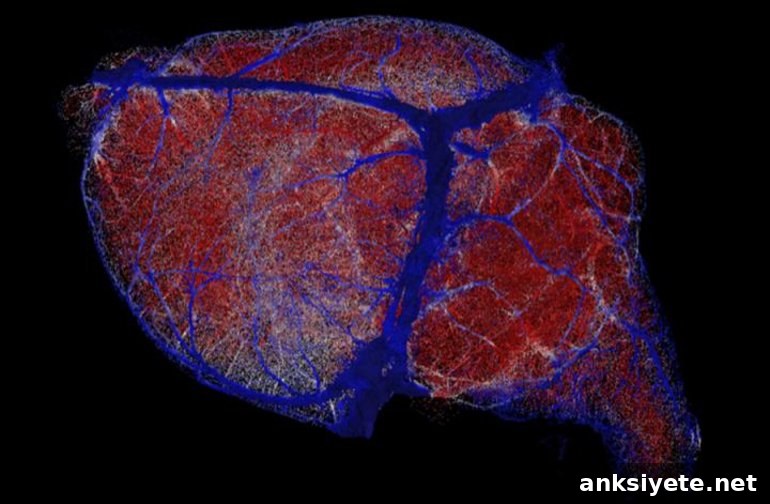
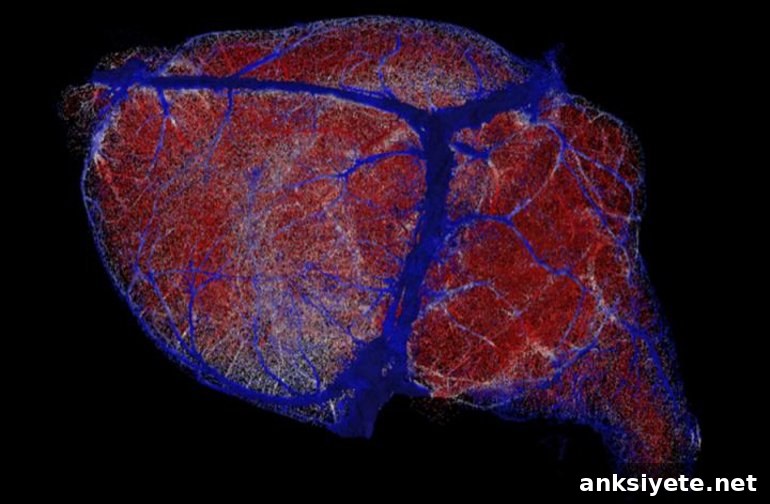
Using whole mouse brains, the research team led by Xiang Ji and David Kleinfeld produced detailed maps of the brain microvasculature at sub-micrometer resolution—finer than one-millionth of a meter, or about one-hundredth the thickness of a human hair. Their approach combined novel experimental labeling with high-precision imaging and computational reconstruction, allowing the group to analyze vascular architecture across entire brains.
“We developed an experimental and computational pipeline to label, image and reconstruct the microvascular system in whole mouse brains with unprecedented completeness and precision,” said David Kleinfeld, professor in the UC San Diego Department of Physics and Section of Neurobiology. Kleinfeld described the work as a form of reverse engineering of vascular design in the brain.
To create the maps, the team infused nearly 99.9 percent of the vessels—about 6.5 million individual vessels in a single mouse brain—with a dye-labeled gel, then imaged the intact tissue at sub-micrometer precision. The resulting datasets produced roughly fifteen trillion voxels per brain, which were converted into a digital vascular network for quantitative analysis with modern data-science tools.
Analyzing the reconstructed networks, the researchers found that oxygen concentration is remarkably uniform across different brain regions. Rather than large regional differences in oxygen tension, the brain appears to regulate supply by adjusting microvessel geometry and density. Small blood vessels—the capillaries and fine arterioles—serve as the primary compensatory elements that match local metabolic demand.
For example, white matter tracts that convey information between hemispheres and to the spinal cord have relatively low energy demands and correspondingly lower capillary density. By contrast, auditory-processing regions that use roughly three times more energy exhibit substantially higher microvessel density. These spatial differences in vascular geometry align with regional metabolic needs, providing a structural basis for how the brain balances supply and demand.
The study also revealed shared organizational principles across the brain. Graph analyses show a common network topology that confers structural robustness against the rarefaction, or loss, of vessels. Geometrical measurements uncovered a scaling relationship linking the length density of vessels—the total vessel length per unit volume—to typical distances between tissue and the nearest vessel. From this relationship, the authors derived a formula connecting regional metabolic rates to vessel length density and predicted a nearly uniform maximum tissue oxygen tension throughout the brain.
Orientation of capillaries was generally weakly anisotropic, meaning vessel directions are only slightly aligned in particular directions across most regions, though a few areas showed pronounced anisotropy. Such orientation differences can affect the interpretation of functional imaging signals like fMRI and highlight the need to consider microvascular geometry in imaging analyses.
“In the era of increasing complexities being unraveled in biological systems, it is fascinating to observe the emergence of shared simple and quantitative design rules underlying the seemingly complicated networks across mammalian brains,” said Xiang Ji, a graduate student in physics and co‑author of the study.
Beyond establishing these global design principles, the researchers used their data to predict a tipping point: a threshold level of capillary loss beyond which brain health may deteriorate rapidly. This link between vascular rarefaction and sudden declines in tissue perfusion could have implications for understanding vascular contributions to neurodegenerative disease and recovery after injury.
Future work will use these comprehensive vascular maps to trace finer details of blood flow into and out of brain regions and to explore the largely uncharted interactions between the brain’s vasculature and the immune system. By combining anatomical maps with physiological and immunological measurements, the team aims to deepen our understanding of how vascular structure supports function and resilience in the brain.
Authors of the paper include Xiang Ji, Tiago Ferreira, Beth Friedman, Rui Liu, Hannah Liechty, Erhan Bas, Jayaram Chandrashekar and David Kleinfeld.
About this neuroscience research news
Source: UCSD
Contact: Mario Aguilera, UCSD
Image: The image is credited to Xiang Ji and Edmund O’Donnell, UC San Diego
Original Research: Closed access. “Brain microvasculature has a common topology with local differences in geometry that match metabolic load” by Xiang Ji, David Kleinfeld et al., published in Neuron.
Abstract
Brain microvasculature has a common topology with local differences in geometry that match metabolic load
Highlights
- •Whole mouse brain microvascular connectome reconstructed at sub-micrometer resolution
- •Shared network topology provides structural robustness against vessel loss
- •Regional vascular geometry correlates with metabolism through diffusive oxygen transport
- •A substantial portion of brain microvasculature shows significant anisotropy in specific regions
Summary
The microvasculature underpins the supply networks that sustain neuronal activity across diverse brain regions. This study asks which features of vascular connectivity, density, and orientation are common across the brain and which vary with local metabolic demand.
To answer this, the team imaged, reconstructed, and analyzed whole adult mouse brain microvascular networks at sub-micrometer resolution. Graph-based and geometric analyses revealed a common topology that supports resilience, a scaling law linking vessel length density to tissue-vessel distances, and a derived relationship connecting regional metabolism with vessel density that predicts a consistent maximum tissue oxygen tension across the brain. The work also documents regional differences in capillary orientation that can influence interpretation of functional imaging data.