
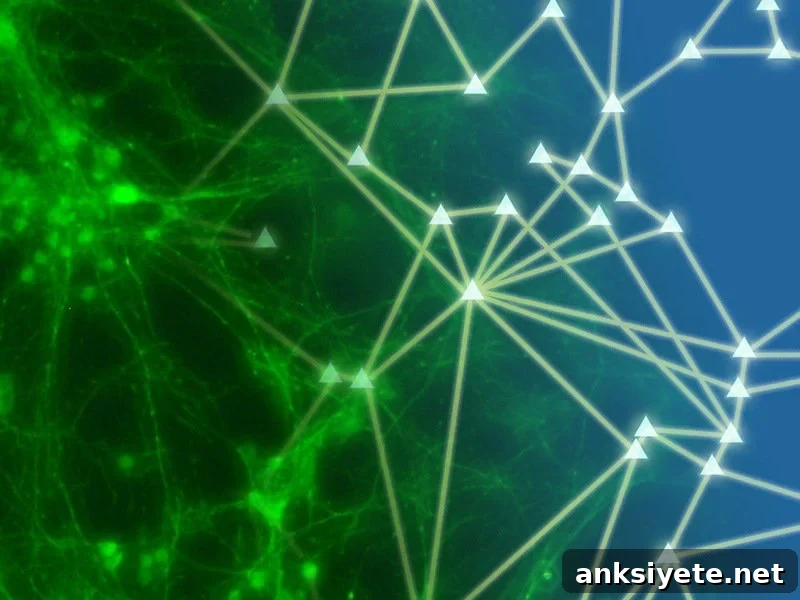
A new method facilitates the mapping of connections between neurons.
The human brain performs extraordinary functions through the coordinated activity of billions of neurons arranged in intricate networks. A research team from the Max Planck Institute for Dynamics and Self-Organization, the University of Göttingen and the Bernstein Center for Computational Neuroscience Göttingen has developed a new, data-driven algorithm that can infer probable connections between neurons from measurements of overall neuronal activity. This approach provides a way to estimate the likelihood that two neurons are directly connected, offering a practical tool for mapping neural connectivity where direct anatomical reconstruction is infeasible.
Neurons never act in isolation; they form dense circuits that exchange electrical and chemical signals. The precise pattern of how neurons connect—the connectivity or circuit diagram—strongly influences how information is processed in the brain. However, reconstructing this connectivity directly from tissue structure remains technically impractical for most preparations, including cultured networks with thousands of neurons. In contrast, technologies for recording dynamic neuronal activity are well established and can capture the timing of signals across many neurons simultaneously. The research group led by Theo Geisel at the Max Planck Institute in Göttingen leverages these activity recordings to infer connectivity patterns indirectly but reliably.
The team used calcium fluorescence imaging data to detect neuronal activity. Calcium imaging relies on indicator molecules that fluoresce when they bind calcium ions; because intracellular calcium levels rise in response to electrical activity, the fluorescence signal acts as a proxy for when neurons fire. This technique allows simultaneous monitoring of thousands of neurons in cell cultures and in living tissue. Calcium signals, however, are slower and noisier than the underlying electrical spikes, and fast propagation of activity across the network means that observed activity can reflect both direct connections and indirect, multi-step interactions. The new algorithm explicitly models these practical limitations and extracts robust statistical estimates of directed interactions from the measured signals.
At the core of the method is the concept of transfer entropy, a measure from information theory that quantifies the directed flow of information between variables. Transfer entropy can indicate how likely it is that a change in one neuron’s activity would predict a subsequent change in another neuron’s activity, providing a directional measure of influence. Olav Stetter, the study’s lead author, explains that by combining transfer entropy with careful statistical controls, the method distinguishes genuine causal interactions from spurious associations that arise from common inputs, indirect pathways, or measurement noise.
The researchers first validated their approach using simulated calcium imaging experiments. They generated network activity with realistic models of neuronal dynamics and calcium indicator kinetics, then applied their reconstruction algorithm to the simulated fluorescence traces. This testing revealed an important insight: reconstructed causal relationships depend on the network’s activity state. During relatively quiet phases with low overall activity, the inferred causal links align more closely with the true underlying connections. During highly active phases, many neurons fire simultaneously and information paths overlap, making it harder to resolve direct links. By focusing their analysis on appropriate activity regimes and accounting for state-dependent variability, the team extracted more accurate connectivity estimates.
Applying the algorithm to real calcium imaging recordings, the researchers found notable structural features in the inferred networks, such as localized concentrations of connections around individual cells. These results demonstrate that a model-free, data-driven reconstruction method can reveal meaningful organizational patterns in neuronal networks without assuming a specific network architecture in advance. Demian Battaglia, a co-author, emphasized the generality of the approach: it can be applied across a wide class of preparations and recording conditions, provided sufficiently informative activity data are available.
Beyond basic mapping, the method offers potential to support broader questions in neuroscience. With connectivity estimates from multiple networks and conditions, researchers can begin to investigate how neurons select partners during development and how network structure relates to function. The algorithm may be useful both for cultured neuronal systems used in laboratory studies and for larger-scale recordings in intact tissue. While challenges remain—such as limits imposed by measurement noise, indicator dynamics, and high-activity states—the approach provides a practical route to infer circuit diagrams from commonly available activity data.
Notes about this neural network research
Contacts: Dr. Birgit Krummheuer – Max Planck Institute for Dynamics and Self-Organization
Olav Stetter – Max Planck Institute for Dynamics and Self-Organization
Prof. Dr. Theo Geisel – Max Planck Institute for Dynamics and Self-Organization
Source: Max Planck Institute news release
Image Source: Neuronal activity image credited to MPI for Dynamics and Self-Organization.
Original Research: Open access research paper titled “Model-free Reconstruction of Excitatory Neuronal Connectivity from Calcium Imaging Signals” by Olav Stetter, Demian Battaglia, Jordi Soriano and Theo Geisel in PLoS Computational Biology, August 2012, 8(8): e1002653 (DOI: 10.1371/journal.pcbi.1002653)