
Summary: A large brain imaging study finds reduced white matter integrity in people with major depressive disorder, highlighting structural changes that may underlie symptoms of depression.
Source: University of Edinburgh
Major new imaging research identifies alterations in brain wiring associated with depression.
Researchers have identified structural changes in the brains of people who have experienced depression. The differences involve white matter, the network of fibres that connects brain regions and supports communication via electrical signals.
White matter forms the brain’s wiring. When its structure or integrity is altered, it can affect how regions involved in emotion, cognition and memory communicate, potentially contributing to symptoms such as persistent low mood, fatigue and difficulty concentrating.
This study is the largest of its kind to date, analysing imaging and clinical data from more than 3,400 people. The scale of the sample and the uniform imaging approach strengthen the reliability of the findings and offer important biological insight into major depressive disorder (MDD).
The participants were drawn from the UK Biobank, a national research resource that includes health and imaging data on hundreds of thousands of volunteers. Within a subgroup of thousands who underwent brain imaging and mood assessments, investigators applied diffusion tensor imaging (DTI), an advanced MRI technique designed to map white matter microstructure.
Using DTI, the research team measured fractional anisotropy (FA), a widely used indicator of white matter integrity. Lower FA values typically indicate reduced coherence or organization of white matter fibres, which can reflect compromised connections between brain regions.
Compared with people without depressive symptoms, individuals reporting symptoms consistent with MDD showed significant reductions in global white matter integrity. The study found particularly notable declines in FA across association and commissural fibers and in thalamic radiations—pathways that connect cortical and subcortical regions involved in mood regulation and cognitive processing.
Tract-specific reductions were also reported in several key white matter bundles, including the left superior longitudinal fasciculus, the superior thalamic radiation and the forceps major. These tract-level findings point to distributed disruptions rather than changes confined to a single brain area.
Heather Whalley, Senior Research Fellow in the University of Edinburgh’s Division of Psychiatry, noted that this large, single-sample analysis provides robust evidence that altered white matter structure is associated with depression. She emphasized the clinical importance of understanding these brain differences to guide the development of better diagnostic tools and more effective treatments. The team plans further work to investigate why some individuals do not show these brain changes and whether that resistance relates to resilience against low mood and distress.
The work was led by researchers at the University of Edinburgh in collaboration with the University of Glasgow and forms part of the Wellcome Trust-funded STRADL initiative (Stratifying Resilience and Depression Longitudinally), which aims to classify subtypes of depression and identify risk and protective factors.
Funding: This research was supported by the Wellcome Trust.
The authors report no financial or other conflicts of interest.
Study and authors
The findings were published in Scientific Reports under the title “Subcortical volume and white matter integrity abnormalities in major depressive disorder: findings from UK Biobank imaging data.” The author list includes Xueyi Shen, Lianne M. Reus, Simon R. Cox, Mark J. Adams, David C. Liewald, Mark E. Bastin, Daniel J. Smith, Ian J. Deary, Heather C. Whalley and Andrew M. McIntosh.
Key conclusions
- Major depressive disorder is associated with reduced white matter integrity across the brain, as measured by fractional anisotropy (FA).
- Significant reductions were observed in association/commissural fibres and thalamic radiations, suggesting impaired connectivity between cortical and subcortical regions.
- Specific tracts—such as the left superior longitudinal fasciculus, superior thalamic radiation and forceps major—showed tract-level FA reductions in participants with depression.
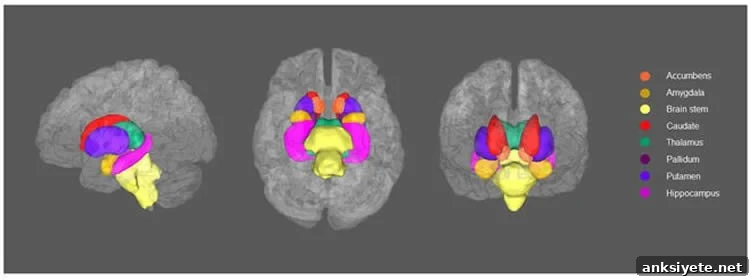
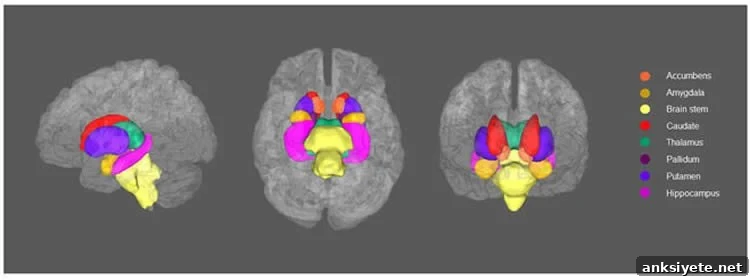
- No significant differences in subcortical grey matter volumes were detected in this large sample, highlighting the importance of examining white matter microstructure in MDD.
These results add to a growing body of evidence that disrupted brain connectivity plays a role in depression. By clarifying which white matter pathways are affected, this work helps focus future research on mechanisms that may underlie symptoms and on potential biomarkers for more precise diagnosis and treatment stratification.
Abstract summary
Previous studies of grey and white matter in depression have shown inconsistent findings. In this large UK Biobank sample, no robust differences in subcortical grey matter volumes were observed, but significant reductions in global white matter integrity were identified in depressed individuals. The pattern of reduced FA in key fibre systems supports the view that white matter disruption contributes to major depressive disorder.