
Summary: Researchers have identified two distinct pathways for how amyloid pathology develops in Alzheimer’s disease.
Source: Karolinska Institute
Two commonly used methods to detect amyloid pathology in Alzheimer’s disease—amyloid PET imaging and cerebrospinal fluid (CSF) analysis—sometimes give conflicting results, which can lead to delayed or incorrect clinical decisions. Researchers at Karolinska Institutet, in collaboration with colleagues in Milan, have now uncovered genetic and biological explanations for these discrepancies. Published in Molecular Psychiatry, the study points to two alternative amyloid accumulation pathways and has implications for more personalized diagnosis and future drug development.
Alzheimer’s disease is the most common form of dementia, causing progressive memory loss and ultimately leading to premature death. In Sweden, about 120,000 people live with Alzheimer’s, and an estimated 50 million people are affected worldwide. The number of cases is expected to rise substantially in the coming decades as life expectancy increases.
One of the earliest measurable signs of Alzheimer’s is the abnormal build-up of amyloid-β protein into insoluble deposits, commonly called amyloid plaques, in brain tissue. This amyloid accumulation can begin many years before clinical symptoms are obvious and often appears prior to mild cognitive impairment.
Detecting amyloid pathology early is critical for timely care and intervention. The two standard diagnostic tools are PET imaging, which visualizes amyloid deposits in the brain, and analysis of amyloid-β42 levels in cerebrospinal fluid. However, these methods yield discordant results in up to one-fifth of cases, particularly at early disease stages, creating uncertainty in diagnosis and management.
PET imaging and CSF analysis: complementary perspectives
The new study, performed by researchers at Karolinska Institutet and Vita-Salute San Raffaele University in Milan, examined PET and CSF biomarker data from 867 participants that included cognitively healthy controls, people with mild cognitive impairment, and patients with Alzheimer’s dementia. A subset of 289 participants underwent both PET imaging and CSF analysis over a two-year follow-up, allowing the team to track how amyloid markers changed over time.
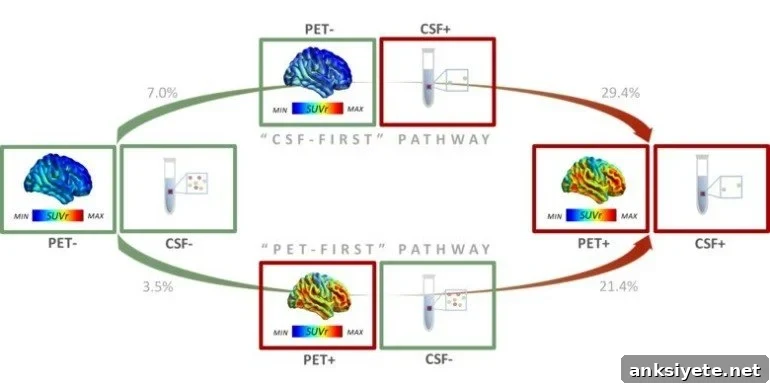
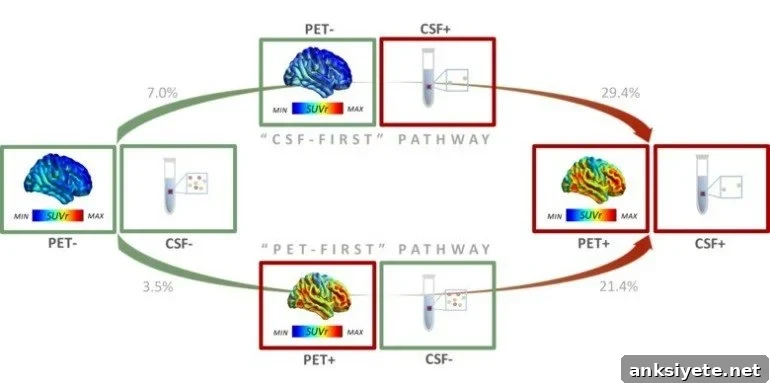
The team found that in some individuals amyloid abnormalities appear first in PET imaging (PET-first), while in others they are detected earlier in CSF measurements (CSF-first). The CSF-first group showed a higher prevalence of the Alzheimer’s genetic risk factor APOE-ε4ε4 and a faster rate of brain amyloid accumulation compared with the PET-first group.
These findings suggest that CSF and PET do not always become abnormal at the same time; instead, they can reflect different stages or pathways of the same disease process. As a result, interpreting PET and CSF findings as interchangeable may miss important biological differences between patients.
Implications for diagnosis, trials and personalized care
According to the authors, recognizing CSF-first and PET-first patterns can improve early diagnosis and help tailor treatment strategies. “Because amyloid biomarkers are key early indicators for diagnosing Alzheimer’s, viewing PET and CSF as complementary rather than equivalent could enable earlier and more individualized care,” says Arianna Sala, the study’s first author.
Elena Rodriguez-Vieitez, senior researcher and last author on the paper, adds that the distinct genetic profiles and differing rates of amyloid accumulation have potential consequences for how clinical trials are designed and how patients are selected for therapies targeting amyloid. Biomarker discordance may identify individuals at higher risk for progression to fully abnormal amyloid status and subsequent neurodegeneration and cognitive decline.
Funding: The study received support from the European Union Innovative Medicines Initiative AMYPAD, the Alzheimer’s Foundation, the Brain Foundation, the Dementia Foundation, the Foundation for Strategic Research (SSF), the Swedish Research Council, the Åke Wiberg Foundation and Region Stockholm. The authors report no conflicts of interest.
About this Alzheimer’s disease and genetics research news
Source: Karolinska Institute
Contact: Press Office – Karolinska Institute
Image: Credit to the research team
Original Research: Open access. “Longitudinal pathways of cerebrospinal fluid and positron emission tomography biomarkers of amyloid-β positivity” by Arianna Sala, Agneta Nordberg and Elena Rodriguez-Vieitez. Molecular Psychiatry
Abstract
Longitudinal pathways of cerebrospinal fluid and positron emission tomography biomarkers of amyloid-β positivity
Discordance between CSF and PET amyloid-β biomarkers occurs in roughly 20% of individuals in the preclinical or prodromal stages of Alzheimer’s disease, and the causes of this mismatch have been unclear. This study tested the hypothesis that CSF/PET discordance reflects meaningful biological and clinical differences. Baseline assessments of CSF amyloid-β42 and [18F]Florbetapir PET were analyzed in 867 participants, with longitudinal follow-up in 289 individuals after two years. The researchers tracked concurrent longitudinal trajectories of CSF and PET biomarkers and observed that participants who were normal on both measures more often progressed first to a discordant state (CSF+/PET− or CSF−/PET+) rather than to simultaneous abnormality on both measures (CSF+/PET+). Progression to CSF+/PET+ status occurred ten times more frequently among participants who already had discordant biomarkers compared to those who were initially CSF−/PET−. Compared to the CSF+/PET− group, the CSF−/PET+ group exhibited a lower prevalence of APOE-ε4ε4 (χ2(6) = 197; p < 0.001; n = 867) and a slower rate of brain amyloid-β accumulation (F(3,600) = 12.76; p < 0.001; n = 608). These findings indicate that biomarker discordance represents a regular stage in the natural history of amyloid-β accumulation: either CSF or PET may become abnormal first, rather than both changing simultaneously. Therefore, discordant biomarker profiles can help identify individuals at elevated risk of progressing toward fully abnormal amyloid-β status, with increased likelihood of subsequent neurodegeneration and cognitive decline. The study supports the existence of two alternative pathways—“CSF-first” and “PET-first”—characterized by different genetic backgrounds and rates of amyloid accumulation. In clinical and research contexts, CSF and PET amyloid-β biomarkers should be considered as providing distinct, complementary information rather than interchangeable measures.