
Summary: Researchers have identified a long non-coding RNA, Paupar, that plays a crucial role in regulating genes required for healthy brain development in mice.
Source: University of Bath.
New research reveals a non-coding RNA essential for early brain development
Since the human genome was first mapped, scientists have wondered why large portions of DNA are transcribed into RNA even though they do not encode proteins. These transcripts, known as non-coding RNAs, have been dismissed by some as transcriptional noise, while others suspect they serve important regulatory roles.
Researchers from the Universities of Bath, Oxford and Edinburgh have now provided strong evidence that one such long non-coding RNA (lncRNA), named Paupar, is necessary for healthy brain development in young mice. Their study shows Paupar directly interacts with the epigenetic regulator KAP1 and helps coordinate the activity of genes that control neural proliferation and differentiation.
The KAP1 protein is already known to be essential for many processes in neurodevelopment. It acts as a regulator for multiple genes involved in brain growth and the formation of diverse neural cell types. Using molecular biology techniques, the team demonstrated that Paupar binds to KAP1 and modulates its function. This interaction influences KAP1’s occupancy on chromatin and affects deposition of repressive histone marks at specific genomic locations, thereby altering expression of target genes important for neurogenesis.
It is the first time a non-coding RNA has been shown to bind KAP1 directly. The researchers describe a ribonucleoprotein complex that includes Paupar, KAP1 and the transcription factor PAX6. Genome-wide analyses revealed a significant overlap between sequences bound by Paupar, KAP1 and PAX6, supporting a model in which Paupar helps recruit or stabilize KAP1 at distal regulatory elements to shape gene expression programs during central nervous system development.
Dr Keith Vance of the University of Bath Department of Biology & Biochemistry led the study. He commented: “It is now clear that the genome expresses many non-coding RNAs that are not made into protein. Despite this, there is a lot of controversy regarding their function. Some groups argue that these non-coding RNAs are a result of transcriptional noise with no apparent use whilst others think that the vast majority of them must be doing something important.”
Dr Vance added, “We have shown here good evidence that one of these genes, called Paupar, is important for development of the brain. It’s a young field, but I think it’s clear we have to reassess the central dogma of molecular biology that DNA is transcribed to RNA that codes for a protein. We’re now seeing that some RNAs can go off and do something themselves. Our findings also help us understand the essential role of KAP1, which is something we’re really interested in as we look at the development of the central nervous system.”
Funding: The research was supported by the Biotechnology and Biological Sciences Research Council (BBSRC) and the Medical Research Council (MRC).
Source: Chris Melvin, University of Bath.
Publisher: NeuroscienceNews.com.
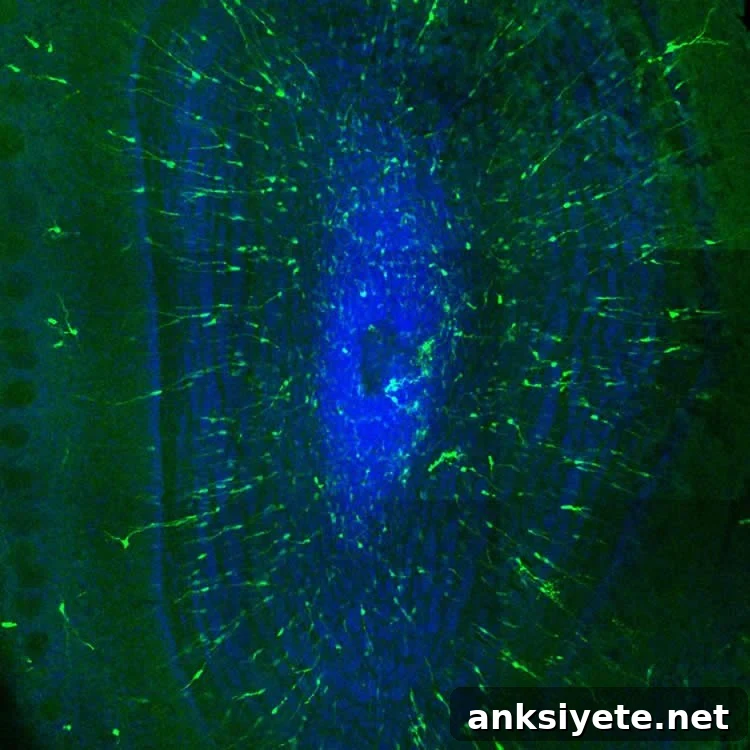
Image Source: Image credited to Francis Szele.
Original Research: Open access research titled “The long non‐coding RNA Paupar promotes KAP1‐dependent chromatin changes and regulates olfactory bulb neurogenesis” by Ioanna Pavlaki, Farah Alammari, Bin Sun, Neil Clark, Tamara Sirey, Sheena Lee, Dan J Woodcock, Chris P Ponting, Francis G Szele, and Keith W Vance in The EMBO Journal. Published April 16, 2018.
doi: 10.15252/embj.201798219
Abstract (summarized)
Paupar is a central nervous system–expressed long non-coding RNA that regulates neurogenesis by interacting with KAP1, an essential epigenetic regulator. Paupar binds directly to KAP1 and influences expression of shared target genes involved in cell proliferation and neuronal differentiation. The lncRNA promotes KAP1 chromatin association and H3K9me3 deposition at a subset of distal genomic targets through formation of a ribonucleoprotein complex containing Paupar, KAP1 and PAX6. Genome-wide analyses show a significant enrichment of co-occupied sites between Paupar and KAP1, many of which also associate with PAX6. Functional loss of either Paupar or Kap1 in vivo disrupts olfactory bulb neurogenesis, supporting roles for both factors in regulating neurodevelopment. These findings provide insight into trans-acting lncRNA-mediated epigenetic regulation and mechanisms of KAP1 recruitment across the genome.