
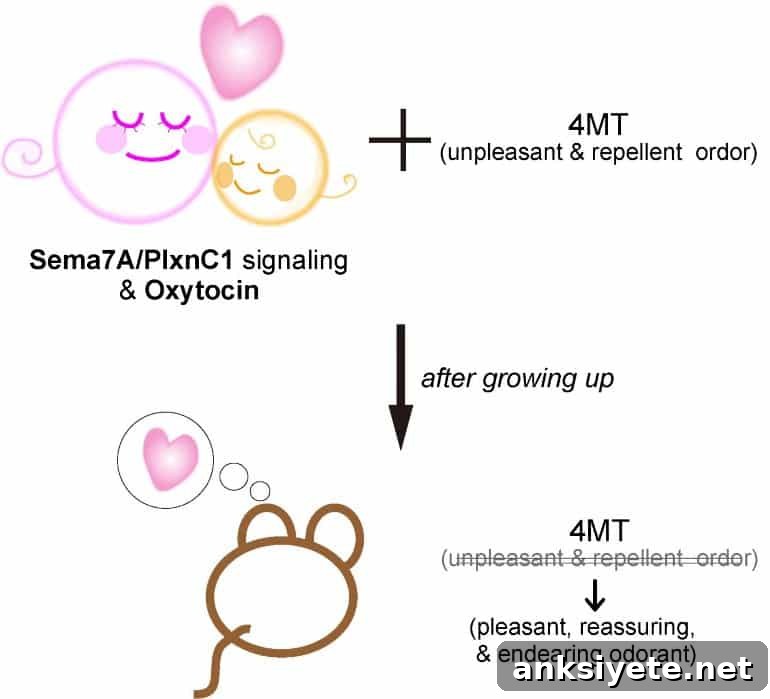
Summary: Olfactory imprinting during a neonatal critical period in mice shapes adult social behavior.
Source: eLife
Imprinting is a well-known biological phenomenon in which newborn animals form lasting attachments to sights, sounds, or smells encountered immediately after birth. In birds like ducklings, this often means following the first moving object, typically the mother. In migratory fish such as salmon, early-life exposure to the unique odor of their home stream guides them back years later. What mechanisms allow these early sensory experiences to create long-term behavioral changes?
Early sensory exposure during a restricted developmental window—often called a critical period—is essential for establishing sensory maps and neural circuits. In mammals, early-life sensory experiences influence later perception and social behavior. While visual imprinting has been extensively explored, the neuronal basis of smell-based or olfactory imprinting has remained poorly understood.
Researchers in Japan, including Nobuko Inoue, Hirofumi Nishizumi, Hitoshi Sakano at the University of Fukui, and Kazutaka Mogi and Takefumi Kikusui at Azabu University, investigated how olfactory imprinting occurs in mice. Their study in eLife identifies specific molecular and hormonal players that link neonatal odor exposure to adult behavior. “We identified three key molecules involved in this process,” explains Dr. Nishizumi.
Those three components are: Semaphorin 7A (Sema7A), a signaling molecule produced by olfactory sensory neurons; Plexin C1 (PlxnC1), the Sema7A receptor localized to dendrites of mitral and tufted cells in the olfactory bulb; and oxytocin, a neuropeptide commonly associated with social bonding.
During the neonatal critical period, exposure to a particular odor induces Sema7A expression in odor-responsive sensory neurons. Sema7A interacts with PlxnC1 on mitral/tufted-cell dendrites, a receptor whose dendritic localization is restricted to the first postnatal week. This temporally constrained receptor presence defines the short critical window for olfactory imprinting. Sema7A/PlxnC1 signaling enhances post-synaptic events and drives selection of dendrites in mitral/tufted cells, producing enlargement of individual glomeruli and increasing sensitivity to the experienced odor.
At the same time, oxytocin released during maternal nursing assigns a positive valence to the imprinted odor. Together, these mechanisms explain how neonatal odor experience both strengthens sensory representation and shapes later social responses.
The study also explored behavioral consequences. Male mice typically show curiosity toward novel mouse odors regardless of sex. When Sema7A signaling is blocked during the neonatal critical period, mice do not display this usual investigatory behavior and instead avoid unfamiliar conspecific odors. Remarkably, if a pup encounters an innately aversive odor during the critical window, the imprinted memory can override the innate aversion and produce a positive response. In other words, the imprinted circuit can outcompete hard-wired aversive circuitry.
This competition between innate and imprinted circuits suggests the brain maintains mechanisms for crosstalk and conflict resolution between opposing responses—a finding that raises many questions about analogous processes in humans. Do humans have comparable critical periods for olfactory or other sensory systems? Might early sensory experiences similarly reconfigure innate preferences or avoidance behaviors?
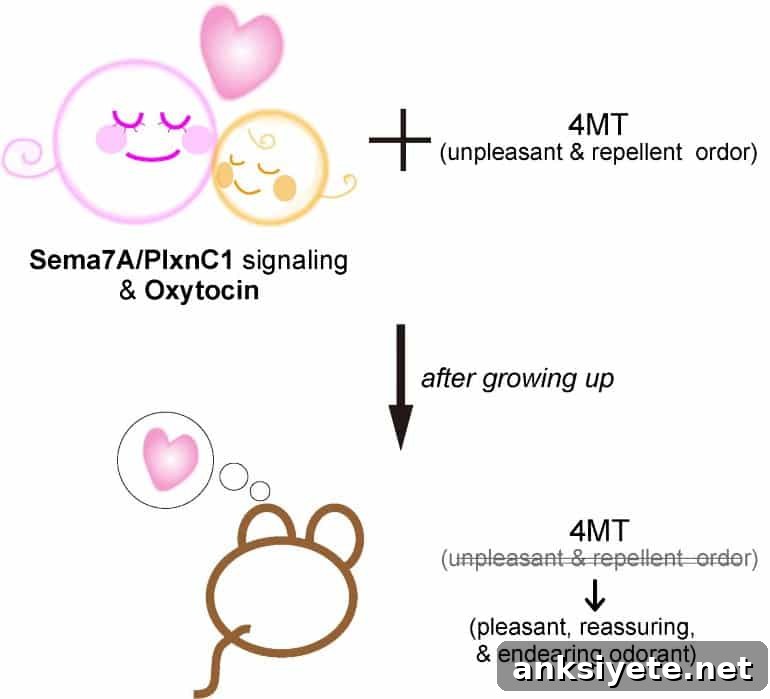
Beyond basic neuroscience, the findings have potential clinical relevance. The authors note that abnormal sensory experiences during early life might contribute to neurodevelopmental disorders such as autism spectrum disorders (ASD) and attachment disorders. Oxytocin has been used experimentally to treat some ASD symptoms in adults, but these results suggest that oxytocin delivery during the neonatal period could be more effective at preventing or reducing later social impairments. As Dr. Nishizumi comments, early oxytocin treatment before the end of the critical period may better rescue social behavior deficits than treatments initiated later, highlighting a possible window for therapeutic intervention.
Overall, this work advances our understanding of how transient molecular signaling and neonatal hormones interact to form durable sensory memories and shape adult social behavior. It opens new research directions into developmental timing, circuit competition, and how early-life sensory environments influence lifelong behavior.
About this neuroscience and behavior research news
Source: eLife
Contact: Emily Packer – eLife
Image: The image is credited to Hirofumi Nishizumi, University of Fukui
Original Research: Open access.
“The olfactory critical period is determined by activity-dependent Sema7A/PlxnC1 signaling within glomeruli” by Nobuko Inoue, Hirofumi Nishizumi, Rumi Ooyama, Kazutaka Mogi, Katsuhiko Nishimori, Takefumi Kikusui, Hitoshi Sakano. DOI: 10.7554/eLife.65078
Abstract
The olfactory critical period is determined by activity-dependent Sema7A/PlxnC1 signaling within glomeruli
Early odor exposure in neonatal mice alters social behavior in adulthood. Odor-responsive olfactory sensory neurons induce Semaphorin 7A (Sema7A), which signals through Plexin C1 (PlxnC1) receptors on mitral/tufted cells. PlxnC1 dendritic localization is confined to the first postnatal week, defining the short critical period. Sema7A/PlxnC1 signaling promotes postsynaptic changes and dendrite selection in mitral/tufted cells, leading to glomerular enlargement and heightened sensitivity to the experienced odor.
Neonatal odor experience also produces positive behavioral responses toward imprinted odors. Genetic knockout and rescue experiments indicate that oxytocin in neonates is necessary to confer positive valence on imprinted memory. In oxytocin knockout mice, sensitivity to the experienced odor increases but the promotion of positive responses is impaired, showing that Sema7A/PlxnC1 signaling and oxytocin operate through distinct but complementary pathways.
These results provide new insights into the molecular and hormonal mechanisms that underlie olfactory imprinting during the neonatal critical period.