
Summary: Brain regions that process spatial information also appear to encode and organize data about social relationships and social network structure.
Source: SfN
New research published in Journal of Neuroscience shows that the brain represents information about our social relationships using regions commonly associated with spatial processing.
Humans maintain hundreds of social ties, and keeping track of those relationships requires the brain to store details about individuals and the links between them. How the brain organizes this complex social information has been unclear. The study by Peer and colleagues explored how social network structure is encoded in the brain by combining objective social media data with brain imaging.
Researchers mapped participants’ real-life Facebook social connections to create a measurable picture of each person’s social network. While undergoing functional MRI (fMRI) scanning, participants were asked to think about people from their own social networks. The researchers then analyzed brain activity patterns to determine how information about each person and about the relationships between people was represented neurally.
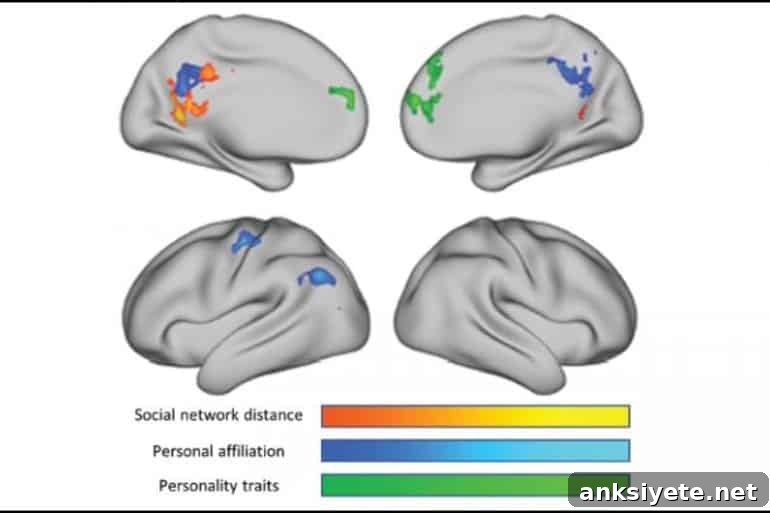
The study found that activity patterns elicited when thinking about specific individuals produced a distinct neural signature in the retrosplenial complex, a region traditionally linked to spatial processing. Crucially, the similarity between activity patterns corresponded to social “distance” in the network: individuals who were closer in the social network—measured by shared friends and mutual connections—evoked more similar retrosplenial complex activity patterns than individuals who were more distant.
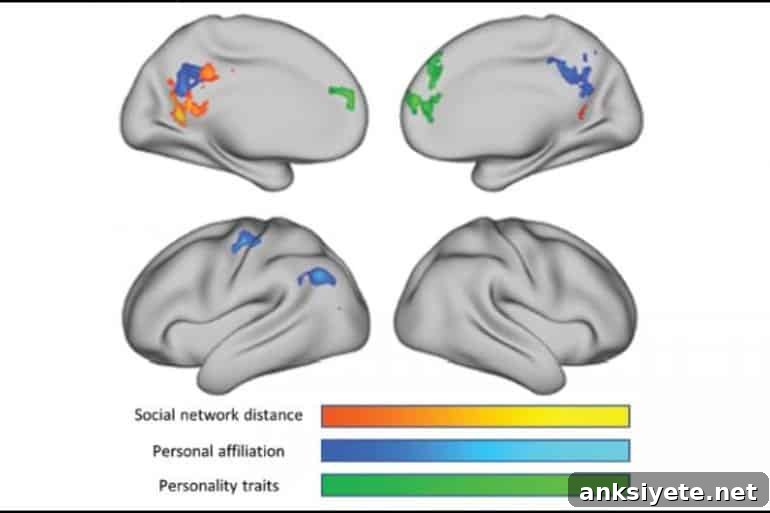
In addition to social network distance encoded in the retrosplenial complex, the study identified other dissociable neural representations for complementary aspects of social knowledge. Personal affiliation—how closely an individual related to the participant—was represented in medial parietal regions, while perceived personality traits of others were encoded in the medial prefrontal cortex. In other words, different brain areas carried different types of social information: the network position of others, their relationship to the self, and trait-based impressions.
By using representational similarity analysis (RSA) of fMRI activity patterns and controlling for overlapping factors such as personal affiliation, perceived personality, and physical appearance, the authors demonstrated that social network distance information was uniquely localized to the retrosplenial complex. This finding suggests a cortical division of labor in social cognition, with spatial-processing regions supporting an allocentric map-like representation of social network structure and other regions supporting self-referenced social distances and trait knowledge.
About this neuroscience research news
Source: SfN
Contact: Calli McMurray – SfN
Image: Image credited to Peer et al., JNeurosci 2021
Original Research: Closed access.
“Brain coding of social network structure” by Michael Peer, Mordechai Hayman, Bar Tamir and Shahar Arzy. Journal of Neuroscience
Abstract
Brain coding of social network structure
People live within large, interconnected social networks composed of hundreds of individuals. To study how the brain captures the structure of these networks, the authors used participants’ Facebook data to create objective maps of real-life social connections. During fMRI scanning, participants reflected on individuals from their own networks, and the researchers applied representational similarity analysis to the resulting neural activity patterns.
Results revealed that social network distances—the relative positions of people within the network—were represented across regions of the default-mode network, including medial prefrontal, medial parietal and lateral parietal cortices. When the analysis controlled for related variables such as personal affiliation, personality traits, and visual appearance (all rated by participants), the unique coding of social network distance emerged specifically in the retrosplenial complex, a brain area known for spatial processing.
Conversely, information about how closely individuals were affiliated with the participant was found in medial parietal cortex, while perceived personality trait similarity was represented in medial prefrontal cortex. Together, these results indicate a cortical segregation between allocentric social network representations (non-self-referenced), egocentric social distance (self-referenced), and trait-based social knowledge.
Significance statement
Every person maintains a complex social network made up of diverse individuals and varying patterns of connection. This study suggests the brain organizes that complexity by mapping different aspects of social knowledge to distinct neural systems. Specifically, it reveals that the retrosplenial complex, a region involved in spatial cognition, carries information about an individual’s position within a social network, while medial parietal and medial prefrontal regions code self-related affiliation and personality traits, respectively.
These findings point to a neural dissociation between different forms of social information and support the idea that spatial and social cognitive mapping may rely on overlapping neural mechanisms. Understanding this organization advances our knowledge of social cognition, social memory, and the neural basis for navigating complex social environments.