
Summary: By selectively disabling specific brain regions in rats and observing the animals’ preferred ambient temperatures, researchers clarified how distinct neural pathways contribute to sensing and responding to external temperature. These findings advance understanding of thermoregulation and may shed light on disorders such as heatstroke.
Source: Nagoya University.
Maintaining a stable body temperature requires coordinated physiological and behavioral responses—everything from shivering and altering blood flow to moving into or out of sunlight. While these responses are well characterized at the level of actions and effectors, the precise neural circuits that detect external temperature and drive appropriate behavior have remained incompletely understood.
Investigators in the Department of Integrative Physiology at Nagoya University Graduate School of Medicine probed the brain circuits that underlie thermoregulation by selectively disabling parts of the rat brain and observing how that affected the animals’ choices of comfortable environmental temperature. Published in Scientific Reports, the study distinguishes two ascending thermosensory pathways and clarifies their separate roles in the perception of temperature and in the behavioral and autonomic responses that preserve core body temperature. The results have potential relevance to clinical conditions in which thermoregulatory control fails, including heatstroke.
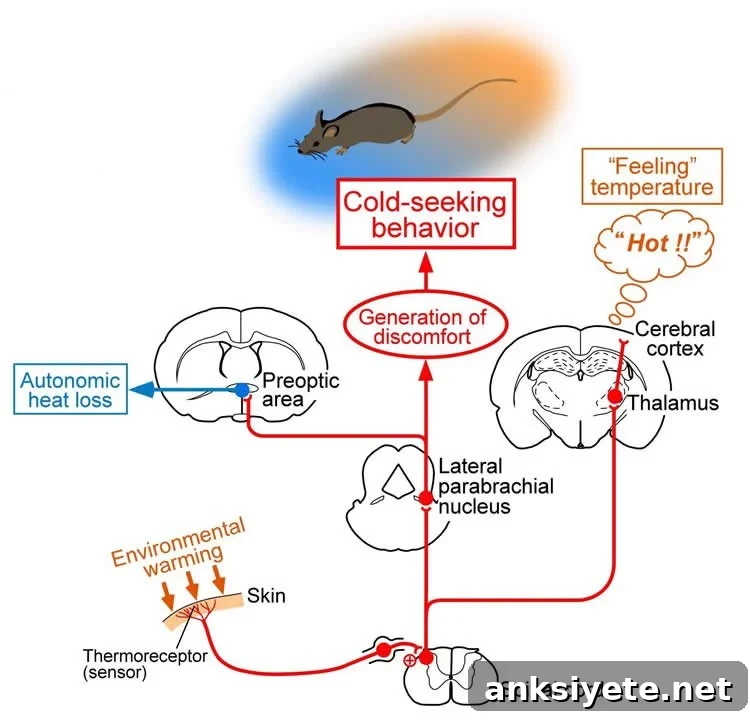
The team focused on two candidate pathways suggested by prior research: the spinothalamocortical (STC) pathway, which conveys cutaneous thermosensory signals to the cerebral cortex for conscious temperature perception, and the lateral parabrachial nucleus–preoptic area (LPB–POA) pathway, which relays cutaneous signals to hypothalamic thermoregulatory centers that coordinate autonomic and behavioral responses.
To test the roles of these pathways, the researchers injected neurotoxic agents into specific brain regions to disable each pathway in turn and then measured the rats’ temperature-related behavior. Experimental animals were placed on an apparatus containing two floor plates kept at different temperatures, allowing the rats to choose their preferred surface temperature. Under control conditions, rats reliably preferred the mildly warm 28°C plate over colder (15°C) or hotter (38°C) plates.
When the investigators lesioned thalamic regions involved in the STC pathway, they observed a surprising dissociation: electrophysiological recordings showed that responses to skin temperature changes in the primary somatosensory cortex were greatly diminished, indicating loss of cortical thermosensory signaling and conscious temperature perception. Yet the thalamic-lesioned rats continued to select the 28°C plate and avoided the extremes, demonstrating that intact cortical temperature sensation is not required for normal thermoregulatory behavior.
In contrast, inactivation of neurons in the LPB produced a markedly different outcome. Rats with LPB disruption no longer avoided the cold or hot plates and failed to seek comfortable temperatures. Continuous body-temperature measurements revealed that these animals developed hyperthermia when exposed to warm surfaces, showing that the organism’s ability to enact autonomic heat-loss responses and behaviorally escape thermal stress had been compromised. In short, the LPB pathway was necessary for generating the discomfort or drive that elicits avoidance behavior and for initiating autonomic defenses against overheating.
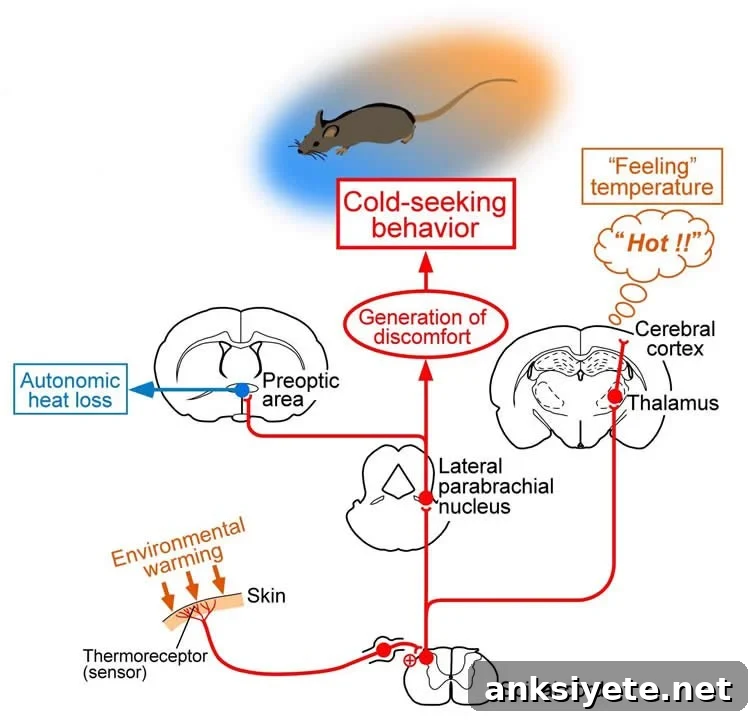
“These experiments reveal distinct functions for two thermosensory pathways: the spinothalamocortical route contributes to cortical temperature perception, whereas the lateral parabrachial nucleus pathway is essential for producing the aversive drive and autonomic responses that underlie behavioral thermoregulation,” says senior author Kazuhiro Nakamura. By separating perception from behavioral control, the work clarifies how thermal comfort and discomfort are generated in the brain and how those signals translate into actions that preserve core temperature.
The researchers plan to follow up by mapping the specific neuronal populations within these pathways, and by investigating how emotion-related brain regions interact with thermosensory circuits to shape comfort-seeking behavior. Such studies may deepen understanding of the neural basis of thermal preference and could inform strategies for treating thermoregulatory dysfunction in humans.
Funding: Support came from the Ministry of Education, Culture, Sports, Science and Technology of Japan, the Japan Science and Technology Agency, Hori Science and Art Foundation, the Takeda Science Foundation, and other funding bodies.
Source: Koomi Sung, Nagoya University. Image credit: Kazuhiro Nakamura. Original research: Takaki Yahiro, Naoya Kataoka, Yoshiko Nakamura & Kazuhiro Nakamura, “The lateral parabrachial nucleus, but not the thalamus, mediates thermosensory pathways for behavioural thermoregulation,” Scientific Reports, published online July 10, 2017. DOI: 10.1038/s41598-017-05327-8.
Nagoya University (2017). Different sensory pathways engaged in feeling and responding to external temperature. Neuroscience news summary, August 3, 2017.
Abstract
The lateral parabrachial nucleus, but not the thalamus, mediates thermosensory pathways for behavioural thermoregulation
Thermoregulatory behavior—such as moving to a comfortable thermal environment—is an innate strategy that supports efficient autonomic regulation of body temperature while conserving resources. This study identifies the central ascending thermosensory pathway that transmits cutaneous temperature information to elicit thermoregulatory behavior. Lesions of thalamic regions that mediate the spinothalamocortical pathway impaired cortical electroencephalographic responses to skin temperature changes, confirming functional disruption of cortical thermosensory signaling. Despite this loss, thalamic-lesioned rats retained normal heat- and cold-avoidance behaviors in a two-plate temperature preference test. In contrast, inactivation of neurons in the lateral parabrachial nucleus abolished both heat- and cold-avoidance behaviors and eliminated heat-defense responses, demonstrating that the LPB—but not the thalamus—is required for cutaneous thermosensory signaling that drives behavioral thermoregulation. These findings refine the central circuit model for thermal comfort and discomfort and illuminate how distinct pathways support perception versus action in thermoregulation.
Article authors: Takaki Yahiro, Naoya Kataoka, Yoshiko Nakamura & Kazuhiro Nakamura. Scientific Reports, published online July 10, 2017. DOI: 10.1038/s41598-017-05327-8.