
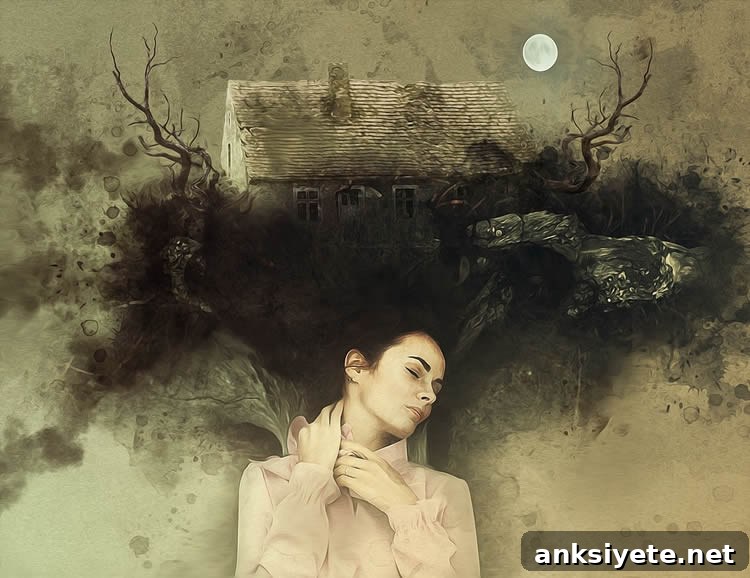
Summary: Psychologists examine why haunted houses make us feel creeped out, concluding they unsettle us not because of clear danger but because it is unclear whether or not they pose a real threat.
Source: The Conversation.
The haunted house is a time-honored setting for horror.
We have all shivered through classic scary films set in haunted houses, from The Haunting and The Amityville Horror to The Sentinel and Poltergeist. It’s not only at the movies that people seek out fear: commercial haunted-house attractions are a major part of contemporary Halloween traditions. These attractions deliberately use the same cues and motifs we recognize from film and folklore to provoke fear.
The familiar features of haunted houses work on deep-seated psychological processes. Many of the sensations they produce — dread, unease, and the prickling sense that something might be watching — tap into cognitive and evolutionary mechanisms that developed long before there were modern homes. Those mechanisms are designed to detect and respond to potential threats, especially when danger is uncertain.
Ambiguous threat: the core of why haunted houses creep us out
Haunted houses unsettle us because they create ambiguity about whether a real threat is present. That uncertainty triggers a prolonged state of hypervigilance: you feel frozen or anxious because you don’t know whether to flee or stay put. Social norms make it awkward to overreact in a harmless setting, yet ignoring a genuine danger could be costly. This tension — between self-preservation and social self-presentation — is central to the “creeped out” feeling and explains why haunted environments are so effective at producing sustained fear.
Agent detection: why creaks and rustles matter
Evolutionary psychologists describe an “agent detection” system that causes us to assume a willful agent might be nearby when we hear unexplained noises or notice subtle cues of movement. If you walk alone through the woods and a bush rustles, your brain treats it as if something with intent might be present. Overreacting to a false alarm usually costs little, while failing to respond to a real predator can be fatal. Haunted houses exploit this bias: rattling floorboards, sighing winds, fluttering curtains, echoes, and sudden cold spots all signal possible agency and keep our alarm systems active.
Feeling trapped intensifies fear
Environmental psychology shows we need more personal space in some situations than in others — more room when seated, more room in corners, and more headroom with higher ceilings. We become especially uncomfortable in places where escape feels difficult. Haunted houses are often portrayed as isolated and remote, with confusing layouts, dark corridors, and obstacles that could impede fleeing. These features reduce our perceived ability to escape, amplifying anxiety. In fictional horror, phones conveniently fail and roads become impassable, underlining the sense of helpless isolation.
A “womb with a view” gone wrong
British geographer Jay Appleton coined the terms “prospect” and “refuge” to describe why some places feel attractive and safe. Prospect refers to a clear, unobstructed view of the surroundings; refuge refers to a sheltered, protected spot. Favorable environments typically give both prospect and refuge — a secure place from which one can also observe threats. Haunted houses often invert this balance: the building itself may offer hiding places (refuge) for unknown dangers while depriving occupants of good visual prospect. Low legibility — a layout that is hard to read, remember, or navigate — further increases the sense of danger. Large, dark houses with winding staircases, secret rooms, attics, and basements create poor prospect and high refuge for threats, a combination that people instinctively judge as unsafe.
The effect of age, relics, and interrupted life
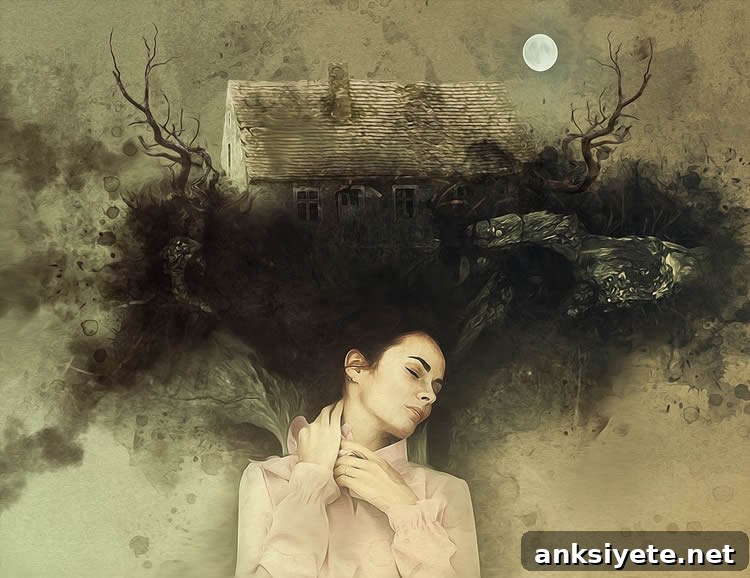
Many haunted houses come with a backstory: a legend of tragedy, accident, suicide, or murder. Older places feel more likely to be haunted, simply because age implies more time for past events to have occurred. Visual and sensory cues that suggest antiquity — wood-paneled rooms, Victorian or Gothic architecture, the smell of mold, and faded portraits — boost the sense that something in the house belongs to the past and may have been left in an unfinished, ominous state. Signs that life was abruptly interrupted — a half-eaten meal on a kitchen table, clothing laid out as if someone just vanished — introduce disturbing ambiguity that fuels imagination and fear.
Beliefs and expectations shape experience
Perception of haunted houses depends not only on physical features but on the expectations and beliefs of the person inside. Individuals who already believe in the paranormal or expect supernatural events are more likely to interpret ambiguous stimuli as threatening or agentive. Top-down cognitive processes — the mind imposing meaning on uncertain cues — can transform otherwise ordinary sounds or sights into chilling experiences for these visitors.
Designing terror: what haunted houses get right
From a psychological standpoint, successful haunted houses exploit the same cues that trigger our evolved alarm systems: ambiguous threat cues, reduced escape options, poor prospect with high refuge for unseen agents, low legibility, signs of age or recent disruption, and the power of expectation. Those design principles explain both why haunted houses feel so effective at provoking fear and how simple environmental features can be arranged to maximize unease while keeping people safe.
Source: Frank T. McAndrew – The Conversation
Publisher: Organized by NeuroscienceNews.com.
Image Source: Image is in the public domain.
MLA: The Conversation, “Why Haunted Houses Creep Us Out.” NeuroscienceNews, 29 October 2018.
APA: The Conversation (2018, October 29). Why Haunted Houses Creep Us Out. NeuroscienceNews. Retrieved October 29, 2018.
Chicago: The Conversation, “Why Haunted Houses Creep Us Out.” (accessed October 29, 2018).