
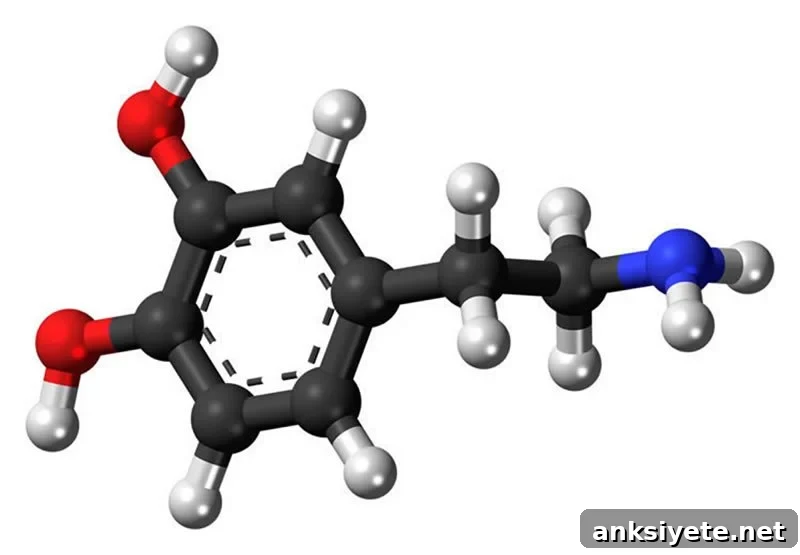
Summary: Long-term exposure to psychosocial adversity appears to reduce the brain’s ability to produce dopamine in response to acute stress, which may contribute to increased vulnerability to mental illness and addiction.
Source: eLife
Key finding: People who have experienced sustained psychosocial adversity across their lives may be less able to mount a normal dopaminergic response to sudden stressful events, potentially explaining part of the link between chronic trauma and later mental health problems.
Researchers publishing in eLife used positron emission tomography (PET) to investigate how lifetime exposure to psychosocial stress affects dopamine synthesis and the immediate physiological and psychological responses to an acute stressor. The study offers a plausible biological mechanism that could help explain why prolonged psychological trauma and adversity increase the risk of disorders such as depression, schizophrenia, and substance use problems.
Dr Michael Bloomfield, lead author and leader of the Translational Psychiatry Research Group at University College London, explains: “We already know that chronic psychosocial adversity can induce vulnerability to mental illnesses such as schizophrenia and depression. What we’re missing is a precise mechanistic understanding of how this risk is increased.”
To probe that mechanism, the team recruited 34 volunteers and divided them into two groups based on lifetime exposure to psychosocial adversity: 17 people with high cumulative exposure and 17 age- and sex-matched people with low exposure. All participants underwent the Montréal Imaging Stress Task, a standardized procedure that induces acute psychosocial stress by combining demanding mental arithmetic with social evaluation and critical feedback.
Two hours after completing the stress task, each participant received an injection of a small amount of the radioactive tracer 3,4-dihydroxy-6-[18F]-fluoro-l-phenylalanine ([18F]-DOPA). PET scans using this tracer enabled the researchers to measure dopamine synthesis capacity across the striatum.
The scans showed a clear difference between the groups. In participants with low lifetime exposure to psychosocial adversity, dopamine synthesis capacity correlated with the subjective degree of threat they reported and with physiological markers of stress. In other words, when these individuals perceived greater threat during the task, their dopaminergic activity rose proportionally.
By contrast, participants with high lifetime exposure to adversity displayed an altered pattern: they reported stronger subjective feelings of threat, yet their striatal dopamine synthesis was reduced. Other physiological stress responses were also blunted in this group — increases in blood pressure and cortisol seen in the low-adversity group were smaller or absent among those with high adversity exposure.
Dr Bloomfield stresses caution about causal claims: “This study can’t prove that chronic psychosocial stress causes mental illness or substance abuse later in life by lowering dopamine levels. But we have provided a plausible mechanism for how chronic stress may increase the risk of mental illnesses by altering the brain’s dopamine system.”
Oliver Howes, senior author and Professor of Molecular Psychiatry, adds: “Further work is now needed to better understand how changes in the dopamine system caused by adversity can lead to vulnerability towards mental illnesses and addiction.” The authors highlight the need for longitudinal and mechanistic studies that clarify whether and how these dopaminergic alterations contribute directly to the onset of psychiatric conditions.
Source:
eLife
Media Contacts:
Emily Packer – eLife
Image source:
The image is in the public domain.
Original Research (open access):
“The effects of psychosocial stress on dopaminergic function and the acute stress response.” Michael AP Bloomfield, Robert A McCutcheon, Matthew Kempton, Tom P Freeman, Oliver Howes. eLife. DOI: 10.7554/eLife.46797
Abstract (summary)
Chronic psychosocial adversity increases vulnerability to mental illness. Animal models indicate this may involve dopaminergic dysfunction. The researchers used [18F]-DOPA PET to compare dopamine synthesis capacity in 17 human participants with high cumulative exposure to psychosocial adversity and 17 age- and sex-matched participants with low exposure. PET scans were performed two hours after inducing acute psychosocial stress with the Montréal Imaging Stress Task. In the low-exposure group, dopamine synthesis correlated with subjective threat and physiological stress responses. In contrast, long-term exposure to psychosocial adversity was associated with reduced striatal dopamine synthesis (p = 0.03, d = 0.80), a blunted physiological stress response, and an exaggerated subjective sense of threat. Future research should examine how these changes contribute to risk for psychiatric disorders.