
Summary: New research on the gar fish shows that the modern eye-to-brain wiring appeared far earlier in vertebrate evolution than previously thought.
Source: Michigan State University
The neural wiring that links our eyes to the brain is more ancient than scientists had assumed, and a surprising study subject—the gar fish—helped reveal why.
Researchers, including Ingo Braasch of Michigan State University, have shown that the pattern of eye-to-brain connections present in humans already existed in ancient bony fish at least 450 million years ago. That pushes back the origin of this wiring by roughly 100 million years compared with earlier estimates.
“This is the first time a paper I helped publish has required me to change the textbook I use in class,” said Braasch, assistant professor in the Department of Integrative Biology in the College of Natural Science.
Published in Science on April 8, the study demonstrates that the neural arrangement allowing each eye to send information to both hemispheres of the brain predates the move of vertebrates onto land. Previously, many researchers believed this bilateral connection evolved in tetrapods (four-limbed terrestrial vertebrates) and later supported binocular depth perception and three-dimensional vision in mammals, including humans.
Beyond revising evolutionary timelines, the findings have practical implications for biomedical research that uses animal models to study human vision and neurological disease. Not all popular laboratory fish mirror human visual wiring—zebrafish, for example, typically route retinal signals exclusively to the opposite (contralateral) brain hemisphere, a pattern that differs from human anatomy.
“Modern teleost fish like zebrafish don’t show this type of eye-brain connection,” Braasch explained. “That’s one reason scientists previously thought bilateral visual projections were a tetrapod innovation.”
Gars, by contrast, have evolved more slowly and retain anatomical and genetic features closer to the last common ancestor of bony fishes and tetrapods. Those conserved traits make gar a valuable comparative model for understanding how key aspects of vertebrate anatomy—including visual circuitry—arose and were modified over hundreds of millions of years.
Braasch’s expertise with spotted gar enabled an international team led by researchers at Inserm in France to include this comparatively rare species in their survey of visual wiring across diverse fishes. Alain Chédotal of Inserm, director of research and a group leader at the Vision Institute in Paris, emphasized Braasch’s essential role: “We did not have access to spotted gar, a fish that does not exist in Europe and occupies a key position in the tree of life. Without his help, this project wouldn’t have been possible.”
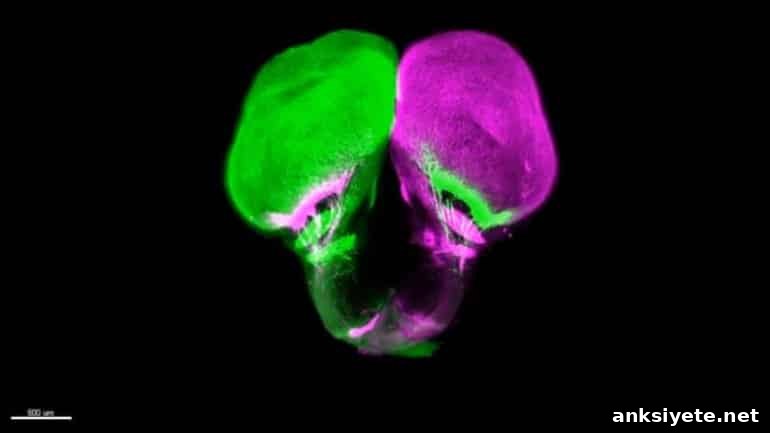
Using advanced imaging methods, the team mapped optic nerve projections in multiple fish species, from widely studied zebrafish to less common species such as spotted gar and Australian lungfish. In zebrafish, each eye typically connects to the opposite hemisphere: the left eye projects to the brain’s right side and the right eye to the left. But in gar and other non-teleost bony fishes, the researchers found ipsilateral (same-side) as well as contralateral projections—meaning each eye sends fibers to both hemispheres, paralleling the arrangement seen in humans.
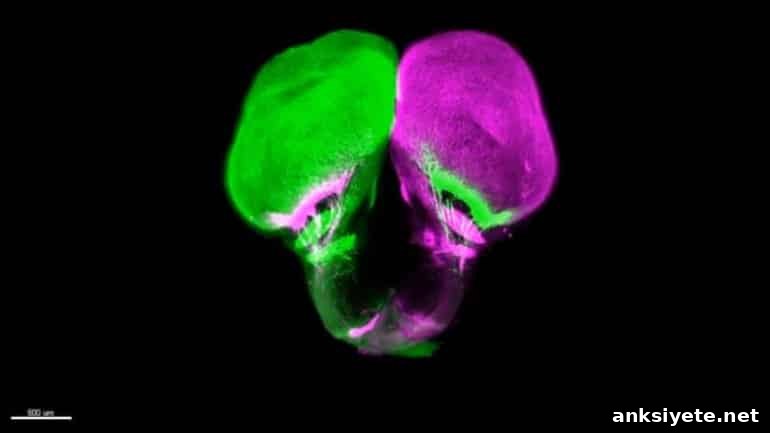
Combining anatomical data with genetic and developmental analyses, the team estimated when bilateral visual projections first appeared. Their results indicate that ipsilateral retinal projections were present in ancient bony fish long before the terrestrial transition, implying that the neural groundwork for binocular vision existed in aquatic ancestors of tetrapods.
The study also explored developmental mechanisms. While the Zic2 transcription factor directs the specification of ipsilateral retinal ganglion cells in tetrapods, the investigators did not detect Zic2 in fish retinal ganglion cells, suggesting that fishes and mammals use different molecular programs to establish visual laterality. Remarkably, overexpressing human ZIC2 in zebrafish can induce ipsilateral projections, highlighting conserved responsiveness in the developmental system despite evolutionary differences in gene expression patterns.
Lead authors and collaborators say this work is only a starting point. The researchers plan to expand comparative studies across more species and to probe the developmental and genetic mechanisms that produce diverse patterns of visual connectivity. Chédotal praised the collaboration: “What we found in this study was just the tip of the iceberg. We can’t wait to continue the project.”
For Braasch, the findings underscore a broader pattern emerging from comparative evolutionary biology: many anatomical features thought to be recent innovations are in fact ancient. “I learn something about myself when I study these unusual fish and discover how old parts of our own bodies are,” he said. He looks forward to sharing the revised story of eye evolution with students in his Comparative Anatomy course.
About this evolutionary neuroscience research news
Source: Michigan State University
Contact: Caroline Brooks – Michigan State University
Image: The image is credited to R.J. Vigouroux et al. Science
Original Research: Closed access.
“Bilateral visual projections exist in non-teleost bony fish and predate the emergence of tetrapods” by Ingo Braasch et al. Science
Abstract
Bilateral visual projections exist in non-teleost bony fish and predate the emergence of tetrapods
In most vertebrates, camera-style eyes contain retinal ganglion cells that send axons to visual centers on both sides of the brain. Historically, fish were thought to route ganglion cell projections only to the contralateral hemisphere, suggesting that bilateral visual pathways emerged with tetrapods.
This study shows that ipsilateral retinal projections are present in several non-teleost bony fish and that their occurrence does not align with the transition to land or with predatory lifestyle. The developmental program that establishes visual laterality also differs between fishes and mammals: the Zic2 transcription factor, which specifies ipsilateral retinal ganglion cells in tetrapods, appears absent from fish ganglion cells.
Nevertheless, forced expression of human ZIC2 in zebrafish induces ipsilateral projections, indicating that the capacity for bilateral projection patterns preceded the evolution of binocular vision in terrestrial vertebrates.