
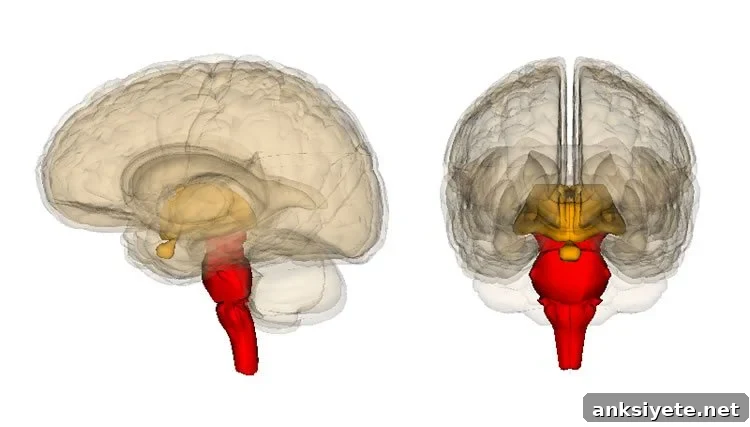
Researchers at Karolinska Institutet have identified a specific population of brainstem neurons that are essential for stopping locomotion in mice. Published in the journal Cell, the study describes a descending pathway from the rostral medulla whose selective activation causes immediate arrest of movement, while its suppression makes stopping more difficult. The findings reveal a dedicated neural mechanism that gates the episodic nature of locomotor behavior.
Locomotion is a fundamental motor behavior for animals and humans alike. It is inherently episodic: we initiate movement when needed and are able to terminate it when we choose. Traditionally, episodic control of movement has been attributed to descending excitatory signals from the brainstem that activate spinal circuits responsible for generating rhythmic locomotor patterns. The new work asks whether the ability to stop movement simply reflects the absence of those excitatory drive signals or whether the brain also issues an active “stop” command.
The research team, led by Julien Bouvier, Vittorio Caggiano and Professor Ole Kiehn, used a combination of modern neuroscience tools to study how complex brainstem circuits control locomotion in mice. Their approach included optogenetics, which permits precise activation of genetically targeted neurons with light, and genetic silencing techniques that selectively block neuronal activity. These methods allowed the researchers to identify and manipulate a discrete population of excitatory neurons in the reticular formation known as V2a neurons.
Surprisingly, this excitatory V2a population proved critical for halting movement. When researchers optogenetically activated these neurons in the rostral medulla, mice stopped walking almost instantaneously. By contrast, when the same neurons were silenced genetically, animals showed reduced ability to terminate locomotion spontaneously. The results indicate that these “stop cells” provide a descending glutamatergic signal whose engagement promotes immobility.
Electrophysiological and circuit analyses in the study suggest that the stop cells do not inhibit motor neurons that directly contract muscles. Instead, their activity suppresses the spinal neuronal networks that generate the locomotor rhythm — effectively switching off the internal “clock” that drives repetitive stepping. According to Professor Ole Kiehn, this arrangement enables an animal to stop gracefully without losing muscle tone, much like the deliberate way humans halt when confronted with an obstacle.
Although the experiments focused on normal brain function in mice, the discovery may have broader implications for understanding locomotor deficits in disease. For example, Parkinson’s disease is characterized by gait disturbances, including episodes of freezing where patients are unable to initiate or continue stepping. The authors suggest it is possible that abnormal activity within the stop-cell pathway could contribute to such symptoms, though additional work will be required to test that hypothesis directly.
Funding: The study received support from several organizations, including the Swedish Brain Foundation, the Söderberg Foundations, the Swedish Research Council, the European Research Council, an EMBO fellowship, and the NIH.
Source: Karolinska Institutet
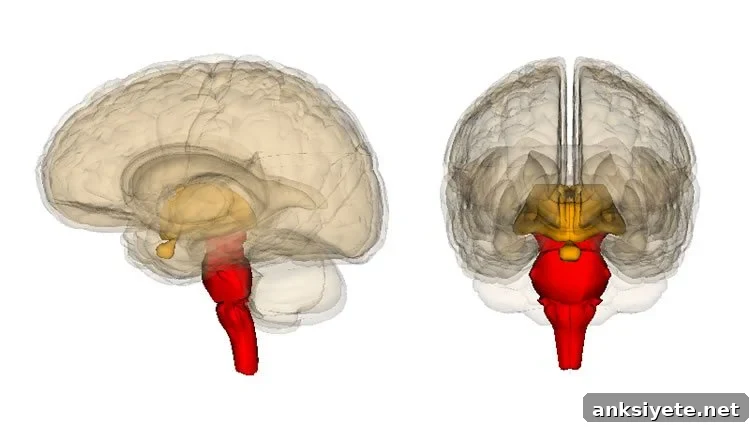
Image credit: Life Science Databases (LSDB). The image is credited to LSDB and provided under a permissive license.
Original research: The study is titled “Descending command neurons in the brainstem that halt locomotion” and was authored by Julien Bouvier, Vittorio Caggiano, Roberto Leiras, Vanessa Caldeira, Carmelo Bellardita, Kira Balueva, Andrea Fuchs, and Ole Kiehn. It was published in Cell in November 2015.
Abstract summary
Descending command neurons in the brainstem that halt locomotion
Highlights
• V2a neurons in the brainstem are glutamatergic (excitatory) and project to ventral regions of the spinal cord.
• Optogenetic activation of rostral medullary V2a neurons halts ongoing locomotion in mice.
• These “V2a stop neurons” operate by suppressing the spinal locomotor rhythm generator rather than directly inhibiting motor neurons.
• V2a stop neurons are necessary for normal episodic stopping during locomotion.
Summary
The episodic pattern of locomotion has been primarily attributed to descending excitatory commands that initiate and sustain rhythmic spinal circuits. However, dedicated signals that actively terminate movement have been less well defined. By targeting V2a neurons in the reticular formation and manipulating them with genetic and optical tools, the authors demonstrate that this population constitutes a major excitatory projection to locomotor regions of the ventral spinal cord. Activation of V2a neurons in the rostral medulla produces an immediate stop of locomotor activity by inhibiting premotor rhythm-generating networks in the spinal cord. Conversely, inactivating these neurons reduces spontaneous stopping behavior. Thus, V2a “stop neurons” form a descending glutamatergic pathway that promotes immobility and helps shape the episodic structure of locomotion.