
Summary: New research shows Neanderthals had auditory and vocal capacities comparable to modern humans, enabling them to perceive and produce human speech.
Source: Binghamton University
Neanderthals — the closest extinct relatives of modern humans — had the hearing and vocal capabilities necessary for human-like speech, according to a new multidisciplinary study that includes researchers from Binghamton University, Universidad Complutense de Madrid, and other international institutions.
Rolf Quam, an anthropology professor at Binghamton University and a coauthor of the study, calls this one of the most significant projects in his career. “The evidence is robust and indicates Neanderthals could both perceive and produce the sounds used in human speech,” Quam says. The team’s findings rely on fossil evidence and advanced auditory modeling to address a complex question in human evolution: when and how speech emerged.
For decades, scientists have debated whether spoken language was unique to Homo sapiens or shared with other hominins such as Neanderthals. Juan Luis Arsuaga, Professor of Paleontology at the Universidad Complutense de Madrid and co-director of the Atapuerca excavations, explains that the study reconstructs how Neanderthals heard, which offers important clues about how they might have communicated.
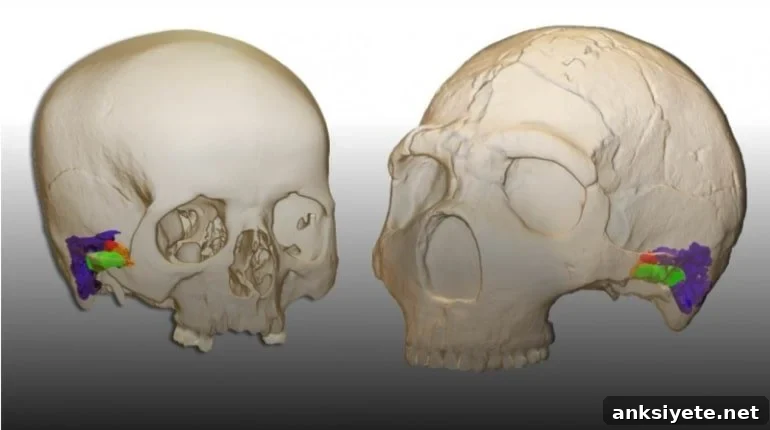
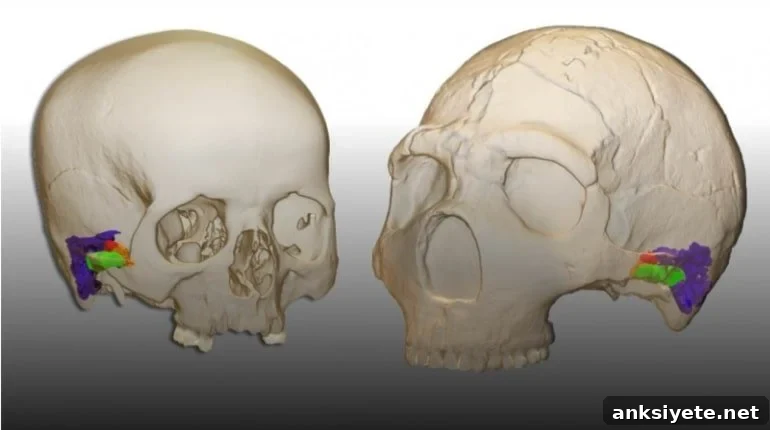
The research team created high-resolution CT-based 3D models of the outer and middle ear from modern humans, several Neanderthal specimens, and earlier hominin fossils from Atapuerca representing Neanderthal ancestors. These detailed reconstructions were then analyzed with software developed in auditory bioengineering to estimate sound transmission and sensitivity up to 5 kHz — the frequency range that encompasses most modern human speech sounds.
Compared with the older Atapuerca fossils, Neanderthals showed slightly enhanced hearing sensitivity in the 4–5 kHz range and overall auditory profiles that more closely resemble those of modern humans. The researchers also estimated the “occupied bandwidth” for each group — the frequency range where auditory sensitivity is highest and which relates directly to the efficiency of a species’ vocal communication system.
A wider occupied bandwidth permits a greater number of clearly distinguishable acoustic signals, improving the speed and clarity of vocal communication. The study found that Neanderthals had a wider occupied bandwidth than the Atapuerca hominins and one similar to modern humans, suggesting their auditory system supported a rich and efficient vocal repertoire.
“This is the key result,” says Mercedes Conde-Valverde, lead author and professor at the Universidad de Alcalá. “Neanderthals possessed hearing abilities, especially in bandwidth, that would support a communication system as complex and efficient as modern human speech.”
The study also suggests Neanderthal speech may have relied more heavily on consonants. Quam notes that prior research often emphasized vowel production, but consonants carry a high information load in human language and are a major factor distinguishing human speech from the vocal communication of other primates. Detecting this consonant-rich pattern in Neanderthals offers a novel perspective on their linguistic abilities.
Taken together, the findings indicate that Neanderthals not only could produce the range of sounds used in human speech but their auditory systems were well tuned to perceive those sounds. These auditory changes coincide with archaeological evidence showing increasingly complex Neanderthal behavior over time, including advances in stone tool technology, use and control of fire, and potential symbolic activities.
The results therefore support the idea of coevolution between complex behavior and efficient vocal communication across human evolution. The research team has been developing this line of inquiry for nearly twenty years and plans to expand analyses to additional fossil species to map how hearing and speech capabilities changed across hominin lineages.
“After more than a century of study on this topic, we believe these results provide a decisive perspective on Neanderthal speech capacities,” says Ignacio Martínez of the Universidad de Alcalá. The authors emphasize, however, that further fossil data and continued interdisciplinary work will refine our understanding of how speech evolved.
About this evolution and speech research news
Source: Binghamton University
Contact: Binghamton University
Image credit: Mercedes Conde-Valverde
Original research: Closed access. Title: “Neanderthals and Homo sapiens had similar auditory and speech capacities” by Mercedes Conde-Valverde et al., published in Nature Ecology & Evolution.
Abstract
Neanderthals and Homo sapiens had similar auditory and speech capacities
Auditory function in fossil hominins is closely linked to the potential for intraspecific vocal communication. While early hominins and Middle Pleistocene Sima de los Huesos hominins have been studied, Neanderthal hearing has been less well understood. Using computerized tomography and an auditory bioengineering model, this study reconstructed sound power transmission through the outer and middle ear and calculated occupied bandwidth in Neanderthals. The occupied bandwidth is directly related to the efficiency of a species’ vocal communication system. Results show Neanderthals had a greater occupied bandwidth than Sima de los Huesos hominins and a bandwidth similar to modern humans, implying Neanderthals evolved auditory capacities capable of supporting a vocal communication system as efficient as modern human speech.