
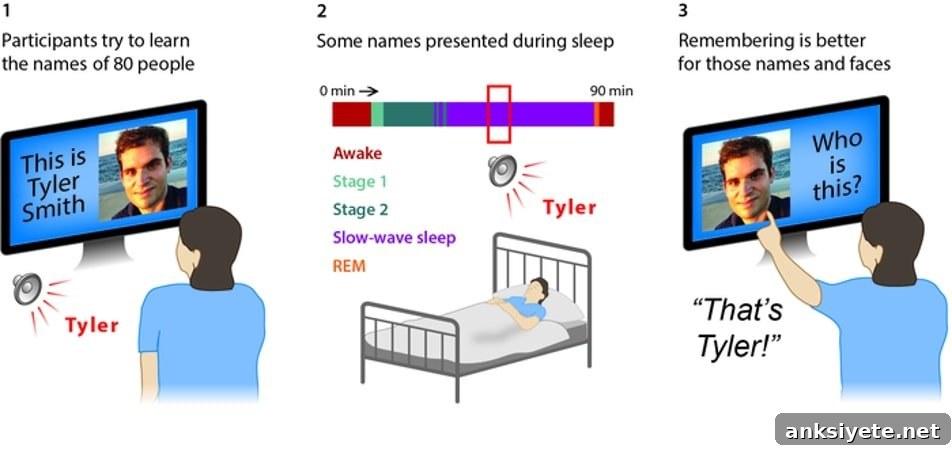
Summary: New Northwestern University research shows that deep, uninterrupted sleep can strengthen memory for faces and names when specific memories are reactivated during slow-wave sleep.
Source: Northwestern University
Struggling to remember names while faces stay familiar? The solution might be a better nap.
A study from Northwestern University provides the first clear evidence that reactivating memories during sleep can enhance face-name learning. The researchers found that when newly learned face-name associations were cued during deep sleep, participants recalled more names afterward — but only if their slow-wave sleep remained ample and uninterrupted.
Lead author Nathan Whitmore, a Ph.D. candidate in Northwestern’s Interdepartmental Neuroscience Program, described the finding as “new and exciting,” noting that it links the quality of deep sleep with the brain’s ability to replay information and consolidate memories.
The study, titled “Targeted memory reactivation of face-name learning depends on ample and undisturbed slow-wave sleep,” is scheduled for publication in the Nature partner journal NPJ: Science of Learning on Jan. 12. The senior author is Ken Paller, professor of psychology and director of the Cognitive Neuroscience Program at Weinberg College of Arts and Sciences at Northwestern. Co-author Adrianna Bassard is a Ph.D. candidate in psychology at Northwestern.
In the experiment, 24 healthy adults between the ages of 18 and 31 learned 80 face-name pairs: 40 associated with a hypothetical Latin American history class and 40 with a Japanese history class. After the initial learning phase, each face was shown again and participants attempted to recall the name paired with that face.
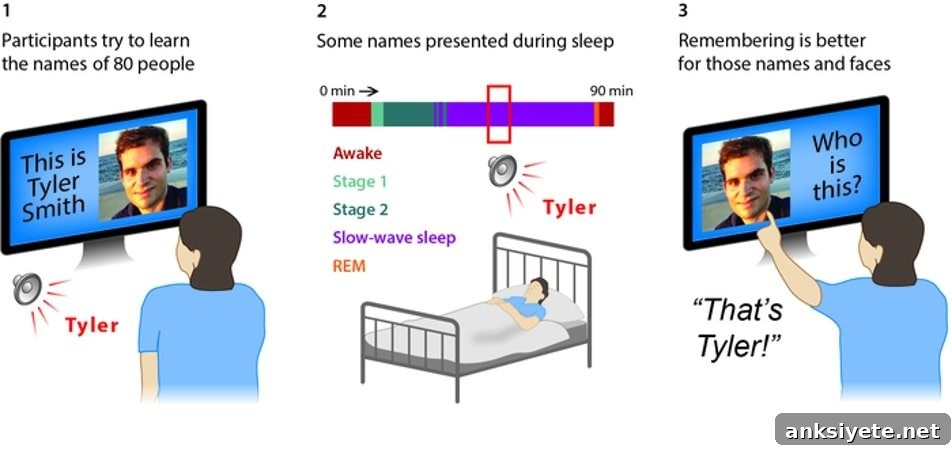
Following the learning session, participants took a monitored daytime nap while researchers recorded brain activity using electroencephalography (EEG). During periods of N3 slow-wave sleep, the research team softly played spoken names tied to a background music cue for one of the class sets. These audio cues were intended to trigger targeted memory reactivation for a subset of the face-name pairs.
When participants woke and were retested, the study found a clear benefit for the reactivated items: on average, participants recalled just over 1.5 more names for the cued face-name pairs compared with uncued pairs. Crucially, this improvement depended on sleep quality. Participants whose EEG showed disrupted sleep around the time of the sound presentations did not benefit, and reactivation under disrupted conditions could even harm memory.
The connection between memory improvement and uninterrupted slow-wave sleep has important implications. “We already know that some sleep disorders like apnea can impair memory,” Whitmore said. “Our research suggests a potential explanation for this — frequent sleep interruptions at night might be degrading memory by interfering with reactivation processes.”
Paller emphasized that the study points to both possibilities and cautions: reactivation during deep sleep can strengthen associative memories like face-name links, but the effectiveness of this approach hinges on the presence of stable, undisturbed N3 sleep. The lab is now pursuing follow-up work to deliberately disrupt sleep during memory reactivation, aiming to better understand the underlying brain mechanisms and boundary conditions.
This line of research raises practical and scientific questions: Could improving sleep quality enhance learning in everyday contexts? Might controlled sleep disruption ever be used therapeutically to weaken unwanted memories? For now, the findings add to a growing body of evidence underscoring the value of high-quality sleep for memory consolidation.
About this memory and sleep research news
Author: Stephanie Kulke
Source: Northwestern University
Contact: Stephanie Kulke – Northwestern University
Image: The image is credited to Nathan Whitmore, a Ph.D. candidate in the Interdepartmental Neuroscience Program at Northwestern University.
Original Research: Open access. “Targeted memory reactivation of face-name learning depends on ample and undisturbed slow-wave sleep” by Ken Paller et al., NPJ: Science of Learning.
Abstract
Targeted memory reactivation of face-name learning depends on ample and undisturbed slow-wave sleep
Face memory — including the ability to recall a person’s name — plays a central role in social interaction. Like many memory functions, it appears to depend on sleep. This study examined whether targeted memory reactivation during sleep could strengthen both associative and perceptual aspects of face memory.
Participants learned 80 face-name pairs; during a monitored daytime nap, a subset of spoken names accompanied by background music was presented unobtrusively during slow-wave (N3) sleep. This targeted reactivation selectively enhanced name recall and face recognition for reactivated pairs. Memory benefits correlated positively with the duration of N3 sleep and negatively with measures of sleep disruption.
The study concludes that (a) reactivating specific face-name memories during sleep can strengthen those associations and component memories, and (b) the effectiveness of such reactivation depends on ample, undisturbed slow-wave sleep.