
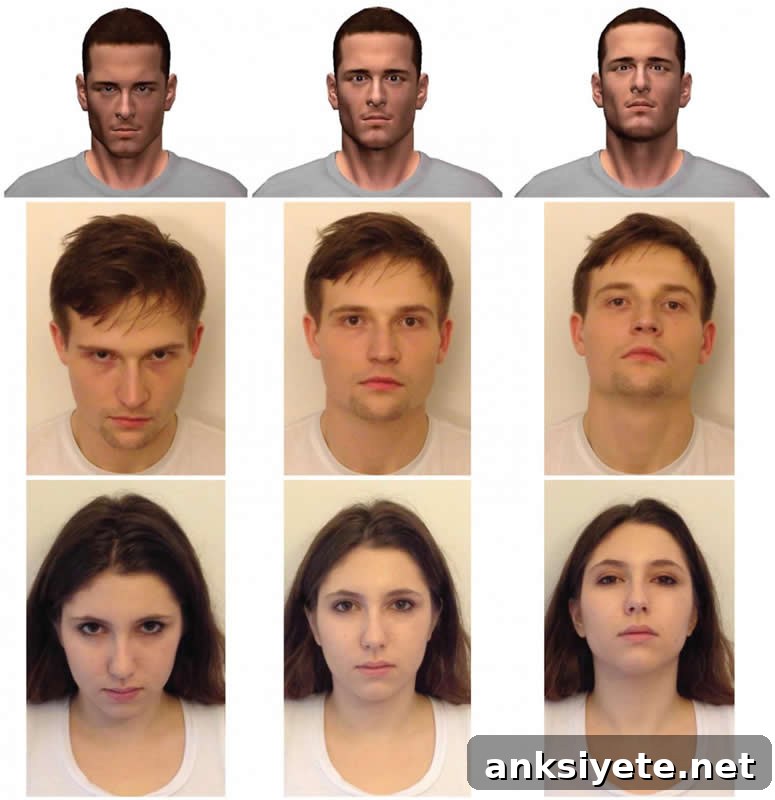
Summary: Tilting the head downward creates the illusion of a facial action that strongly alters social perception. New research shows that judgments about dominance and aggression are influenced not only by facial shape or muscle movement but also by the angle of the head.
Source: APS
Overview
We regularly scan faces for cues about others’ thoughts and emotions—whether the eyes are narrowed or wide, whether the mouth curves up or down. However, research published in the June 2019 issue of Psychological Science demonstrates that head position itself is a powerful source of social information. Tilting the head changes how an otherwise neutral face is read by observers, affecting impressions of dominance and intimidation.
Researchers Zachary Witkower and Jessica Tracy at the University of British Columbia show that a slight downward tilt of the head makes a neutral face look more dominant. The effect arises because a downward head tilt creates the visual impression of lower and V-shaped eyebrows, even when the face’s muscles remain relaxed. Those eyebrow cues, in turn, trigger perceptions of aggression, intimidation, and dominance.
“Neutral faces can still communicate a great deal,” the authors note. “Small shifts in head orientation can substantially alter how a face is perceived because the tilt changes the apparent shape of facial features.”
Study design and findings
Although previous studies have focused on facial expressions and muscle movements, Witkower and Tracy specifically tested whether static head angle alone would influence social judgments. They ran a series of studies using both computer-generated avatars and photographs of real people, always keeping facial expressions neutral so that any effects came from head position rather than facial musculature.
In an online experiment with 101 participants, the team presented avatars photographed with three head orientations: tilted upward by 10 degrees, neutral (0 degrees), and tilted downward by 10 degrees. Participants rated perceived dominance using statements such as “This person would enjoy having control over others” and “This person would be willing to use aggressive tactics to get their way.” Avatars with downward head tilts were rated as more dominant than those with neutral or upward tilts.
A larger online study with 570 participants who rated images of real people replicated this pattern: downward head tilt reliably increased perceived dominance even when the face itself showed no expression.
Role of the eye and eyebrow region
Further experiments isolated which parts of the face drive the effect. When participants could see only the eye and eyebrow region, the dominance effect from downward head tilt persisted; when the eye and eyebrow region was obscured but the rest of the face remained visible, the effect disappeared. This indicates that the eye–eyebrow area is both necessary and sufficient for the tilt-induced dominance impression.
Two additional studies pinpointed the mechanism: a lowered, V-shaped eyebrow appearance produced by the head tilt, not actual eyebrow muscle contraction, accounted for the increased dominance ratings. In other words, the physical angle of the head creates an illusory facial action that observers interpret the same way they would a genuine muscle-based expression.
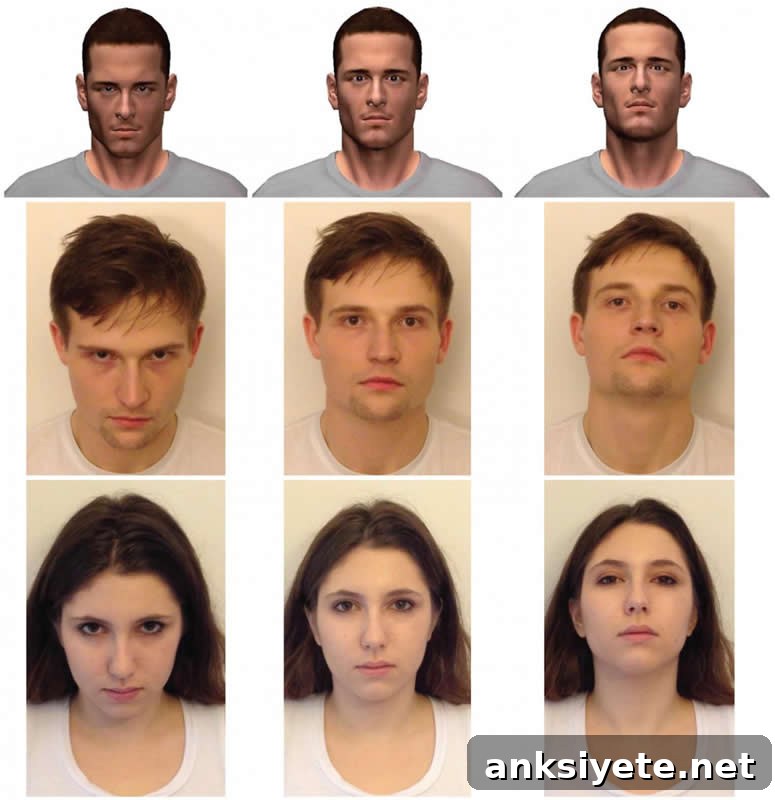
“Tilting the head downward can mimic the social signal produced by lowering one’s eyebrows—a motion attributed to the corrugator muscle known in the Facial Action Coding System as Action Unit 4—even though the eyebrows do not move,” the authors explain. They describe head tilt as an “action unit imposter” because it produces the visual impression of a facial action that is not actually present.
Implications and future directions
The findings suggest that social judgments about faces are shaped not only by facial morphology and muscle activity but also by the head’s orientation—the face’s physical foundation. Witkower and Tracy are continuing to explore whether head tilt affects perceptions beyond dominance, including how observers interpret emotional expressions.
Practically, this research implies that subtle head positions can change the social meaning of otherwise neutral or positive expressions. When people interact—smiling, nodding, or gesturing—how they hold their heads may add layers of unintended meaning to their expressions, potentially altering impressions of friendliness, authority, or threat.
Funding
This research was supported by a Canadian Institutes of Health Research Operating Grant (Ref. No. 123255) and a Social Sciences and Humanities Research Council Insight Grant (No. 435-2018-0154).
Source:
APS
Anna Mikulak – APS
Image source:
Image credit: Psychological Science.
Original research: Closed access
“A Facial-Action Imposter: How Head Tilt Influences Perceptions of Dominance From a Neutral Face.” Zachary Witkower, Jessica L. Tracy. Psychological Science. doi: 10.1177/0956797619838762
Abstract
Research on face perception typically emphasizes facial morphology and muscle activation while overlooking head position. Across five studies (total N = 1,517), this research demonstrates that downward head tilt, with gaze directed forward, increases perceived dominance by producing the illusory appearance of lowered, V-shaped eyebrows. Thus, head tilt acts as an action-unit imposter, creating the appearance of a facial action that strongly influences social perception. Social judgments of faces are therefore driven by facial shape and musculature as well as by movements of the head.