
Summary: The ion channel TRPC5 functions as a molecular cold sensor in teeth. Researchers identify TRPC5 as a potential target for reducing toothache pain and cold sensitivity.
Source: HHMI
For many people with tooth decay, even a sip of a cold drink can cause sharp, stabbing pain.
“It’s a very specific kind of pain,” says David Clapham, vice president and chief scientific officer of the Howard Hughes Medical Institute (HHMI). “It can be excruciating.”
An international team led by researchers at HHMI and Friedrich–Alexander University has now identified how teeth detect cold and which molecular and cellular components are involved. In both mice and human samples, odontoblasts—the cells that form dentin—contain the cold-sensitive ion channel TRPC5. When activated by temperature drops, these cells send signals that ultimately register as pain in the brain, the team reports in Science Advances.
The findings also shed light on why clove oil, a traditional remedy used in dentistry for centuries, can relieve tooth pain. The active compound in clove oil blocks the TRPC5 channel, reducing the sensor’s activity, explains Katharina Zimmermann, the electrophysiologist who led the study. Identifying TRPC5 as a target opens the possibility of designing more specific therapies to prevent or reduce cold-induced tooth pain.
A longstanding mystery
Tooth decay begins when bacterial films and acids wear away enamel, the hard outer layer of a tooth. As enamel erodes, cavities can expose underlying dentin and the sensitive pulp beneath. An estimated 2.4 billion people worldwide have untreated cavities in permanent teeth, and many of them experience intense sensitivity to cold.
Scientists have long debated how teeth sense temperature. One prevailing idea has been that fluid inside microscopic dentinal tubules moves when the tooth is heated or cooled, and that nerves detect this motion. But direct evidence for this ‘‘hydrodynamic’’ theory has been hard to obtain because studying intact teeth is technically challenging: researchers must penetrate the enamel and dentin without destroying the delicate pulp, blood vessels, and nerves.
Zimmermann, Clapham, and colleagues were not originally focused on teeth. Their primary interest is ion channels—protein pores in cell membranes that open or close in response to stimuli and create electrical signals. About fifteen years ago, when Zimmermann worked in Clapham’s lab, the group discovered that TRPC5 is highly cold-sensitive. At the time they could not find its role in skin or other tissues; mice lacking TRPC5 still responded to cold in many contexts, and the trail went cold.
The breakthrough came when the team asked which other tissues might detect cold. Teeth emerged as a strong candidate.
Whole-tooth experiments
Pathologist Jochen Lennerz examined human tooth specimens and found elevated TRPC5 expression in teeth affected by cavities. To test function, the team developed an experimental setup that preserved the entire tooth organ in mice—the jawbone, tooth, and the connecting nerves—and recorded neural responses while applying an ice-cold solution to the tooth surface.
In normal mice, the cold stimulus triggered nerve activity consistent with cold sensing. This response was greatly reduced in mice lacking TRPC5 or in teeth treated with a chemical blocker of the channel, indicating that TRPC5 has a key role in detecting cold. The researchers also found that another channel, TRPA1, contributes to the response.
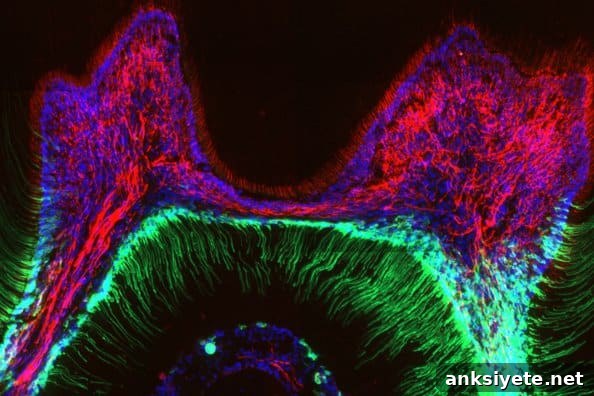
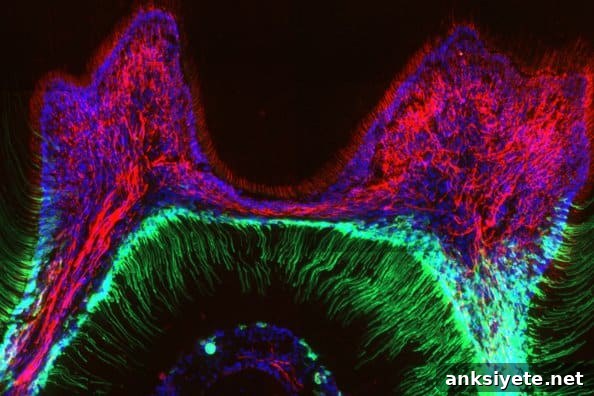
The team localized TRPC5 specifically to odontoblasts, the cells that form the interface between dentin and the pulp. In teeth where dentin is exposed—such as in cavities or after enamel erosion—odontoblasts packed with TRPC5 can detect temperature changes and convey a sharp pain signal to sensory nerves. This mechanism helps explain the characteristic sting of a cold drink on a sensitive tooth.
Clapham notes that tooth pain is an underappreciated but widespread concern. “It may not be glamorous science, but it matters to a lot of people,” he says. Zimmermann emphasizes the length of the effort: tracing the biological role of a single molecular sensor took more than a decade of careful work. “Good research can take time,” she adds.
About this neuroscience research news
Source: HHMI
Contact: Meghan Rosen – HHMI
Image: The image is credited to L. Bernal et al./Science Advances 2021
Original Research: Closed access. “Odontoblast TRPC5 channels signal cold pain in teeth” by Laura Bernal et al., Science Advances.
Abstract
Odontoblast TRPC5 channels signal cold pain in teeth
Teeth are complex structures covered by rigid enamel. Unlike most tissues, teeth can become extremely sensitive to cold when inflamed, but the biological mechanisms behind this sensitivity were unclear. This study clarifies the molecular and cellular components of dental cold sensing and demonstrates that odontoblasts are essential for transducing cold stimuli in teeth. TRPC5 operates as a cold sensor in healthy teeth and, together with TRPA1, is sufficient to generate cold responses. The odontoblast serves as the direct site of TRPC5-mediated cold transduction and can support prolonged cold sensing due to TRPC5’s sensitivity to intracellular calcium and its resistance to desensitization. These findings expand the known functions of odontoblasts and establish them as integral components of the dental cold-sensing system.