
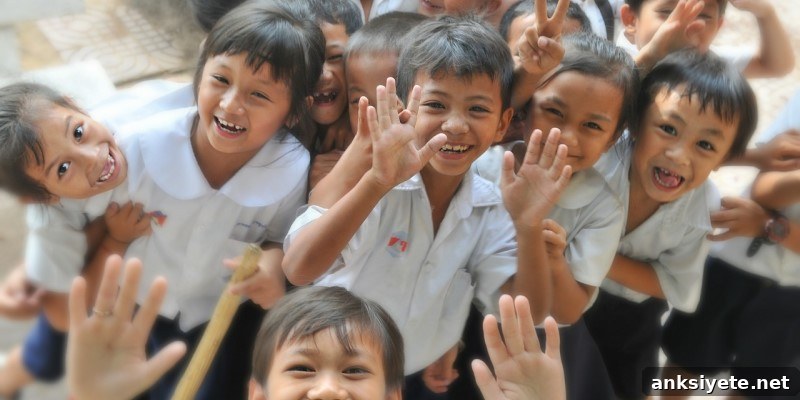
 School is where children and adolescents gain both academic knowledge and essential social abilities.
Interacting with others, making friends, cooperating, and resolving conflicts are social skills schools help develop by creating opportunities for students to engage with one another.
While many social skills emerge naturally through everyday interactions, the school environment is especially important for this learning. Teachers who understand the fundamentals of social skills training can intentionally support students’ social development across ages.
This article offers practical guidance for social skills training aimed at educators and caregivers. It covers how social skills develop, suggestions for fostering early social growth, key skills for teens, simple teaching strategies, games and activities, recommended resources, and lesson ideas you can use in the classroom or at home.
This Article Contains:
- How Do Social Skills Develop?
- Fostering Social Skills in Toddlers
- 3 Important Social Skills for Teenagers
- Teaching Social Skills 101
- Social Skills Training for Kids: 3 Games & Activities
- 4 Online Games & Board Games
- Resources for Teachers: 3 Lesson Plans & Tips
- Helpful Tools and Materials
- A Take-Home Message
- References
How Do Social Skills Develop?
Social skills develop through practice and experience—much like learning to ride a bike. Two foundational abilities are theory of mind and perspective taking.
Theory of mind, which develops during the preschool years, is the capacity to understand that other people have thoughts, desires, and beliefs that differ from one’s own. Its development typically follows predictable stages:
- Wanting: Recognizing that different people want different things and may act accordingly.
- Thinking: Understanding that people can hold different beliefs about the same event.
- Knowledge: Realizing that people have access to different information—someone who hasn’t seen something needs extra context to understand it.
- False beliefs: Appreciating that others can hold beliefs that are incorrect.
- Hidden feelings: Knowing that people can hide their emotions or display feelings that differ from what they truly feel.
As children develop these capacities, they become better at perspective taking—the ability to understand another person’s visual viewpoint and internal experience. Perspective taking supports empathy, flexible thinking, and healthier social interactions.
Fostering Social Skills in Toddlers
 Toddlers show wide variation in development, so building social skills at this stage requires patience and playfulness. Pretend play and role-play are especially powerful tools.
When adults join in a child’s imaginative play—staying in character during a game of “doctor,” for example—they give toddlers safe practice with different roles, emotions, and social scripts. Other effective strategies include:
- Follow their lead: Observe the child, get down to their level, copy their actions, and gently add new ideas as play develops.
- Put feelings into words: Even before toddlers can speak fluently, narrating their actions and emotions supports language, understanding, and early perspective taking.
- Use picture books to discuss emotions: Pictures of faces and short dialogues like “Pig’s mouth is down, and he looks sad” help children recognize and name feelings.
3 Important Social Skills for Teenagers
With increasing screen time and online communication, teens may have fewer chances for face-to-face social practice. Yet social and emotional skills remain critical for success in school and life. Three high-impact skills for adolescents are:
1. Active listening
Active listening involves attending to both the words and the emotional cues behind them. A simple classroom activity is a storytelling circle: one student begins a story, speaks two to three sentences, then the teacher says “stop.” Another student repeats the last sentence and continues the story. This exercise trains attention, memory, and respectful turn-taking.
2. Assertiveness
Assertive communication lets teens express opinions and boundaries clearly while respecting others. Practicing how to say “no” politely and how to state needs without aggression builds confidence and reduces passive or hostile responses.
3. Self-awareness
Self-awareness is recognizing one’s emotions and the situations that trigger them. When teens understand their feelings, they can select coping strategies and respond more empathetically to peers.
Teaching Social Skills 101
 Integrating social-emotional learning into a busy schedule can feel daunting. The most practical approach is to use short, low-preparation activities that fit into transitions and downtime.
Below are easy-to-run games and classroom practices that require little setup but provide consistent practice in cooperation, communication, and perspective taking.
Social Skills Training for Kids: 3 Games & Activities
These quick activities work across ages and encourage turn-taking, listening, and cooperation.
1. Charades
Charades develops perspective taking because players must interpret gestures and infer meanings. Divide the class into teams, have players act out items from categories (movies, animals, activities), and encourage discussion about different interpretations.
2. Passing the ball
One player starts a conversation on a chosen topic and then throws a ball to another student, who adds a related comment. Use a short timer (20–30 seconds) so everyone practices concise turn-taking and eye contact.
3. Checker stack
Three players take turns placing stackable tokens and adding a comment to a conversation. A judge (teacher or rotating peer) gives feedback. The tower grows while the players stay on topic; the round ends if someone becomes irrelevant or the tower falls. Model a round first so students understand expectations.
4 Online Games & Board Games
Games can be a fun, structured way to practice social skills such as perspective taking, emotion recognition, and assertiveness. Examples include:
1. Apples to Apples Jr.
This game encourages players to explain why a descriptive card matches a chosen adjective, promoting perspective taking and persuasive, respectful discussion.
2. Hall of Heroes
Designed for middle-schoolers, this digital game presents realistic social dilemmas—like peer pressure and exclusion—and allows players to explore consequences in a virtual setting, practicing assertive responses and decision-making.
3. My Feelings Game
A board game for younger children that uses scenarios, emotion-identification tasks, and role-play to build emotional awareness and empathy. It encourages players to describe situations that elicit emotions and compare perspectives.
4. TeachTown Social Skills
An interactive curriculum for children that teaches rules, communication, coping, friendship, and interpersonal skills through videos, stories, and guided exercises—useful especially for learners who benefit from clear modeling and repetition.
Resources for Teachers: 3 Lesson Plans & Tips
Teachers often need ready-to-use materials for moments when social challenges arise. The following adaptable lesson ideas work across ages and can be used on short notice.
1. Wanted: Friend
Students design a “wanted” poster that describes qualities of a good friend. This activity helps learners reflect on traits they value and examine whether they demonstrate those traits themselves.
2. How to apologize
Teach the components of an effective apology—acknowledgement, responsibility, and repair—through role-play scenarios. Practicing apologies builds accountability and restores relationships.
3. Understanding empathy
Activities that invite students to “step into another’s shoes” improve emotional awareness and perspective taking. Use short stories, guided reflection, and paired sharing to reinforce empathetic responses.
Practical Materials for Classroom Use
Collections of validated exercises, lesson plans, and worksheets make it easier to embed social-emotional learning into regular lessons. Look for resources that are evidence-informed, adaptable for different ages, and quick to implement.
Helpful Tools and Materials
Books that teach empathy, guided mindfulness exercises, emotion charts, and ready-made worksheets are valuable supports for fostering social skills. Mindfulness practices can increase self-awareness and emotional regulation, which in turn promote empathy and perspective taking.
When selecting materials, prioritize evidence-based activities that are age-appropriate and easy to adapt for classroom constraints.
A Take-Home Message
Social skills are as essential as academic skills, and schools play a central role in helping children and adolescents develop them. Regular social interaction—both structured and informal—is the strongest way to build competence in perspective taking, empathy, and communication.
Even brief, consistent practices—short games, role-plays, and discussions—can make a measurable difference. Encourage mixed-age interactions, provide opportunities for peer feedback, and model respectful communication to embed social learning throughout the school day.
Share strategies with colleagues and caregivers so that social skills practice extends beyond a single classroom. Small, repeated opportunities to practice are what produce lasting change.
- Duffy, J. (2019). The power of perspective taking. Psychology Today.
- Lowry, L. (2015). “Tuning in” to others: How young children develop theory of mind. The Hanen Centre.
- Moll, H., & Meltzoff, A. N. (2011). Perspective-taking and its foundation in joint attention. In N. Eilan, H. Lerman, & J. Roessler (Eds.), Perception, causation, and objectivity. Oxford University Press.
- OECD. (2015). Skills for social progress: The power of social and emotional skills. OECD Publishing.
- Ruhl, C. (2020). Theory of mind. Simply Psychology.
- White, S. W. (2011). Social skills training for children with Asperger syndrome and high-functioning autism. Guilford Press.