
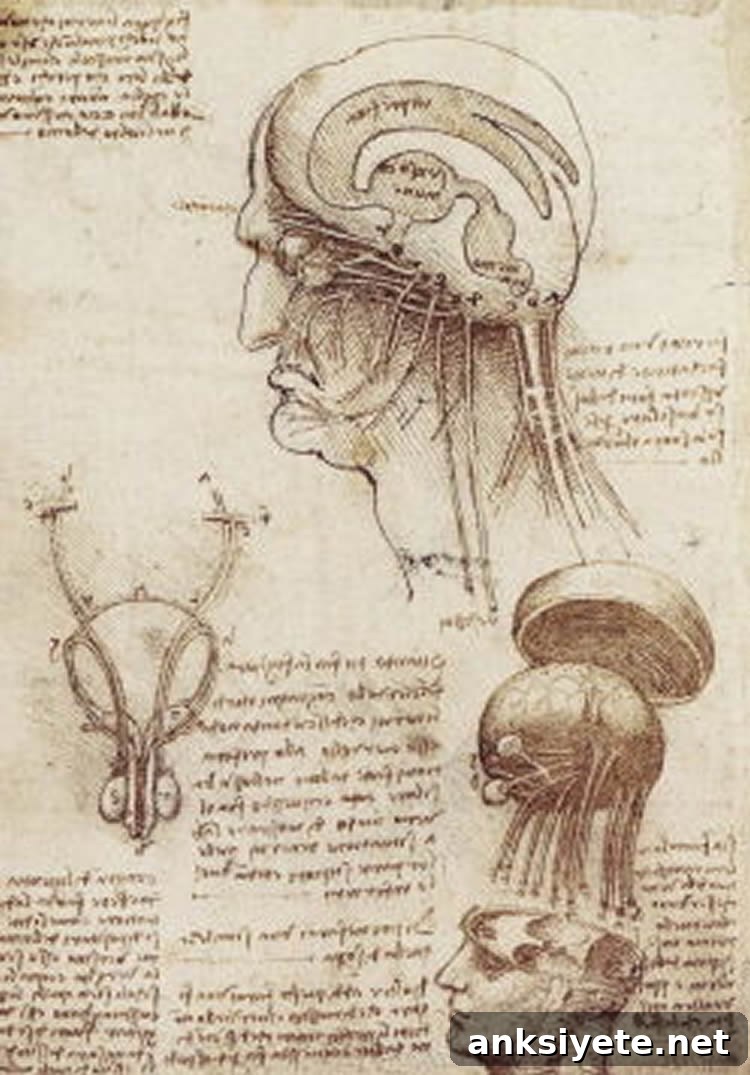
Summary: A recent review examines Leonardo da Vinci’s contributions to neuroscience and how his anatomical studies anticipated methods and ideas central to modern science.
Source: Profiles, Inc
May 2, 2019, marked the 500th anniversary of Leonardo da Vinci’s death. A towering figure of the Renaissance—artist, engineer, inventor and experimentalist—Leonardo remains a source of inspiration worldwide. In the April issue of The Lancet, Jonathan Pevsner, PhD, a professor and research scientist at the Kennedy Krieger Institute, published an article titled “Leonardo da Vinci’s studies of the brain.” Pevsner highlights Leonardo’s exacting anatomical drawings, his scientific curiosity and the methodological rigor that allowed him to make insightful observations about brain structure and function.
Pevsner emphasizes several notable achievements from Leonardo’s anatomical work. Leonardo appears to have been the first to recognize the olfactory nerve as a cranial nerve and to document its place within the cranial anatomy. He conducted careful dissections and detailed studies of the peripheral nervous system, questioning long-standing assumptions and correcting earlier authorities where his observations diverged. These efforts reflect an approach to anatomy that relies on close observation and practical experimentation rather than unquestioned deference to ancient texts.
One of Leonardo’s most striking experimental techniques was his ventricular casting procedure. Returning to anatomical study after a hiatus in the early 1500s, Leonardo devised a method of injecting warm wax into the brain’s ventricular spaces to create a cast, revealing the shape, extent and three-dimensional relationships of the cerebral ventricles. This early attempt to create a physical model of internal brain structures demonstrates both his inventive experimentation and his drive to visualize biological form—an approach that foreshadowed later anatomical and physiological investigations.
“Leonardo’s work reflects the emergence of the modern scientific era and forms a key part of his integrative approach to art and science,” said Pevsner.
Pevsner notes that Leonardo’s curiosity extended to functional questions as well as anatomy. Leonardo asked how the brain operates in health and disease and considered clinical phenomena such as epilepsy and the influence of maternal health on fetal development. These are questions that continue to inform contemporary neuroscience and clinical practice. At the Kennedy Krieger Institute, Pevsner and his colleagues pursue many of the same problems—seeking molecular and physiological explanations for developmental and psychiatric disorders—yet they emphasize that Leonardo’s combination of passion, careful observation, visual thinking and logical analysis still provides a valuable model for scientific inquiry.
Although Pevsner is recognized for his scholarship on Leonardo da Vinci, his primary focus remains biomedical research. At the Kennedy Krieger Institute his laboratory investigates the molecular basis of childhood and adult brain disorders. His team identified the mutation responsible for Sturge–Weber syndrome, and other ongoing projects explore the genetics and biology of bipolar disorder, autism spectrum disorder and schizophrenia. Pevsner is also the author of the textbook Bioinformatics and Functional Genomics, reflecting his engagement with computational approaches to biological data.
Source:
Profiles, Inc
Media Contacts:
Jamie Watt Arnold – Profiles, Inc
Image Source:
The image is credited to Leonardo da Vinci and is in the public domain.
Original Research: Closed access.
“Leonardo da Vinci’s studies of the brain” — Jonathan Pevsner
The Lancet, Vol. 393, No. 10179, pp. 1465–1472. Published: April 06, 2019. doi: 10.1016/S0140-6736(19)30302-2
Abstract
Leonardo da Vinci’s studies of the brain
Leonardo da Vinci (1452–1519) made important contributions to the study of the nervous system. His earliest surviving anatomical drawings, dated roughly 1485–1493, include careful studies of the skull, brain and cerebral ventricles and reflect attempts to reconcile medieval psychological theories with anatomical observation, including ideas about the localisation of sensory and motor functions. He is reported to have been the first to pith a frog in a way that demonstrated how piercing the spinal medulla causes immediate death. After a decade-long interval, Leonardo returned to anatomy and developed the wax-injection method to cast the ventricular system, producing three-dimensional models that showed the size, shape and extent of the ventricles. During this later period he also advanced his understanding of cranial nerve anatomy and was the first to identify the olfactory nerve as a cranial nerve. His dissections showed that nerves do not converge on the lateral or third ventricles, countering previous theories, and he produced detailed studies of the peripheral nervous system. Although his discoveries had limited immediate influence on the subsequent development of anatomy, they represent a dramatic departure from the stagnant state of the field in the preceding centuries. Leonardo’s work illustrates the transition toward the modern scientific era and exemplifies an integrated approach that combines artistic representation with empirical investigation.