Summary: A new study clarifies how vesicles are recycled at inhibitory synapses.
Source: OIST.
Neurons in the brain form dense networks of connections. Within these networks, cells communicate to coordinate motor control, cognition and other functions.
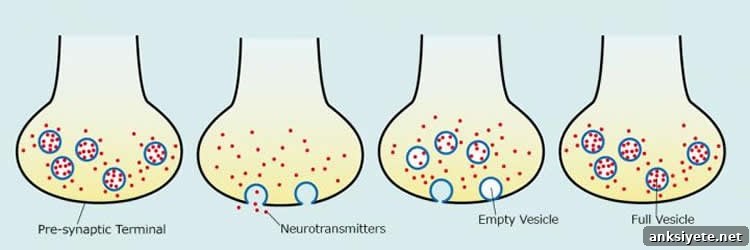
When a neuron is activated, it generates an electrical signal that travels along its axon. That electrical signal cannot cross the synapse—the small gap between two neurons—so communication from one cell to the next depends on chemical signaling. The presynaptic neuron releases tiny membrane-bound sacs, called synaptic vesicles, which contain neurotransmitters. These vesicles fuse with the presynaptic membrane, releasing neurotransmitter into the synaptic cleft. The molecules travel across the cleft and bind to receptors on the postsynaptic neuron, producing an electrical response in that cell.
Because neurotransmission is directional—from presynaptic to postsynaptic cell—the vesicles must be reassembled and refilled for signaling to continue. “Recycling is a critical process to keep synapses functional,” explains Professor Tomoyuki Takahashi, head of the Cellular & Molecular Synaptic Function Unit at the Okinawa Institute of Science and Technology Graduate University (OIST). In a study published in Cell Reports, Takahashi and colleagues investigated a previously understudied part of this recycling cycle: the refilling of vesicles with neurotransmitter.
Vesicle recycling proceeds in three major steps. First, the neuron retrieves membrane from the presynaptic surface to form new vesicles—a process known as endocytosis. Second, those vesicles are refilled with neurotransmitter. Third, refilled vesicles are positioned and prepared for release. While endocytosis has been extensively examined, the kinetics of the refilling step have been less clear. In experiments on a major class of inhibitory synapses, Takahashi’s team found that refilling can take longer than vesicle reformation, making it a potential rate-limiting factor for synaptic recovery.
The team’s results indicate that the speed of vesicle refilling determines how quickly synapses can recover and be reused after periods of intense activity. Until now, many neuroscientists assumed that endocytosis primarily limited recycling speed. “We showed that vesicle refilling rate is also an important factor,” says Prof. Takahashi.
Neurons release different neurotransmitters and thus can be excitatory or inhibitory. Glutamate typically mediates excitation, increasing the likelihood that the postsynaptic cell will fire. GABA and glycine usually mediate inhibition, reducing that likelihood. Takahashi’s group previously measured how quickly glutamate is taken into vesicles at excitatory synapses, but the refilling rate at inhibitory terminals had not been characterized.
To study inhibitory synapses, the researchers recorded simultaneously from presynaptic and postsynaptic terminals using glass electrodes. They focused on synapses that release GABA and used a specialized photo-uncaging approach to measure uptake. The team introduced “caged” GABA into presynaptic terminals—a chemically modified form that remains inactive until liberated by a UV light pulse. By triggering release of GABA at precise times with UV photolysis, they could measure how rapidly vesicles reaccumulated GABA.
They found that vesicular GABA uptake at inhibitory terminals is five to six times slower than glutamate uptake at excitatory synapses. Using the uncaging method, the measured time constant for GABA uptake at physiological temperature was approximately 40 seconds. Surprisingly, that same time course closely matched how quickly inhibitory postsynaptic currents (IPSCs) recovered after synaptic depression—reduced synaptic strength following high-frequency activity when releasable vesicles are depleted.
This parallel suggests that most of the recovery period after strong activity is spent refilling vesicles with GABA, not reforming the vesicles themselves. Vesicle refilling requires concentrating GABA inside the vesicle by 10- to 100-fold compared with the cytosol, a process driven by molecular transporters and pumps, which helps explain the slower kinetics.
Because all inhibitory neurons use either GABA or glycine, and because glycine is refilled by the same transport mechanism, the authors conclude that slow vesicular uptake of inhibitory neurotransmitters likely limits recovery at many inhibitory synapses throughout the brain. In other words, vesicle refilling is a critical determinant of inhibitory synapse function and may play an important role in maintaining balanced neural circuit activity.
Funding: JSPS Core-to-Core Program A, Advanced Research Networks, and the Okinawa Institute of Science and Technology supported this study.
Source: Peter Zekert, OIST.
Publisher: Organized by NeuroscienceNews.com.
Image credit: OIST (image provided to NeuroscienceNews.com).
Original research: “Vesicular GABA Uptake Can Be Rate Limiting for Recovery of IPSCs from Synaptic Depression” by Manami Yamashita, Shin-ya Kawaguchi, Tetsuya Hori, and Tomoyuki Takahashi, published in Cell Reports, March 20, 2018.
doi: 10.1016/j.celrep.2018.02.080
Vesicular GABA Uptake Can Be Rate Limiting for Recovery of IPSCs from Synaptic Depression
Highlights
- Vesicular GABA uptake time constant is approximately 40 seconds at physiological temperature.
- The recovery rate of IPSCs from depression matches the measured vesicular GABA uptake rate.
- Vesicular GABA uptake can therefore be a rate-limiting step for recovery of inhibitory transmission after synaptic depression.
Summary
Synaptic efficacy—how effectively neurons signal one another—shapes circuit operation and plasticity. Presynaptic determinants include the neurotransmitter content of vesicles and the number of vesicles available for release. Bursts of presynaptic activity depress efficacy mainly by exhausting the pool of releasable vesicles. Recovery requires endocytic retrieval of membrane to form vesicles and subsequent refilling with neurotransmitter. In cerebellar inhibitory cell pairs, the authors induced rundown of IPSCs by washing out presynaptic cytosolic GABA and then accelerated recovery using photo-uncaging to restore GABA. The time course of recovery matched that seen after activity-dependent depression induced by high-frequency stimulation, supporting the conclusion that vesicular GABA uptake can limit the recovery of inhibitory neurotransmission from synaptic depression.
For reuse and citation, please refer to the original research article listed above and acknowledge the authors and institutions involved.