
Pitt Researchers Publish Mathematical Model Showing How Clustered Neurons Drive Brain Dynamics
Summary: Mathematical modeling by researchers at the University of Pittsburgh reveals how neurons organized into clustered networks produce unpredictable, competitive dynamics in the brain. These clustered groups can dominate activity at different times, and even weak stimuli can bias which groups prevail. The results illuminate how spontaneous brain activity emerges and suggest consequences for how the brain processes input.
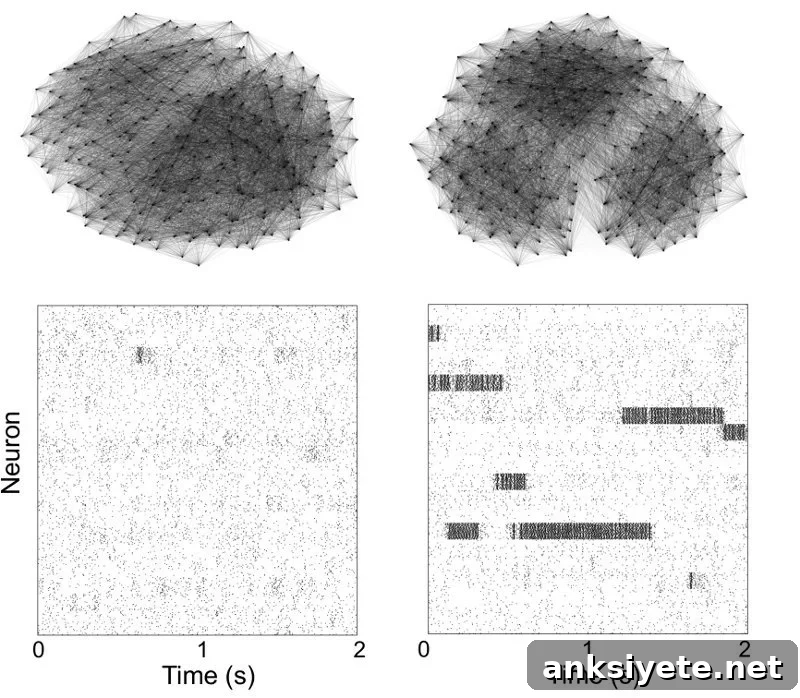
Neurons in the cortex do not form a uniform, evenly connected mesh. Instead, they organize into clusters—groups of cells more strongly connected with each other than with the rest of the network. Until now, the functional consequences of this clustered wiring for large-scale neural dynamics have been unclear. Using rigorous mathematical models, two researchers at the University of Pittsburgh show that these clusters create a competitive landscape of neural activity, with different groups intermittently taking the lead much like rival teams in an election or political primary.
Brent Doiron, assistant professor of mathematics, and Ashok Litwin-Kumar, a PhD student studying neural computation at Pitt and Carnegie Mellon’s Center for the Neural Basis of Cognition, developed models in which neurons are organized into distinct clustered networks. “Through complex mathematical equations, we organized neurons into clustered networks and immediately saw that our model produced a rich dynamic wherein neurons in the same groups were active together,” Doiron said. The model shows that at any given time only a few clusters are highly active, effectively advocating for a particular response or representation while suppressing activity in competing groups.
When the researchers simulated the effect of sensory input or a stimulus that selectively increased activity in a subset of clusters, the competition quickly shifted. Just as selective campaign funding can tilt an election, stimulation made the favored clusters more likely to dominate network activity. “We found that stimulation actually reduces the firing rate variability among neurons, an observation that is consistent with recent cortical recordings,” Doiron noted. In other words, adding a stimulus can make ongoing dynamics more predictable by biasing which clusters remain active.
In the absence of any external stimulus, the model produced spontaneous activity characterized by large, irregular fluctuations over long timescales. Different clusters alternated unpredictably between leading and trailing positions, creating a dynamic landscape of winners and losers that changed randomly in time. These long-lasting, high-variability fluctuations resemble recordings from spontaneously active cortex and offer a plausible explanation for how such activity is generated and maintained in a wired neural system.
Previous theoretical treatments that assumed unclustered, homogeneous networks had difficulty reproducing the slow, high-variability spontaneous dynamics seen in cortical recordings. The clustered-network model provides a natural mechanism: internal competition among densely interconnected groups can sustain complex, fluctuating activity even without external drive. This shifts attention toward the importance of anatomical wiring for shaping the brain’s intrinsic dynamics.
Doiron and Litwin-Kumar emphasize that understanding spontaneous activity is fundamental for a broader theory of neural computation. Much prior work has focused on how the brain responds to explicit inputs during tasks such as remembering a number or grasping an object. Far less is known about what the brain does when it appears to be idle. “Unlike the quiet states of your computer between processing jobs, the brain has a highly variable and random political fight going on when there are no immediate tasks,” Doiron said. That internal competition likely helps preserve and strengthen specific network links, maintaining the circuits that will be important when the brain becomes driven by sensory input or behavioral demands.
Looking ahead, the researchers plan to use their models to study how these spontaneous cluster-driven dynamics influence the processing of external stimuli. Understanding the interaction between intrinsic activity and incoming signals could shed light on biological principles useful for new forms of computation inspired by the brain. Neural computation is a rapidly developing field with many challenges, and clarifying the brain’s default dynamics is an important step toward a more complete theory of cognition.
Research Support and Notes
This research was supported by the National Science Foundation, the Sloan Foundation, and the U.S. Department of Defense.
Contact: B. Rose Huber, University of Pittsburgh
Source: University of Pittsburgh news release
Image source: Neuron image adapted from the University of Pittsburgh news release image.
Original research citation: Litwin-Kumar, A. and Doiron, B., “Slow dynamics and high variability in balanced networks with clustered connections,” Nature Neuroscience, online 23 September 2012, doi: 10.1038/nn.3220.