
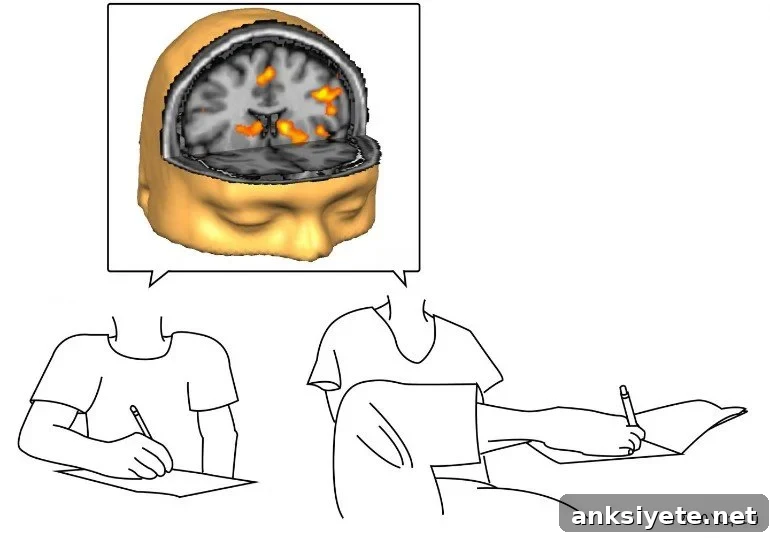
Summary: The brain organizes motor commands at multiple levels. Beyond controlling individual muscle contractions, higher-order motor areas encode abstract action plans—such as reaching and grasping—that can be executed with different effectors (hands or feet).
Source: Georgetown University Medical Center
Neuroscientists at Georgetown University Medical Center report that people born without upper limbs who use their feet to reach and grasp engage the same brain regions that control reaching and grasping in people with hands.
Published October 26, 2020 in PNAS, this study advances our understanding of brain organization and motor function and suggests new directions for prosthetic design and rehabilitation, according to Ella Striem-Amit, PhD, assistant professor and senior investigator who leads the Sensory and Motor Plasticity (SAMP) Lab in Georgetown’s Department of Neuroscience.
The researchers found evidence that the brain contains higher-level motor areas that represent action types—such as reaching and grasping—as abstract plans or blueprints. These representations operate independently of the specific body part performing the movement. In other words, whether a person reaches with a hand or with toes, the same action-selective regions are engaged alongside the primary motor cortex areas that control the relevant muscles.
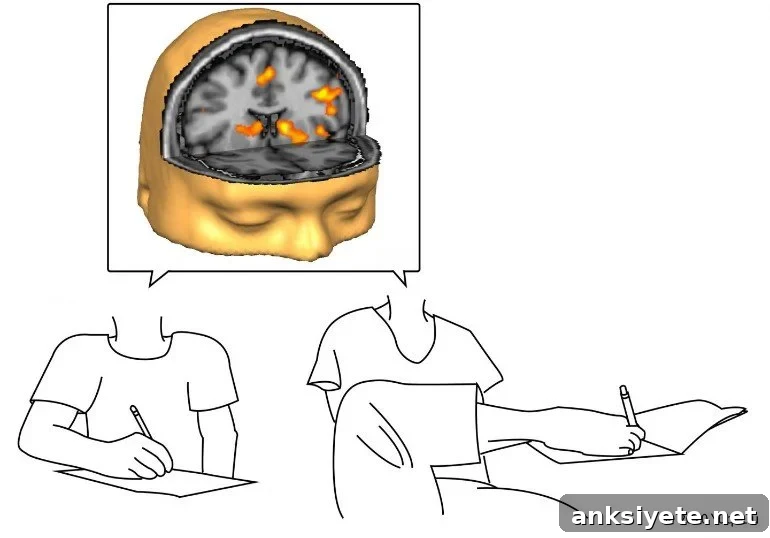
The study compared two groups. One group included four individuals born without arms or hands (congenital upper-limb dysplasia) who habitually use their feet to manipulate objects. The control group consisted of typically developed volunteers who performed the same tasks first with their hands and then with their feet. Functional MRI showed that, across these different participant groups and effectors, a common network in frontal and parietal cortex was selectively activated for the reaching and grasping action type, in addition to the expected primary motor cortex regions specific to hands or feet.
“Our results show that parts of the motor system compute complex actions—like reaching and grasping—at a higher, more abstract level,” Striem-Amit explains. “These brain areas represent the type of action rather than the particular limb. That explains why using an arm or a leg to perform the same goal-directed task lights up the same regions on fMRI.”
This finding distinguishes two organizational levels in the motor system. Lower-level, point-to-point representations in primary motor cortex map directly onto specific muscles and limbs, while higher-order motor areas encode task-level computations that generalize across different effectors. “We are building a model showing that task-specific computations—such as those required for reaching and grasping—are a general principle of motor cortex organization and are independent from the low-level control of particular body parts,” says Yuqi Liu, PhD, a postdoctoral research fellow in the SAMP Lab and co-author on the paper.
The research team includes authors from multiple institutions, among them Alfonso Caramazza, PhD, from Harvard University, and Gilles Vannuscorps, PhD, from Université catholique de Louvain. Striem-Amit notes that these results complement prior work in sensory neuroscience showing that higher-order sensory areas can be organized by function rather than by modality. For example, visual association areas can represent categories like letters even when information arrives via touch (Braille) in congenitally blind individuals, and auditory association regions can process temporal rhythms whether input is heard or presented visually in deaf participants.
“Just as higher-order visual and auditory areas appear to be organized by the computations they perform, rather than strictly by the sensory inputs they receive, we find that association motor areas are organized by action type rather than by which body part performs the movement,” Striem-Amit says. This functional organization may reflect a broad principle of brain design in which task-level representations support flexible behavior across different bodily means.
The study has practical implications for this knowledge of motor representation and neural plasticity. Current prosthetic devices typically require users to control low-level movement parameters directly, a demanding and sometimes frustrating process. By tapping into higher-level action representations—signals that encode the intended action rather than the precise muscle commands—prosthetic systems might be designed to interpret a user’s action goal and translate it into coordinated, goal-directed movements. This approach could simplify control, reduce mental load, and potentially increase prosthesis acceptance and long-term use.
“If we can better understand and access these higher-level action representations, future prostheses may be guided not only by detailed limb motion, but by the intended action or aim,” Striem-Amit says. “That could make advanced prosthetic control more intuitive and less taxing for users.”
Funding: This research was supported by the von Matsch Professorship in Neurological Disease awarded to Striem-Amit, the Società Scienze Mente Cervello–Fondazione Cassa di Risparmio di Trento e Rovereto, a grant from the Provincia Autonoma di Trento, and a Harvard Provostial postdoctoral fund to Caramazza.
About this neuroscience research news
Source: Georgetown University Medical Center
Contact: Karen Teber – Georgetown University Medical Center
Image: The image is credited to Yuqi Liu, PhD
Original Research: The study was published in PNAS.