
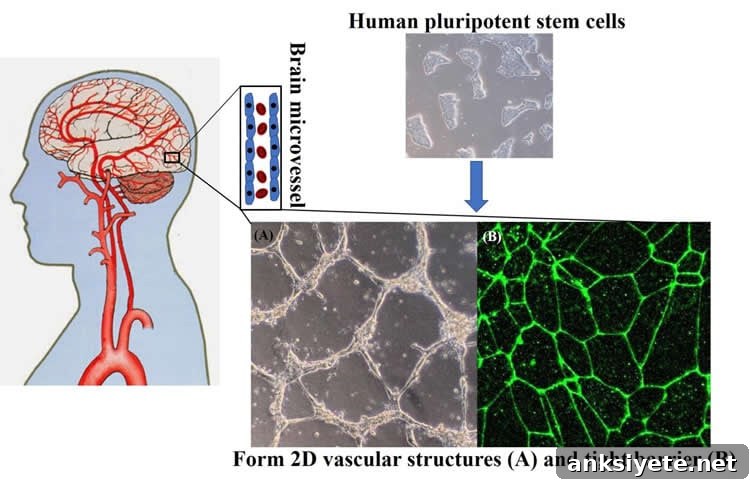
Summary: Researchers have established a defined, chemical-based method to produce more realistic human blood-brain barrier cells in vitro.
Source: University of Wisconsin–Madison.
The blood-brain barrier (BBB) is the brain’s gatekeeper: a tightly regulated layer of endothelial cells that restricts blood-borne toxins and pathogens from entering the central nervous system.
This specialized barrier is essential for brain health and function. While it protects neural tissue, the BBB also limits delivery of many therapeutic molecules, creating a major obstacle for treating neurological disorders such as stroke, traumatic brain injury, multiple sclerosis and brain tumors.
Laboratory models of the BBB have been developed from human stem cells, but many rely on mixtures of supporting cell types to produce the signaling environment that directs pluripotent stem cells toward a brain endothelial fate. Those co-culture approaches can be complex and variable.
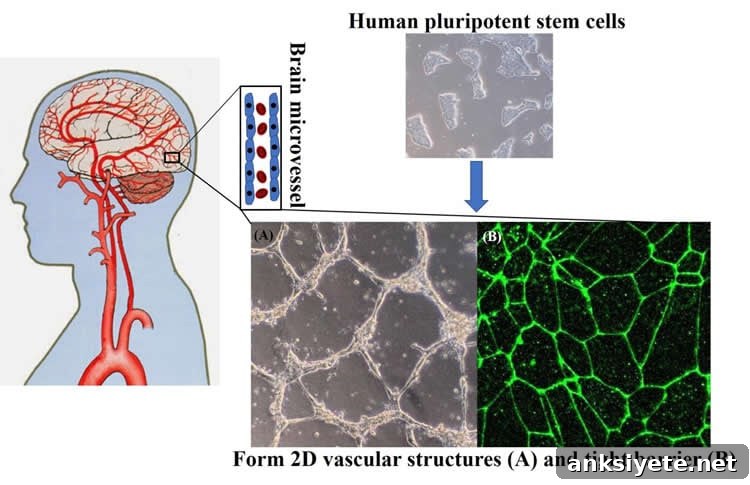
In a report published in Science Advances (November 8, 2017), researchers at the University of Wisconsin–Madison described a fully defined, stepwise chemical protocol that directs human pluripotent stem cells (hPSCs) to become brain microvascular endothelial cells (BMECs). This chemically defined method replaces the need for partner cell types by activating specific signaling pathways at defined stages, producing endothelial cells with blood-brain barrier properties suitable for research and drug screening.
“The main advance is that we now have a fully defined process that uses small molecules to guide cells through the developmental steps,” says Sean Palecek, Professor of Chemical and Biological Engineering at the University of Wisconsin–Madison. “We know which components act on the cells and when during the differentiation sequence.”
The study was led by Tongcheng Qian, a postdoctoral researcher in chemical and biological engineering, in collaboration with Eric Shusta’s laboratory. The team has filed a patent application for the process through the Wisconsin Alumni Research Foundation.
Directing pluripotent stem cells into specific lineages is often technically challenging. By identifying a concise set of small molecules that induce mesoderm commitment, drive endothelial progenitor formation and then trigger BBB-specific maturation with retinoic acid, the Wisconsin group provides a reproducible recipe for generating BMECs at scale. This defined approach reduces variability and makes the model more accessible to non-expert laboratories.
“Other methods require mixing and co-culture of multiple cell types,” explains Eric Shusta. “This protocol is essentially an off-the-shelf recipe that a wider range of labs can use.” Because the technique can be applied to induced pluripotent stem cells derived from adult patients, it opens the door to personalized in vitro models that capture individual genetic backgrounds and disease progression, improving studies of neurological disease onset and dynamics.
Palecek notes that the ability to monitor cells as they move through developmental stages allows researchers to observe the sequence of molecular and cellular events that lead to a functional BBB. This insight can illuminate how pathological processes begin and progress in conditions such as infections, autoimmune disorders, and neurodegenerative disease.
Beyond basic research, the defined differentiation method supports industrial-scale production of BMECs for drug discovery. With reliable human BBB models, scientists can evaluate drug permeability, efflux transporter activity, and toxicity of candidate therapeutics more effectively, accelerating preclinical screening for neurological drugs.
Funding: This work was supported by the National Institutes of Health (grants R21 NS085351, R01 NS083699, and R01 EB007534) and the Takeda Pharmaceuticals New Frontier Science Program.
Source: Sean Palecek, University of Wisconsin–Madison.
Publisher: Organized by NeuroscienceNews.com.
Image credit: University of Wisconsin–Madison.
Original research: “Directed differentiation of human pluripotent stem cells to blood-brain barrier endothelial cells” by Tongcheng Qian, Shaenah E. Maguire, Scott G. Canfield, Xiaoping Bao, William R. Olson, Eric V. Shusta and Sean P. Palecek. Published in Science Advances, November 8, 2017. DOI: 10.1126/sciadv.1701679.
The blood-brain barrier consists of specialized endothelial cells essential to neurological health. A reliable, scalable source of functional brain microvascular endothelial cells (BMECs) is needed to study BBB development and its role in disease. Human pluripotent stem cells can theoretically generate unlimited quantities of BMECs in vitro for disease modeling, drug screening, and potential cell-based therapies. The Wisconsin team demonstrates a chemically defined differentiation protocol that recapitulates key developmental transitions through targeted small-molecule activation of signaling pathways. First, hPSCs are induced to mesoderm by activating canonical Wnt signaling. These mesodermal precursors then progress to endothelial progenitors. Treatment with retinoic acid promotes acquisition of BBB-specific markers and phenotypes. hPSC-derived BMECs produced by this protocol display endothelial behaviors—such as tube formation and low-density lipoprotein uptake—and exhibit efflux transporter activities characteristic of brain endothelial cells. Notably, these cells achieve high transendothelial electrical resistance values above 3000 ohm·cm2, forming a robust human in vitro BBB model useful for studying brain disease and guiding therapeutic development.
MLA: University of Wisconsin–Madison. “A Recipe to Make a Human Blood-Brain Barrier.” NeuroscienceNews. 8 November 2017.
APA: University of Wisconsin–Madison (2017, November 8). A Recipe to Make a Human Blood-Brain Barrier. NeuroscienceNews.
Chicago: University of Wisconsin–Madison. “A Recipe to Make a Human Blood-Brain Barrier.” NeuroscienceNews. Published November 8, 2017.